State Radio and Television and Repeated Violations of the Rights of People with Disabilities: Promoting False Beliefs Instead of Cultural Development
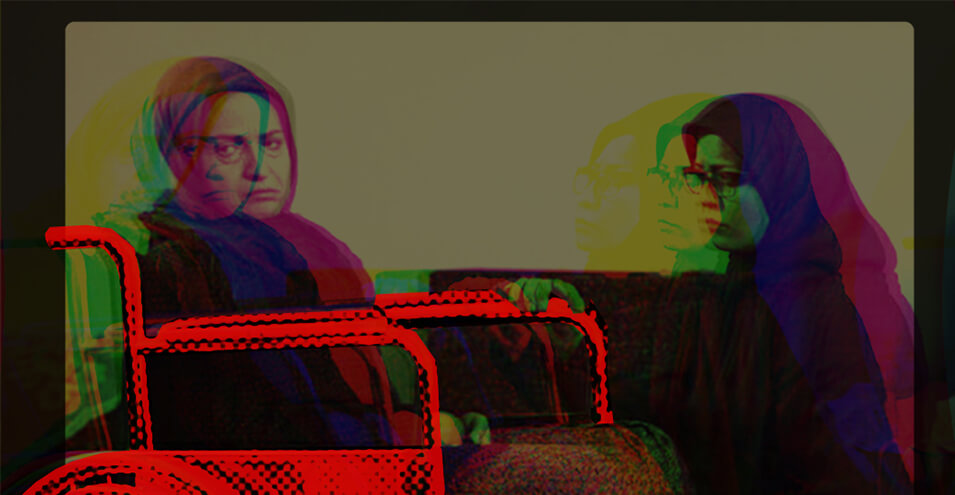
The promotion of a stereotypical belief that disability is a punishment for past sins in a widely-watched series broadcast by Islamic Republic of Iran Broadcasting (IRIB) has sparked protests and criticism from disability rights activists. According to these protesters, people with disabilities are not only not portrayed as independent and capable characters on Iranian television, but due to filmmakers’ ignorance and negligence, as seen in the series “Setayesh,” negative attitudes and social stigma toward them are being promoted and propagated.
Portraying disability as the fate of a negative character in the story clearly conveys the message to the audience that disability results from committing moral mistakes. As a result, when viewers encounter a person with a disability or their family in everyday life, this assumption is evoked in their minds that surely that person or their family has acquired the disability in order to atone for past sins and as a punishment.
In this scene, Gholam tells Anis: “May God heal you, my sister. A few minutes ago I was complaining that you were put in my way, meaning there are people worse off than you.” This dialogue more firmly and clearly conveys the moral conclusion of the story to the audience and fuels the widespread false belief that disability is a punishment for sins. Furthermore, the person with a disability is used as a symbol of helplessness and misery, so that others feel pity when they see them and turn to gratitude for their own condition.
However, this scene was not the only example of the spread of stereotypical views in the “Setayesh” series. As Iransepiyd newspaper writes, the closing credits of “Setayesh” also show that the producers of this series continue to ignore the semantic weight of words, expressions, and repeated efforts by disability rights activists to change language and general perspective. In this song, it says: “Like I’m blind, he gave my cane to the hand of a firefly.” Since the use of the term “blind” (koor) instead of “visually impaired” (nabina) carries negative semantic weight and is not recommended by activists in this field, the use of this word in a series that boasts “viewership” can undermine years of cultural development efforts.
This is while IRIB formally has the responsibility of cultural development regarding the rights of people with disabilities and should act accordingly according to the law. According to Article 21 of the Protection of the Rights of People with Disabilities Law passed in March 2018, “the Islamic Republic of Iran Broadcasting Organization is obligated to allocate at least five hours of its programs per week free of charge at appropriate times to programs of organizations and non-governmental organizations supporting people with disabilities in order to familiarize the public with the rights, capabilities and problems of these people, and to subtitle films and programs of various IRIB networks, use sign language interpreters, and broadcast audio descriptions of films for blind people.” Nearly 18 months after this article came into force, IRIB not only has not fully implemented it, but through ignorance and lack of oversight of the content of produced programs, it reduces the impact of independent cultural development efforts and moves in the opposite direction of its legal obligations.
Article 8 of the Convention on the Rights of Persons with Disabilities also obligates member states to take action to “combat stereotypical, prejudicial and harmful perceptions related to persons with disabilities” and “promote more positive perception and greater social awareness” regarding these people. Iran ratified this convention in 2008, but incidents such as the “Setayesh” series show that the Iranian government and IRIB, which is affiliated with it, have not yet taken serious and planned action to implement this article of the convention.
Disability rights activist Mahnaz Soufi responded to the scene from the “Setayesh” series on her Telegram page: “I and many of my friends are trying to change people’s attitudes toward people with disabilities through cultural development and inclusion, and then you erase all our efforts with a 15-second scene from the podium of a widely-watched series? Why don’t you use your pen for cultural development?”
She added: “We no longer expect you to make a series to promote understanding and awareness of people with disabilities, but I hope that in a time when the whole world is moving toward honoring and equal rights for people with disabilities, we will no longer witness such dialogues in Iranian series.”
Journalist and disability field activist Mohaddeseh Jafari also wrote on her Twitter account: “There have been many criticisms of the closing credits song of the series and of course the issue of Anis and this character being a wheelchair user. Why is disability shown as a consequence of wrongdoing? From the perspective of filmmakers and writers, is disability the result of a grave sin? Why don’t they portray a person with a disability as a psychologist or a lawyer in their films?”
This incorrect practice in television series has a long history and has been repeatedly criticized by disability rights activists. For example, according to an ISNA report in February 2016 following the broadcast of one episode of the “Kimia” series, Shahram Mobasser, an activist from the Disability Association of Region Two, published a text on social networks regarding the image IRIB had left in the minds of audiences about people with disabilities, which stated in part: “Unfortunately, once again IRIB in one of its series “Kimia,” due to the creators’ lack of awareness, unintentionally spread incorrect, stereotypical and outdated culture. A culture that suggests to the viewer that anyone who becomes disabled is paying the price for wrongs and injustices they have committed against people, and now they are being punished by divine punishment for their disability. For years, IRIB has unintentionally been squandering all the efforts of activists and active associations in the field of empowerment and cultural development of people with disabilities. It never tried to make the leading role of a film about a successful person with a disability. We very rarely see in films and series produced a doctor, a university professor, a merchant, or a first-class court lawyer with a disability. But always in series, bad and vile people become disabled, and this is how respect for human dignity is shown in my country.”
It is worth noting that at the global level, the efforts of disability rights activists have led to a somewhat prominent presence of artists with disabilities on television and in cinema, in a way that the positive and negative characteristics of these characters are defined beyond the disability of these people, and disability is normalized in a way and is not made the central axis of the character and story of these people. The appearance of physically-mobile actor Steve Wai in the popular comedy series “Ramy” in America was a successful example of this type of inclusion of disability in the field of art. Contrary to what is common in IRIB, it was not Steve Wai’s disability that added to the humor of the story, but his wit and acting ability that led to the popularity of this character. Although IRIB has a long way to go in terms of participation of artists with disabilities on stage and most of these roles are still performed by actors without disabilities, implementing the law and positive cultural development can be an effective first step in the direction of inclusion of people with disabilities in IRIB.
Source: Human Rights Campaign