Criticisms Over Destruction of Mashhad Church and Four Decades of Eliminating Christian Symbols in the Islamic Republic
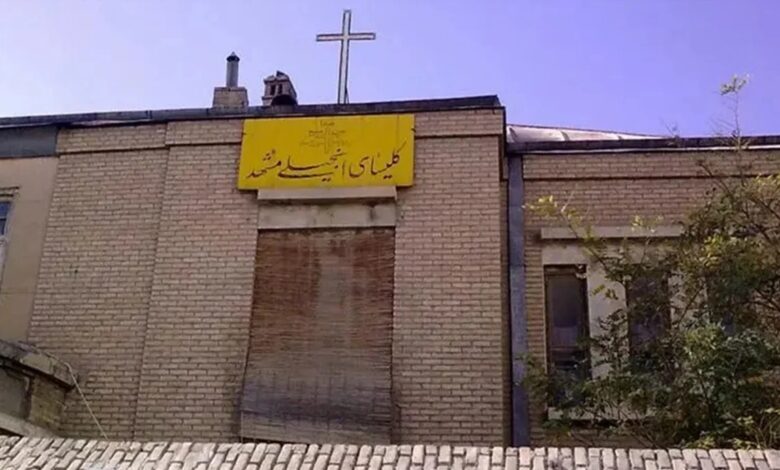
The overnight demolition of the historic evangelical church in Mashhad was not merely the destruction of an old building; rather, it was another blow to the heritage of Iran’s Christians and a sign of a process that began in the earliest years of the Islamic Republic’s establishment and continues to this day. A structure that for over a century was part of Mashhad’s religious and cultural identity has now been reduced to rubble; an event that has sparked a wave of protest and concern among human rights activists, international Christian organizations, and cultural heritage advocates.
According to published reports, the evangelical church in Mashhad was demolished using a bulldozer in the early morning hours of June 4. This building, constructed during the early Pahlavi period, had long been listed among Iran’s national monuments and was considered one of the most recognizable symbols of the historical presence of Christians in eastern Iran. Local sources reported that the demolition operation lasted approximately two hours, after which access to the site was restricted to journalists and citizens.
Reactions to this event extended beyond Iran. The World Communion of Reformed Churches (WCRC), in releasing a statement, condemned the destruction of this church and called on the international community to hold Islamic Republic authorities accountable for their international commitments regarding freedom of religion and belief. The organization also referenced long-standing disputes over the building’s ownership and the role of government institutions in its confiscation.
The evangelical church in Mashhad was not merely a place of worship. During a period of Iran’s modern history, this center was associated with educational, medical, and social activities and was considered a monument to the presence of Christian missionaries in Khorasan. Many Mashhad residents, regardless of their religious beliefs, viewed this building as part of the city’s collective memory; a heritage that is now lost forever.
However, the destruction of this church cannot be considered an isolated incident. Since the 1979 revolution, dozens of churches, schools, hospitals, and centers belonging to or associated with the Christian community have either been confiscated or lost their original purpose. In many cases, the government has distinguished between traditional Christian minorities and converted Christians, with the primary pressure directed at Persian-speaking Christians. Religious freedom advocacy organizations have repeatedly warned that restrictions on Persian-speaking churches and the gradual elimination of Christian symbols from the public sphere are part of a broader policy to control and limit the growth of Christianity in Iran.
Christian and human rights media outlets have also reminded us that the Mashhad church had previously been removed from Christian community access, and for years it was not possible to conduct religious activities there. Now, with the complete demolition of the building, the last physical trace of one of the most important centers of Persian-speaking Christianity in Mashhad has also disappeared.
Reverend Serguz Benjamin, Executive Secretary of the Synod of the Evangelical Church of Iran in exile, responded to this event by saying: “We have not lost hope, but today more than ever we need the solidarity and voice of the global church.”
This statement, amid the ruins of the Mashhad church, may perhaps reflect the sentiment of many Iranian Christians who, despite decades of pressure, confiscation, and restrictions, have not lost their hope.
Although cultural heritage authorities have mentioned the opening of a legal case and pursuing the matter, experience from past years shows that in cases where powerful government institutions are involved, one can rarely hope for genuine accountability. For this reason, the destruction of the evangelical church in Mashhad is not only a cultural heritage matter but also a test of the Islamic Republic’s respect for freedom of religion, cultural diversity, and the right to preserve the historical heritage of religious minorities.
Fred Petrosian, a journalist and researcher of Iranian Christian issues, also believes that what happened in Mashhad should not be considered an isolated incident. According to him, the destruction of the evangelical church in Mashhad is part of a process that began in the years immediately following the 1979 revolution.
Referring to the distinction the government makes between “official Christians” and “converted Christians,” he states: “Traditional minorities such as Armenians and Assyrians are only permitted to operate within a limited framework and under government supervision, but Persian-speaking Christians and new converts face the most severe restrictions.” He believes the destruction of the Mashhad church should be evaluated within the framework of what he calls “the elimination of Christian symbols from Iran’s public sphere”; a policy that, according to him, has included other examples in recent years such as the demolition of the Adventist church in Tehran and the disappearance of historical centers affiliated with churches in various Iranian cities.
This researcher also recalls that the evangelical church in Mashhad was not merely a place of worship. During different periods of modern history, this center had become a refuge for war-displaced Christians and a center for social and humanitarian services. Therefore, its destruction is not simply the demolition of a historic building but rather the erasure of part of the memory and identity of Iran’s Christian community.
Today, nothing remains of the evangelical church in Mashhad except images and memories; however, a question still stands: “Can the destruction of buildings and symbols erase the historical presence of Iran’s Christians from the memory of this land?”