Amid Crisis and Persecution, Iran’s Churches Remain Alive and Advancing the Gospel Message
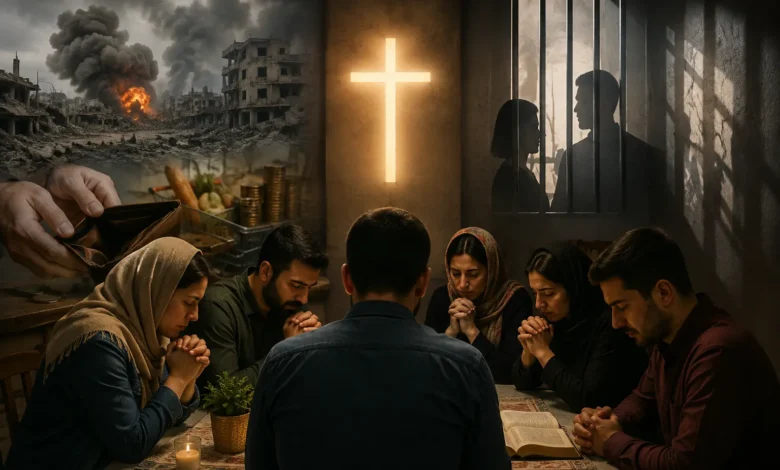
As war, inflation, and economic pressure have made life harder for Iranian citizens and persecution of Christians continues, recent reports indicate the resilience of house churches and a growing interest in the Gospel message among segments of Iran’s population. Christians, facing difficult circumstances, continue not only to worship and pray but also to aid their neighbors and those in need.
Iran has faced one of its most challenging economic and social periods in recent months. Reports from international media document a severe decline in the value of the rial, rising inflation, and increasing difficulty for families to access essential goods. Reuters recently reported Iran’s annual inflation rate at approximately 66 percent, while the Guardian reported annual inflation reaching 84.4 percent in August.
In such circumstances, pressure on the Christian community has not ceased. A joint annual report from Article 18, Open Doors, CSW, and Middle East Concern shows that in 2025 at least 254 Christians were arrested due to their faith or religious activities—a figure nearly double that of the previous year. According to the same report, 57 Christians experienced imprisonment, exile, or forced labor in 2025, with sentences totaling 280 years.
These pressures have continued into 2026. Article 18 reported in recent months on the confiscation and eviction of a historic church in Tehran, prevention of residents from returning, and concerns about complete destruction of the complex. The organization also reported increased pressure on Farsi-speaking Christians and continued arrest and persecution of Christian citizens. However, the picture emerging from Iran’s Christian community is not solely one of persecution and retreat.
John Ceremoniglia, president of SAT-7 USA, told CBN News about the situation of Iranian Christians: “The church is responding with great spiritual maturity. People worship together, they pray for each other, and they help their neighbors, even while they themselves are hungry and don’t have enough food for their families.”
He believes current pressures have not caused Christians to abandon their faith. Ceremoniglia spoke about how Iranian Christians view current suffering and difficulties: “Jesus reminds us that when we choose to follow him, we should expect such circumstances.”
According to SAT-7 USA’s president, simultaneously with increasing fear and insecurity caused by war, interest in the Gospel message has also grown among segments of the population. He stated: “In times of conflict, in times of war, in times of poverty, people are drawn toward God.”
This is not solely one media’s account. Christianity Today also reported in April 2026 that Iran’s church continues to live amid war, with some Christians engaged in evangelism, preparing food for neighbors, and helping others in these very circumstances.
SAT-7 network recently announced that its Farsi programs continue to reach audiences within Iran, and online sessions for prayer, Bible study, and spiritual support for isolated Christians have resumed. The network emphasizes that many Christians in Iran lack access to a local church or house church, and interactive online programs provide them opportunities for fellowship and biblical instruction.
Nevertheless, an important reality must not be overlooked: the church’s resilience does not mean a reduction in pressure. Human rights reports show that the Iranian government remains sensitive to Farsi-speaking Christian congregations, and arrests, heavy sentences, worship restrictions, and pressure on church activities remain part of the reality for Iran’s Christians.
House churches have found a unique place in this context. When opportunities for freely conducting Farsi-language worship in many public spaces do not exist, small groups in homes continue worship, prayer, Bible study, and participation. This characteristic has transformed the church for many Iranian Christians from being bound to a building into a network of human and faith relationships.
Meanwhile, Christian satellite and internet media have become part of this communication network. SAT-7 reports that its daily satellite programs for Iran reach approximately 500,000 people, and alongside this, private online sessions for fellowship, worship, and Bible study are held.
In circumstances where Iranian families struggle with dramatically increased costs to meet basic needs, these activities have taken on another dimension: service to others.
For Iran’s Christian community, helping neighbors, praying for affected families, and maintaining connections among church members are not merely religious activities; they are a means of standing firm against circumstances that war, economic crisis, and security pressure have simultaneously imposed on people’s lives.
Overall, existing reports present a complex picture of Christianity’s situation in Iran: on one hand, persecution and pressure on Christians continues and in some cases has intensified; on the other hand, Christian communities continue their activities, and some Christian sources speak of spiritual growth and increased public attention to the Gospel message.
In such a context, the future of Iran’s church depends more than ever on its ability to maintain connections, support families, and continue worship amid difficult circumstances—a church that, according to Christian leaders, despite heavy pressures, does not yet see itself as a loser in this crisis.