Ancient Iranian Civilization; Uncertain Fate of “Death in Salt” Exhibition
The Frankfurt Museum of Archaeology has removed an important exhibition from its schedule that pertains to ancient Iran. The museum director says he will make every effort to keep cultural projects safe from the harm of political tensions.
Wolfgang David, director of the Frankfurt Museum of Archaeology, regretfully states that an exhibition that has been worked on for two full years has “temporarily” been removed from the museum’s schedule. This exhibition concerns the civilizations of ancient Iran and excavations that began in 2010 with the support of German scientific institutions at a salt mine.
The director of the archaeology museum explains that the exhibition, which was supposed to come to Germany with elaborate preparations, has faced difficulties due to threats and sanctions measures by the United States; because the company responsible for insuring the exhibition pieces cancelled the contract between them due to fear of sanctions-related penalties.
Another insurance company that had taken on this responsibility since last year cancelled its contract shortly after the downing of a Ukrainian passenger plane by missiles fired by Iran’s Islamic Revolutionary Guards Corps in early January 2020.
A Unique Collection
In the Duzlakh region, near Chehrabad, one of the villages in the northwestern province of Iran, one of the oldest salt mines of the ancient world has been discovered. German scientists intended, with the help of their Iranian colleagues, to hold a comprehensive exhibition of this historical site in the cities of Bochum and Frankfurt, Germany.
They traveled to Iran in March 2018 to visit the ancient mine and signed a contract with Iranian cultural authorities, which the official Iranian news agency (IRNA) and Islamic Republic of Iran Broadcasting reported on in detail.
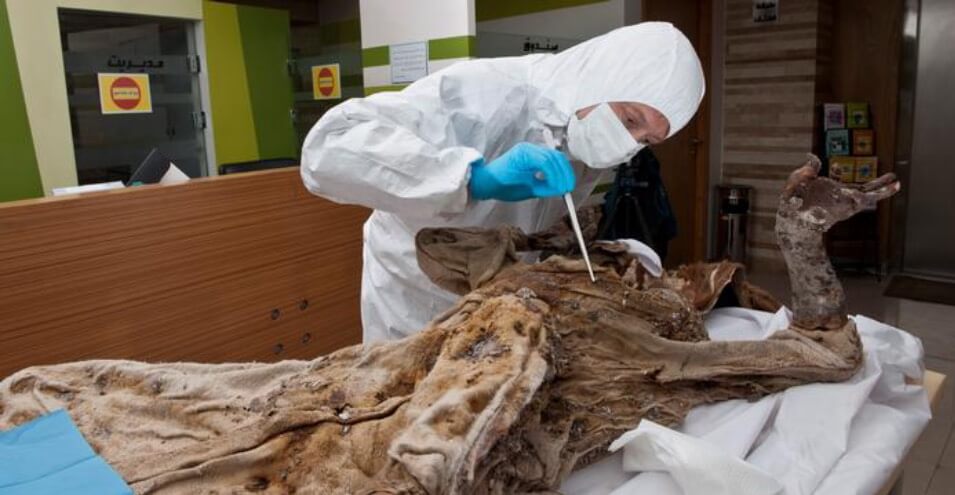
Mr. David told the newspaper “Frankfurter Rundschau” about the importance of this historical opportunity: “In the world, only three salt mines are known: two mines, Hallstatt and Dürrnberg, are in Austria, and the third is the Zanjan mine, which was active until recently. In 1993, a body was found in this mine that research showed belonged to ancient times.”
He adds that eight salt-preserved bodies have been found so far in this mine, the oldest of which dates to the Achaemenid period, approximately 400 years before Christ. Other bodies belong to the Sasanian period, that is, the third and fourth centuries AD.
All the bodies, thanks to mummification in salt, are remarkably preserved and intact.
Mr. David says: “In the exhibition we intend to reconstruct the last day of a mine worker. The clothing and even the color of the workers’ garments, their gloves, and work tools in the mine are well preserved. Salt has kept everything intact.”
He thanked Iranian cultural circles for their cooperation in this interview and emphasized the scientific merit and technical expertise of Iranian archaeologists.
He says he has not lost hope for holding this exhibition and will continue to work toward its realization. According to him: “This treasure has been underground for 2,400 years, and a few years more or less makes little difference.”
Source: DW