Authorities Warn of Water Level Rising Again in Aq Qala and Gomishen
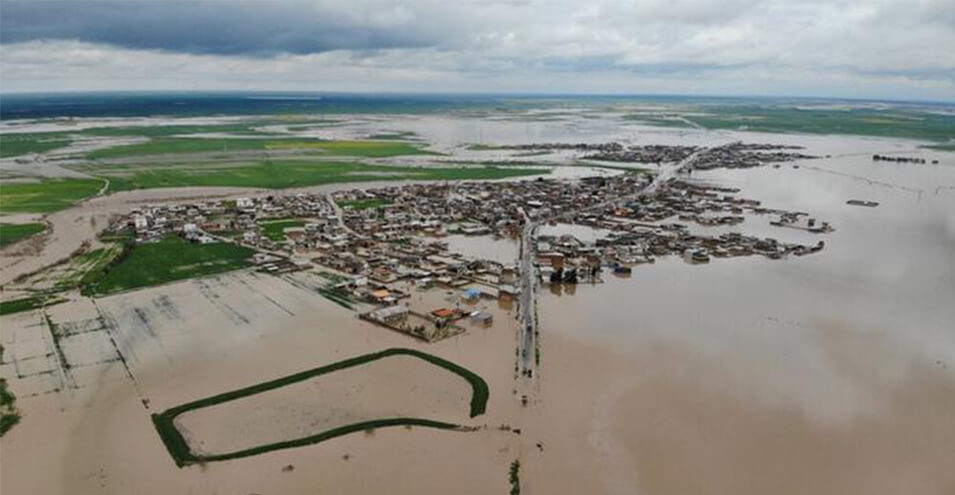
The danger of flooding still threatens northern cities of the country. The Army and the Islamic Revolutionary Guard Corps have intensified their efforts to contain floods in Aq Qala and Gomishen. Nevertheless, with the melting of snow and heavy rainfall, there is a risk of the cities of Aq Qala and Gomishen being submerged.
The Information and Traffic Control Center of Iran’s National Police announced on Sunday, March 31 (Farvardin 11) that snow and rain continues in 18 provinces of Iran, including Golestan Province. The continuation of these conditions could lead to humanitarian disaster, especially in cities that have already been flooded, and if urgent action is not taken, it could have irreversible consequences.
Mohammad Javad Zarif, Minister of Information and Communication Technology of Iran, announced that the water level in Aq Qala has decreased. However, he warned that with the melting of snow upstream, the water level in Aq Qala will rise again. He also emphasized that the water level in Gomishen (Komishtappeh) is increasing sharply. The Minister of Communication provided this information to national media outlets after the latest satellite data and comparison of the flooded area over the past five days.
If Azari Jahromi’s prediction is correct, the city of Aq Qala, which is considered one of the industrial centers of the north of the country and an important border region in the north, will be completely submerged.
Local rescue workers say that government aid as well as assistance from the Guard and Army continues in flooded areas, but this help reached them when water had already entered much of the city of Aq Qala and other flooded areas.
The Iranian Army has also entered the field to contain the floods. General Seyyed Abdolrahim Mousavi, Commander-in-Chief of the Army, entered Golestan Province on the morning of Sunday, March 31 (Farvardin 11) to inspect the flooded areas. He said the priority would be saving flood victims.
Warning from Iran’s Army Commander about “Difficult Days”
The Commander-in-Chief of the Army said that over the past two days the situation has become more complex and harder days lie ahead in the coming weeks. He emphasized that existing waters must be removed from the region and prevented the entry of other waters that, due to future rainfall and the possibility of snow melting, could create more floods and threaten the area.
The Iranian Army has transferred earthmoving equipment across the country to flooded areas to clear the outlet of the Gorganrud River to the Caspian Sea. An Iranian military official said the Army’s dredger is being transferred from Khorramshahr to open the mouth of the Gorganrud River to the Caspian.
Former Governor Apologizes to Turkomans
Meanwhile, Seyyed Manaf Hashemi, the former governor of Golestan Province who was on leave abroad when the flood occurred, apologized to the flood-affected Turkoman people in an interview with the Farsi news agency. He said: “I consider myself a part of the people’s problems and for the two days when for whatever reason I was not present in the province during these turbulent conditions, I deeply apologize to the people and am ashamed before the dear people, especially the honorable Turkomans, that I was unable to serve during this sensitive situation.”
The resignation of Golestan’s governor led to heavy criticism of the government and Iran’s president himself, forcing Rouhani to cut his Nowruz vacation and rush to the Turkoman flooded areas.
Ali Soufi, Secretary-General of the “Advancement of Reforms” party, told the Farsi news agency: “The lack of responsibility in the Golestan flood incident, both by then-Governor Manaf Hashemi and other executive officials, is unacceptable. They say don’t interfere with Mr. Rouhani’s vacation, while the people of Aq Qala voted for Rouhani in the elections.”
Disagreement between Rouhani and the Guard Corps
The Aq Qala flood also sparked debates between Hassan Rouhani and the head of the Guard Corps over the factors causing the flood in Aq Qala. Criticisms included the construction of a railway line in the north of the country by the Guard Corps that was not built professionally, so when the flood occurred, the Guard was forced to demolish the railway line it had built.
Rouhani’s criticism was that the explosion of the railway line did not work and instead transferred water from Aq Qala to Gomishen. Rouhani’s comments prompted a reaction from Mohammad Ali Aziz Jafari, the head of the Guard Corps. In his second visit to the flooded areas, the head of the Guard Corps rejected Rouhani’s statements. Responding to Rouhani, the Guard commander said that “if government agencies also come to work with all their capabilities and forces, certainly the speed of transfer would be greater.”.
Jafari announced on Sunday, March 31 (Farvardin 11) in his latest tweet that 18 connecting bridges have been built in the flooded areas.
Rouhani also, upon returning to Tehran from the Aq Qala flooded areas, immediately agreed to provide free aid and bank facilities for flood victims in the north of the country.
Currently, the water level in phase three of the Aq Qala industrial park is approximately two meters, and the water level in some neighborhoods of Aq Qala such as Kalabad and Gomishen is rising. The Director-General of Crisis Management of Golestan Province attributed the rise in water level to recent rainfall in Golestan National Park and said efforts are being made to drain the water and direct runoff toward the sea.
Possibility of Supreme Leader’s Visit to Flooded Northern Areas
In the latest news, reports have been published on local social media about the possibility of Ayatollah Ali Khamenei visiting the flood-affected areas in the north of the country. However, this report has not yet been confirmed by the Supreme Leader’s office and media outlets associated with Iran’s Supreme Leader.
On social media sites of flooded areas, warnings have also been issued about attacks by venomous snakes. Videos have been published on some Telegram sites showing local people hunting snakes that have taken shelter in trees while fleeing the water.
The risk of disease outbreak in flooded cities is also increasing. Dr. Abdolreza Fadel, Dean of Golestan University of Medical Sciences, announced that the risk of infectious diseases, skin diseases, diarrhea, hepatitis, and snake bites threatens the people of flood-affected areas.
Providing food supplies has also become difficult in flooded cities. The price of fruits and vegetables in Golestan Province markets has tripled, and items such as onions are now selling for 17,000 tomans per kilogram and tomatoes for 13,000 tomans per kilogram.
Source: DW