Baerbock in Israel: Return to JCPOA Will Make Region Safer
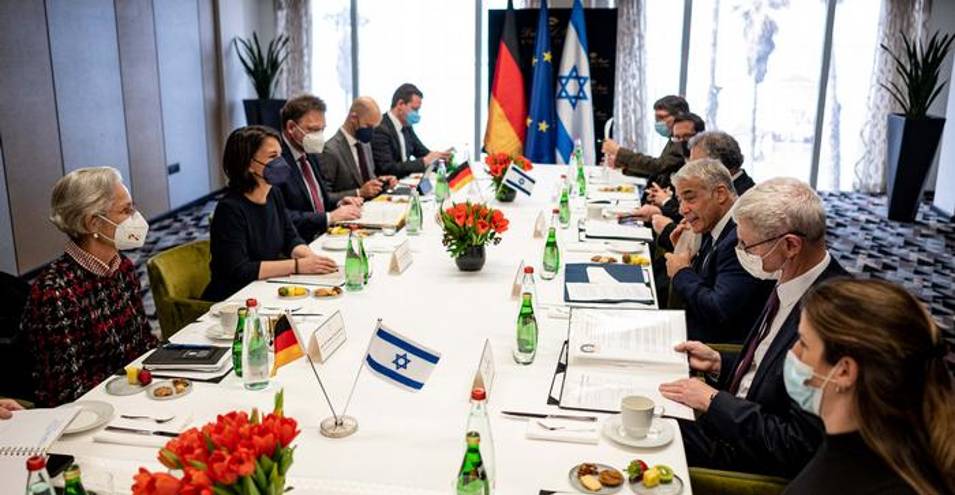
Germany’s Foreign Minister emphasized that she is convinced that a full return to the JCPOA agreement will make the region and Israel safer. Lapid also stressed that a nuclear Iran would be a threat not only to Israel but to the entire world.
Annalena Baerbock, Germany’s Foreign Minister, said at a joint press conference with her Israeli counterpart that nuclear negotiations with Iran have entered a “final stage” and that despite Israel’s concerns about the agreement, a return to the JCPOA will make the region safer.
At this press conference held on Thursday, February 10, in Tel Aviv, Israeli Foreign Minister Yair Lapid also participated.
Baerbock’s remarks refer to negotiations taking place this week in Vienna between Iran and the countries of Germany, Britain, France, China, and Russia with indirect U.S. participation. The goal of these negotiations is to return to the 2015 nuclear agreement that former U.S. President Donald Trump unilaterally withdrew from in 2018.
Iran and Israel are bitter enemies in the region. Leaders of the Islamic Republic have repeatedly emphasized that their goal is the destruction of Israel. Israel, in turn, has carried out several cyber and drone attacks against Iran’s nuclear facilities.
Israeli leaders have repeatedly said they will not be bound by any agreement between Iran and world powers, which could mean military action against Iran.
Yair Lapid, Israel’s Foreign Minister, said at this press conference that he and his German counterpart discussed the nuclear negotiations, and Lapid conveyed Israel’s position to Baerbock that “a nuclear Iran is dangerous not only for Israel but for the entire world.”
Israel’s Foreign Minister said: “Iran is an exporter of terrorism from Yemen to Buenos Aires, and any agreement with this country must include Iran’s regional interference activities.”
Lapid’s reference was to the explosion at a Jewish cultural center in Buenos Aires in the 1990s, in which officials of the Islamic Republic were involved.
Germany’s Foreign Minister also emphasized that she is fully convinced that “a full return to the JCPOA can make the region and Israel safer; otherwise, we would not be conducting these negotiations.”
Ms. Baerbock continued: “We will do everything we can to ensure that this agreement guarantees Israel’s security.”
“Determined to Reach a Good Agreement”
Hossein Amir-Abdollahian, Iran’s Foreign Minister, said on Thursday in remarks commemorating the anniversary of the establishment of the Islamic Republic in Iran that regarding the Vienna negotiations: “We are present at the negotiating table with seriousness, planning, and initiative, and we are determined to reach a good agreement.”
The Islamic Republic’s Foreign Minister tied the timing of the end of negotiations and reaching an agreement to “the will of Western parties in their complete commitment to lifting sanctions and the return of all parties to their commitments.”
Amir-Abdollahian said: “Today in Vienna, there is a great test facing America and Western parties who must demonstrate their true behavior before the international community.”
Iran is seeking the removal of all sanctions, while the West is seeking Iran’s return to all of its JCPOA commitments. Iran has gradually abandoned these commitments and has now been engaged in uranium enrichment at high levels contrary to the JCPOA.
Several times so far, according to American experts, it has been stated that Iran is only a few months away from the capability to build an atomic bomb.
Source: DW