Continued Violations of Environmental Activists’ Rights; Solitary Confinement Despite Court Orders
Mohammad Hossein Aghasi, a lawyer who previously represented two imprisoned environmental activists, said in an interview with the Human Rights Campaign in Iran that “keeping environmental activists in solitary cells has no legal basis and is a violation of law and trampling of prisoners’ rights.”
Meanwhile, Kati Rajabi, sister of Sam Rajabi, posted on her personal Twitter account about preventing her brother’s transfer to hospital, writing: “Today they did not issue a hospital referral for Sami. My brother was held in temporary detention for 20 months, sentenced to 6 years without presenting any evidence, and now they are preventing his treatment! What have you left of his mother? Why don’t you end this harassment?’
According to his sister, Sam Rajabi suffers from a hemorrhoid problem and, based on the prison doctor’s prescription, should be transferred to hospital and undergo surgery.
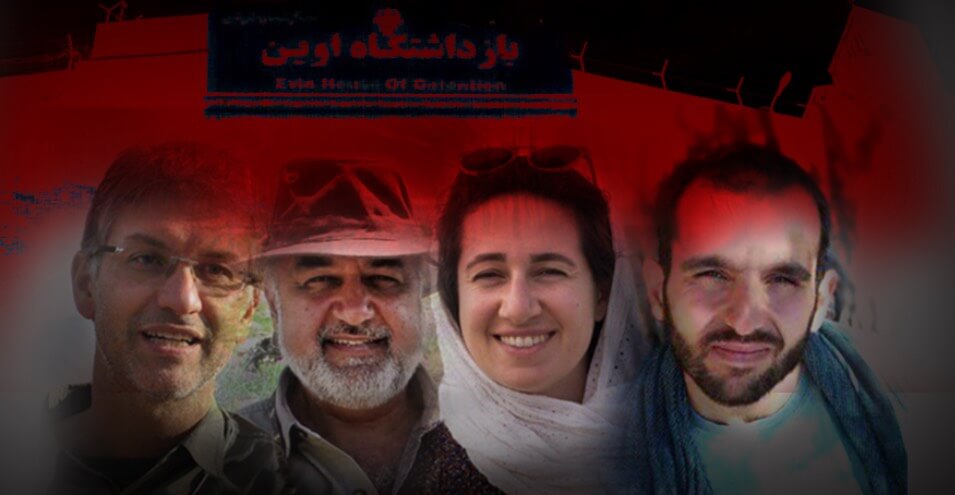
Morad Tahbaz, Niloofar Bayani, and Homan Jokar are three of these imprisoned activists who, despite court orders, remain in solitary cells in section 2A of IRGC prison. Mr. Aghasi told the campaign that “it seems because they objected in court and said they were coerced and deceived into confessing, they are now punishing them in a sense by preventing their transfer to general wards and keeping them in solitary cells, whereas according to law, keeping a defendant in solitary confinement can only be justified as long as there is a possibility of collusion with other defendants or intimidating them or destroying evidence that would prevent investigations from reaching conclusions. After that there is no legal justification whatsoever and it is against the law. The preliminary investigations of these three people have been completed and they should have been transferred to general wards when the preliminary investigations were completed, which they weren’t. Now an indictment has been issued, trial held, and verdict announced, and keeping them in solitary cells is a clear violation of the law.”
Mr. Aghasi explained: “In this case, confessions were apparently obtained from the first and second accused—namely Morad Tahbaz and Niloofar Bayani—through deception and promises that were not kept. In court, especially Niloofar Bayani interrupted the reading of the indictment several times and shouted that this is absolutely invalid and they deceived me. According to the provisions of the Code of Criminal Procedure, confessions made in court are valid, not those made before an investigator or judicial officer. Of course, they ignored this law and convicted them. Because they objected in court, they are being punished and prevented from entering general wards.”
Niloofar Bayani had stated in court in December 2017 that she was coerced through threats and torture into making confessions that formed the basis of her case. The campaign had previously reported that reliance on forced confessions obtained by pressuring defendants during interrogations was the main focus of the first court session of eight imprisoned environmental activists held in branch 15 of the Revolutionary Court under the presiding judge Abolqasem Solvati and in closed session, and no evidence was presented regarding the charges. According to the report, some arrested environmental activists were forced to confess against themselves under threat of death, and IRGC intelligence officers built cases against these activists based on false confessions obtained under coercion and severe pressure.
An informed source told the campaign that some of these environmental activists were subjected to months of solitary detention and psychological torture, death threats, threats of injection with hallucinogenic drugs, and threats of arrest and murder of family members, and some of these activists were beaten to force them to confess against themselves.
This is while the National Security Council, the Ministry of Intelligence, and Iran’s Environmental Organization have rejected the charges attributed to these activists.
The sentences of 8 environmental activists were issued on Wednesday, November 20, 2018, while according to Mohammad Hossein Aghasi, “there were no strong reasons and evidence proving the charges in these activists’ cases.”
Niloofar Bayani and Morad Tahbaz received the heaviest sentences from branch 15 of the Revolutionary Court and each were sentenced to ten years imprisonment. Homan Jokar and Taher Ghadirian each received 8 years imprisonment, Amir Hossein Khaleghi, Sepideh Kashani, and Sam Rajabi each received 6 years imprisonment, and Abdolhossein Koohpayeh received 4 years imprisonment.
Kavous Seyed Emami, Sam Rajabi, Homan Jokar, Niloofar Bayani, Morad Tahbaz, Taher Ghadirian, Amir Hossein Khaleghi, and Sepideh Kashani are current and former staff and managers of the “Pars Wildlife Heritage Institute” who were arrested on January 25-26, 2018. Their arrest remained silent due to security pressures on their families, but with Kavous Seyed Emami’s death in Evin Prison, the names of the detainees became public. Homan Jokar is the project manager for the protection of Asian cheetahs, Taher Ghadirian is a young “Man and the Living World” UNESCO scientist, Sam Rajabi is an environmental expert, Amir Hossein Khaleghi and Niloofar Bayani are wildlife experts, Sepideh Kashani is Homan Jokar’s wife and supervisor of activities and former advisor to the UN Environment Programme, and Morad Tahbaz is a colleague from the Pars Institute.
Kavous Seyed Emami, a sociology professor, member of the faculty at Imam Sadiq University and CEO of the “Pars Wildlife Heritage Institute,” was arrested on January 4, 2018, according to his son, and on January 19, 2018, his family was informed of his death described as “suicide.” However, it is unclear under what conditions Kavous Seyed Emami was interrogated and under what physical and psychological conditions he was held in Evin Prison and how such an incident could occur for someone who had complete physical and mental health. An issue that raised concerns about the situation of other detainees.
The Pars Wildlife Heritage Office was also sealed on January 4, 2018, following Kavous Seyed Emami and his colleagues’ arrest.
Parliament member Mahmoud Sadeghi wrote on his Twitter on May 9, 2018, quoting statements by the Intelligence Minister in parliament that the Intelligence Minister “clearly, reasonably and substantively announced that they found no evidence of espionage against them.”
Issa Kalantari, head of the Environmental Protection Organization, has repeatedly stated that there is no evidence of espionage against environmental activists and they should be released. Kalantari said on May 22, 2018: “Based on the assessment of a four-member committee of the cabinet, ‘the arrested activists should be released because there is no document to prove the charges against them.”
Kalantari also stated on August 13, 2018, while emphasizing that there is no evidence of espionage against them: “But the judiciary has not yet clarified their status and tells us that it is not your concern and do not follow up.”
Kavous Seyed Emami, a 64-year-old university professor and environmental activist, was arrested on January 4, 2018, in news silence by the IRGC Intelligence Organization, but on January 19, 2018, officers informed his family that he had committed suicide in prison. The IRGC officers did not allow an independent autopsy of Kavous’s body, and this university professor was buried on January 25, 2018, amid numerous questions and ambiguities from his family and the public, and especially the Iranian academic community, and no independent investigation was ever conducted into the death of Kavous Seyed Emami, the university professor and environmental guardian, in prison. Just four days after Seyed Emami’s death, while his death was still headline news, Abbas Jafari Dolatabadi, the Tehran prosecutor at the time, accused him of espionage on January 20, 2018. No evidence has been published to date to prove the claims of judicial officials. Mr. Emami’s family has rejected all these claims.
Source: Human Rights Campaign