Continuity of Teachers’ Protests and Students’ Suffering on the Eve of New Academic Year
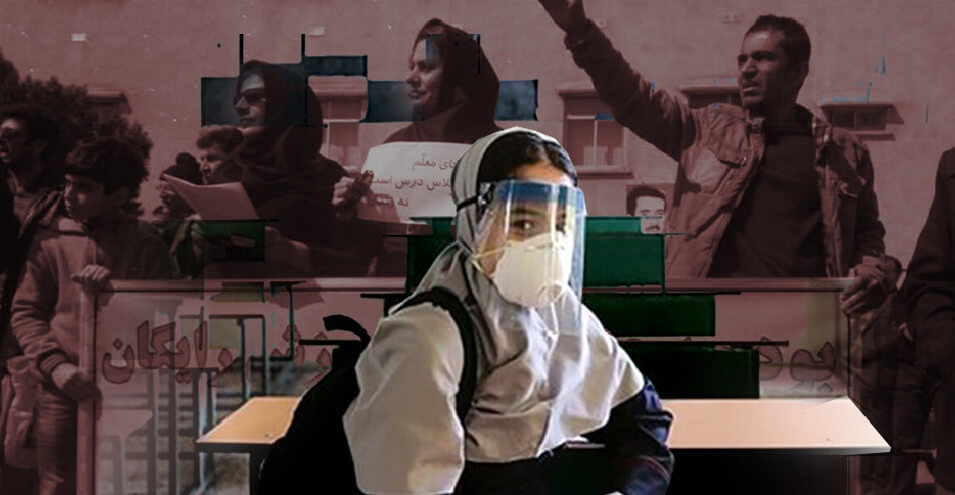
As the new academic year in Iran approaches, multiple reports have been released about teachers’ protest gatherings in Tehran in front of the parliament building and the Plan and Budget Organization. These gatherings protest the livelihood situation and poor conditions in education, as well as decisions made against teachers’ views.
Teachers’ protests in Iran continue despite severe security and judicial pressures from the authorities, ranging from exile and salary cuts to long-term prison sentences. It can be said that Iran’s teaching community is one of the most organized professional and civil societies. In the mid and final years of the 1990s (solar calendar), Iran’s teaching community repeatedly organized and held nationwide gatherings and strikes.
Alongside teachers’ protests against unfavorable livelihood conditions, one of their most important demands is providing suitable educational conditions for students based on Article 30 of the Constitution, which obligates the government to provide free educational facilities through the secondary level.
Deprivation and discrimination among Iranian students, especially during the coronavirus pandemic, became severely apparent, resulting in a significant increase in school dropout rates during this period.
The Regime’s Response to Teachers’ Professional Demands: Suppression, Dismissal, and Prison
The re-establishment of teachers’ professional organizations in the final years of the 1970s coincided with the founding of the Syndicate of Teachers of Iran. The continuation of organized professional activities by teachers’ organizations across the country, despite numerous obstacles and obstructions by the authorities, made the path to pursuing their rights smoother.
Teachers’ protests entered a new phase in the early years of the 1980s; a gathering of nearly 10,000 teachers in front of the Islamic Consultative Assembly and at the office of the Presidency, after which a group of protesting teachers were beaten by officials. Teachers’ protest gatherings and strikes continued in the mid-1980s and after Mahmoud Ahmadinejad came to power.
Widespread economic difficulties and failure to implement parliamentary laws aimed at eliminating discrimination among government employees’ income were among the most important reasons for escalating protests in the years 1385-1386 (2006-2007), which in some cases resulted in ten-day school closures. Security and judicial treatment of teachers’ rights activists intensified during these years, from the detention of some teachers in various cities to salary deductions. Meanwhile, the Ministry of Interior revoked the licenses of teachers’ professional associations in summer 1386 (2007), and most teachers’ professional organizations were declared illegal by the government after nationwide protests and gatherings in 1386 (2007).
After the 2009 elections and with the further securitization of space for civil and professional activities, the intensity of treatment against activists increased; between the years 1389-1392 (2010-2013), at least four teachers were sentenced to death for activities that the authorities claimed were “non-professional,” with the sentences of three of them being executed.
During these same years, many teachers in Iranian cities were sentenced to long-term imprisonment, exile, and flogging after arrest and unjust trials; teachers who had only protested to uphold their rights and demands. Rasoul Badaghi, Hashem Khoshtar, Mahmoud Beheshti Langaroudi, and Ali Akbar Baghani were among teachers’ and educators’ rights activists in the country who faced severe judicial sentences such as long-term imprisonment and exile to deprived areas in the final years of the 1980s.
With Hassan Rouhani’s government coming to power and despite his government’s numerous promises to address teachers’ problems and the country’s educational system’s difficulties, no significant changes occurred in improving the situation, and the pattern of security and judicial treatment of activists in this field continued.
Meanwhile, nationwide teachers’ protests across the country continued despite all limitations. It can be said that one of the most important periods of these protests was 1397 (2018); a large group of Iranian teachers gathered on April 10, 2018, in front of the Plan and Budget Organization building protesting the livelihood situation and the commercialization of education. During this gathering, several teachers were detained. Mohammad Habibizadeh, a member of the Tehran Teachers’ Syndicate, was one of those arrested that day. The Islamic Republic’s judicial system sentenced Habibizadeh to seven and a half years in prison, a two-year ban on political and social activities, and 74 lashes.
With the start of the 1397 (2018) academic year, the Coordination Council of Iranian Educators’ Professional Organizations issued a call asking all educators in the country to stage sit-ins at schools on October 13-14, 2018, and refrain from attending classes. Teachers’ union activists stated in part of their call statement: “Security institutions and the judiciary, instead of dealing with thieves and corrupt officials in society, threaten, exile, dismiss, fire, and imprison demanding and justice-seeking teachers.” The purpose of these strikes was to address the unsuitable economic conditions, low wages, and the freedom of other imprisoned teachers. These strikes were also held in November 2018, with many teachers across the country refusing to attend classes.
Despite severe suppression of protests and the continuation of judicial and security proceedings against educators’ rights activists, teachers’ protests continued in the final years of the 1390s (2010s). Although the most prominent demand of teachers in these protests is addressing the livelihood problems and improving the poor economic conditions of the educators’ community, as teachers’ rights activists say, “opposition to ideological education,” “emphasis on free education and opposition to privatization in education,” and “providing suitable educational facilities for all students” are other serious demands and calls of Iran’s teaching community.
The Teaching Community’s Effort in Combating Discrimination and Deprivation of Students
Article 30 of Iran’s Constitution states: “The State is obliged to provide the means of free education and training for all nation up to the end of secondary school, and to expand higher education facilities to the point of self-sufficiency, free of charge.” The necessity of paying attention to and implementing this constitutional principle has always been one of the most important demands of teachers and their professional organizations across the country; a matter that is directly related to the issue of commodification of education through privatization in education.
In the 1970s with the prevalence of establishing “non-profit” schools in Iran, the project of education commodification began and in subsequent years expanded with greater momentum and in various forms and methods. The spread of various dimensions of discrimination among students in different parts of the country and the noticeable difference in the level of access and enjoyment of educational facilities in different regions are among the most important consequences of intensifying the commodification of education in the country. A matter that became more apparent, especially during the coronavirus pandemic.
Shortly before, Ali Akbar Haqdoost, the educational deputy of the Health Minister, stated that “25 percent of students have dropped out of school due to not having a smartphone.”
This is while educational spaces in the country also face numerous problems in many sections, such as the deterioration of classrooms. An important part of teachers’ protests in recent years has specifically been in opposition to the spread of discrimination and fanning the flames of deprivation among students who mostly live in low-income families and the education system has no special attention to address their problems. It can be said that this aspect of teachers’ protests is precisely linked to the problems and difficulties of various segments of society who are unable to earn their livelihood and whose voices are not heard.
However, another aspect of teachers’ struggle in recent years, which has also been evident in their protest gatherings, has been opposition to the prevalence of ideological education. Clear and explicit positions taken by the Teachers’ Syndicate regarding the adoption of policies such as the increased presence of “seminary students” in education was one of the most recent of these oppositions.
In April 2021, it was reported that the Ministry of Education had a program for “hiring 25,000 male and female seminary students as teachers in line with Islamizing schools.” According to the Ministry of Education’s claim, this is being done in accordance with the 1996 parliament law on hiring clergy and seminary students in education and the charter of the University of Educators approved by the Supreme Council of the Cultural Revolution. Simultaneously, the Coordination Center for Cooperation between Seminary Centers and Education announced that it hired 440 seminary students as teachers in the past year while describing this number as small, while defending the plan to hire 25,000 seminary students in education.
At that time, the Teachers’ Syndicate of Iran in a statement on the occasion of Teachers’ Day, April 1st, protested the low wages of teachers, lack of insurance rights and job security for them, incomplete implementation of salary equalization for retirees, and also “the recruitment of seminary students as teachers in schools.”
Ibrahim Raisi’s Government’s Response to Teachers’ Demands
Shortly after Ibrahim Raisi’s government came to power, the previous government’s decisions on increasing teachers’ salaries were halted. This matter was one of the reasons for teachers’ recent protest gatherings in front of parliament and the Plan and Budget Organization.
Masoud Mir-Kazemi, the head of the Plan and Budget Organization in Raisi’s government, halted Rouhani’s decisions on equalizing teachers’ salaries. Mir-Kazemi stated that increasing teachers’ salaries should be approved by the government and its implementation is “very difficult” due to budget deficits.
While Ibrahim Raisi’s government began work without clarity on “who would be the Minister of Education.” His proposed candidate for the Ministry of Education, Hossein Baghgoli, was the only one who failed to receive a vote of confidence from representatives of the Islamic Consultative Assembly.
The deteriorating situation of Iran’s education system and the government’s inability and ineffectiveness in managing the coronavirus crisis has caused school reopenings in Iran to be accompanied by many conditions and caveats. On the other hand, the intensification of economic crises among different segments of society and inability to access remote learning facilities has increased concerns about rising school dropout rates and its consequences such as forced child marriage.
Hardening economic conditions and the regime’s disregard for teachers’ professional demands will undoubtedly lead to escalation of teachers’ protests. Given that Ibrahim Raisi is relying on the chair of the presidency—a person under whose presence in the judiciary the heaviest sentences against teachers were issued—there is fear that the security outlook and security pressures on educators’ rights activists will increase. A perspective that still exists in the narrative of the country’s judicial authorities and guarantees the regime’s main narrative about teachers’ protests.
One can observe the persistence and insistence of the judicial apparatus in dealing with teachers throughout the leadership of different individuals heading the judiciary in the file of Ismail Abdi, a member of the Tehran Teachers’ Syndicate; Ismail Abdi in 1389 (2010) after arrest was taken to Ward 209 of Evin Prison and held in solitary confinement for more than 30 days. In 1390 (2011), the Revolutionary Court sentenced him to 10 years in prison, a sentence that was suspended for five years. Ismail Abdi was arrested on June 27, 2015 by forces of Tharallah Camp and was sentenced to six years in prison in the primary court in February of that year, and the issued sentence was upheld by Branch 36 of Tehran Province’s Appeals Court. Ismail Abdi was also in prison during Ibrahim Raisi’s leadership of the judiciary. His sentence ended on June 18, 2020. Nevertheless, due to his request for reconsideration being rejected by the Supreme Court regarding the ten-year prison sentence issued for him due to professional activities, he continues to serve his sentence during Ghasem Mohseni-Eje’i’s leadership of the judiciary.
Source: Iran Human Rights Campaign