Dark Scandal in the Chain of Bloody Trade in Iran
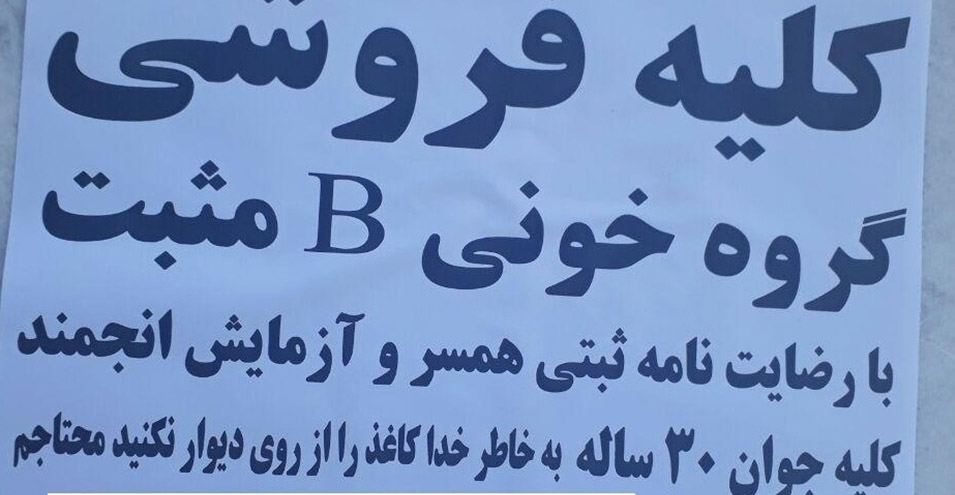
Sohila.Sh. FCNN: The posting of advertisements for the sale of kidneys on walls and doors throughout major cities of the country has become commonplace for several years. We are no longer surprised. It seems we have allowed poverty to penetrate deep into the body and soul of our countrymen. To the point where they sell a body part and receive bread in exchange just to avoid falling below the poverty line and prevent starvation from taking their lives.
The gentlemen see no religious prohibition in this, to the extent that Nasser Makarem Shirazi, a jurist who can easily declare the forbidden permissible and the permissible forbidden as simply as drinking water, puts his stamp of approval on it and says: “The sale of organs that have replacements is not problematic, but the organ owner should demand payment for permission to remove the organ, not for the organ itself.”
And this is where we all approved the legitimacy of a bloody trade in our country. Until today, when these advertisements have gone beyond kidneys and other body parts like eyes have also been targeted.
The more bitter reality is that evidence suggests these organs are being smuggled out of the country to other nations, particularly around the Persian Gulf region.
This unfortunate phenomenon is unfortunately growing, and the main victims are no longer adult poor sellers but innocent children.
Children who are kidnapped and then abandoned after their smuggleable organ is removed. Of course, we must also account for the number of children sold by addicted families, which is unfortunately on the rise.
Even newborns are being sold. The latest prices in Tehran are as follows: a male newborn at 7 million and a female newborn at 8 million tomans. The transaction begins with the care of addicted mothers in supervised facilities and childbirth in state hospitals. This is just one aspect of the news that, despite severe censorship in domestic media, has been reflected and brought to the attention of the public and officials.
Officials Are Indifferent
Yet, until now, no media outlet has confronted the officials or criticized them. Officials who claim to uphold human rights in the country yet remain indifferent to the growth of human organ trade and the killing of innocent children and infants at a small price.
Even the people’s representatives in the Islamic Consultative Assembly, despite acknowledging these crimes in the country, have not addressed regime officials.
According to the Majlis news site, Yahya Kamalipour, deputy chairman of the judicial and legal commission of the Islamic Consultative Assembly, stated that hostage-taking for organ theft and the involvement of street children in this crime has doubled the severity of this violation. To the extent that it seems, given the absence of deterrent law, controlling this crime is not possible, and unfortunately, we are facing the growth of this smuggling sector in the country.
Why the Silence?
But why have all remained silent, and instead of addressing officials and specifically Khamenei as the leader of the Islamic Republic to preserve the lives of the future generations of our land, they do not prosecute?
Amin Qadsi, an Iranian living in Europe who spent years as a guard in Adel Abad prison in Shiraz, believes that severe suffocation is the marginal factor in this media reluctance.
He considers the consequences of exposing the leaders of organ smuggling gangs in the country as the main cause of this silence.
Qadsi, in conversation with FCNN, says: “How is it that security officials become aware of a prayer session held by Bahais or Noahides upon its occurrence and immediately act to arrest the perpetrators, yet remain unaware of the performance of illegal surgical operations and the childbirth of addicted women who never experience motherhood, and this in state hospitals? This is exactly like the growth of drug smuggling in the country, which ends only in the punishment of low-level operatives. But the leaders of smuggling rings continue their work.”
Organ Smuggling Out of Officials’ Sight Is Negligence
According to this citizen, accepting the notion that the victimization of newborns or street children by smugglers remains hidden from the eyes of Islamic Republic leaders is negligence.
Qadsi goes further and, recalling his experiences as a prison guard in Iran, continues: “I remember that seasoned smugglers in prison and court were freed from death sentences by bribing, and later their life sentences were reduced to less than ten years through repeated pardons. But those who only carried drugs and had no money were subjected to full punishment. Even file tampering was easily possible with the payment of less than ten million tomans so that the seized drug of the smuggler would be reduced in weight and his sentence minimized. All of this shows that the regime wants the continuation of drug trade in Iran, because through this, abundant profits flow into the pockets of government leaders and their children.”
He also recalled the strict controls imposed at borders for the export of goods permitted with travelers and said: “People cannot pass a package of medicine or food through the border; how is it that a smuggler can carry human organs, which require special equipment to transport, out of the country unnoticed by officials?”
This compatriot’s experiences of government complicity with some clergy in Shiraz for smuggling goods to neighboring countries, sometimes including drug trafficking, speak volumes. To the extent that they easily import heavy, secondhand foreign vehicles with special compartments into the country for specific purposes. Therefore, in his view, it is not far-fetched that some of these same individuals control or support human organ smuggling gangs.
In Qadsi’s view, the identification and arrest of 12 organ smuggling gangs in recent months was the most appropriate tool that could have led to the identification of higher-ranking individuals in this trade. But nothing special happened, and even the details of these criminals’ files were not made public.
Patients Deprived of Donated Organs
In another part of this sad story is the deprivation of those in need of transplants. While it has been announced that approximately 25,000 people in Iran are waiting for organ transplants and daily, 10 people on the waiting list lose their lives, the organs of Iranians are being transplanted into foreign patients.
Most of these illegal operations have been performed in state and private hospitals in Tehran without security forces being informed.
Based on statistics provided by the Association for Protection of Kidney Patients, in the year 92 (2013-14), approximately 1,800 kidney transplant operations were performed, but only about 800 were coordinated with the association, and more than 1,000 of these operations were conducted illegally and included kidney transplants from an Iranian citizen to another Iranian or from an Iranian to a foreigner, performed with violations by some hospitals and physicians.
Increased Supply of Newborns with the Growth of Sex Workers
Media reports suggest that cardboard-dwelling women, while giving birth in some hospitals in the south and central parts of Tehran, sell their babies for 100 to 200 thousand tomans. Of course, if the newborn is addicted, the price is lower. Particularly with the growth of the population of addicted women and sex workers in Iran, the supply of newborns has also increased, and brokers have gained more opportunity to negotiate.
Yet officials remain indifferent in the face of controlling this process. To the extent that they do not employ any effective tools to ensure the security of addicted women and prevent these heinous crimes. They even pretend that nothing has happened and the country is safe and secure.
Recently, in response to news published in the media, Shahindokht Molaverdi, deputy for women and family affairs of the presidency, announced the number of sold newborns as high and, to counter this trend, merely announced warnings and dos and don’ts, passing the buck to others.
While most of these children have no father and lack identity documents. For this reason, hospital staff, compelled and regardless of the mother’s objection, hand over the child. Because welfare, as the guardian of protection of such children, does not have the necessary capacity to provide services to this segment. These conditions seal a fate for this section of Iran’s population that is in no way pleasant or humane.
Thus, the facts suggest that the growing process of bloody trade in Iran has not been a single-factor phenomenon, but rather a series of sequential factors have played a role in its occurrence. Cultural and economic poverty is one of these links. Yet officials target only this link and turn a blind eye to the source and root of the promotion of this trade.
Thus, the easiest way is for everyone to talk about dos and say solutions that are unclear which institution or authority will implement. Only the shoulder shrugging off responsibility and the buck passing from one person to another. Without anyone being forced to account or any official acknowledging the consequences of this inhumane phenomenon in the country.