European Union on Mahsa Amini Anniversary: Repression and Executions in Iran Must Stop
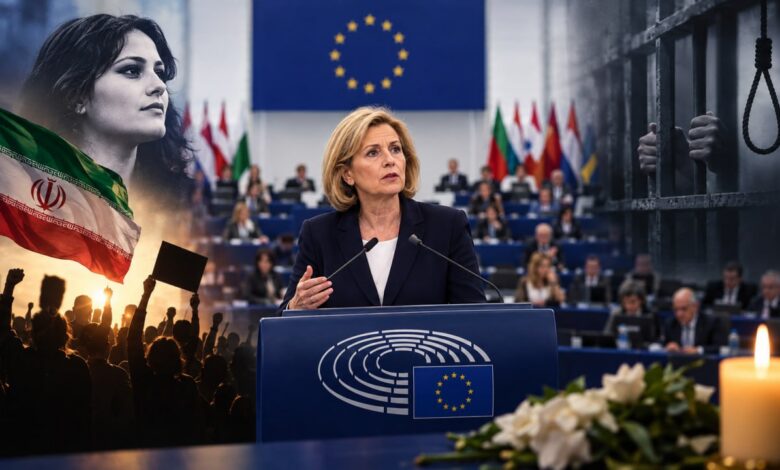
On the fourth anniversary of Zhina Mahsa Amini’s death, the European Union condemned the repression of protesters and the increase in executions in Iran, calling on the Islamic Republic to end violence and intimidation against its people. Praising the courage of Iranian women and men, the European Union emphasized that execution is incompatible with the fundamental right to life and that arbitrary detention, violence, and execution should not be used to silence critical voices.
The European Union’s External Action Service issued a statement on Wednesday, September 16, 2026, marking the fourth anniversary of Zhina Mahsa Amini’s death, regarding the human rights situation and repression in Iran.
In this statement, the European Union recalled that four years have passed since the death of 22-year-old Iranian woman Mahsa Amini and the beginning of the “Woman, Life, Freedom” movement—a movement that emerged in response to her death in police custody and became one of the most widespread protests against the Islamic Republic.
The European Union also referenced the nationwide protests of January 2026, noting that “thousands of protesters” were killed during these demonstrations.
The statement said the European Union “values the courage of Iranian women and men” and supports their aspirations for a future in which human rights and fundamental freedoms are respected, protected, and guaranteed.
One of the main focal points of the European Union’s statement is the increase in executions in Iran. The European Union described the current pace of executions as “appalling” and reiterated its principled opposition to capital punishment in all cases and under all circumstances.
The official statement read: “The death penalty is incompatible with the inalienable right to life and the absolute prohibition of cruel, inhuman, or degrading punishment.”
The European Union has previously condemned the Islamic Republic’s use of death sentences against protesters and opponents on multiple occasions. The Council of the European Union has also identified the use of capital punishment against protesters as a human rights violation in Iran and emphasized the need to guarantee the right to peaceful assembly and freedom of expression.
In their new statement, the European Union and its member states declared their unity in condemning what they called “continuous repression” by the Islamic Republic’s authorities.
According to the European Union, this repression is not limited to the use of force in the streets but encompasses a range of measures, including systematic use of executions, violence, arbitrary arrests, and intimidation tactics to silence critical voices.
This position was stated at a time when in recent months multiple reports have been published about death sentences issued for protesters and political prisoners in Iran.
The Council of the European Union has also stated on its official page regarding Iran-related sanctions, including its areas of concern: the extensive and disproportionate use of force against protesters, arbitrary detention, torture and inhumane treatment of prisoners, and the execution of protesters.
In its statement, the European Union also addressed the consequences of war and military attacks on the Iranian people. The statement said “war has added another layer of suffering to this situation” and expressed deep regret over the killing of civilians and innocent people in attacks.
This section of the statement shows that the European Union, alongside criticizing the Islamic Republic’s internal repression, has also taken into account the consequences of military conflict on ordinary citizens—an issue that from a human rights perspective makes the protection of civilian lives one of the primary concerns.
At the end of its statement, the European Union called on the Islamic Republic’s authorities to end violence and repression against the Iranian people.
The union emphasized that Iranian women and men must be able to enjoy their fundamental rights and freedoms, and the voices of critics should not be silenced through arrest, intimidation, violence, or the death penalty.
The European Union’s new position also continues its policy regarding human rights violations in Iran. The European Union has had a human rights sanctions mechanism against Iran since 2011 and has expanded the scope of these sanctions in the years following the 2022 protests. According to official information from the Council of the European Union, these sanctions include travel bans, asset freezes, and restrictions on individuals and entities involved in internal repression.
Four years after Mahsa Amini’s death, her name remains linked to demands for freedom, human dignity, and fundamental rights of Iranian citizens. The European Union’s new position demonstrates that the issue of suppressing protests, detaining opponents, and the use of capital punishment continues to be at the center of Europe’s human rights concerns regarding Iran.
While many families of the killed and political prisoners continue to await truth and justice, opposition to executions and support for the right to life and freedom of conscience is not merely a political issue; it is directly related to human dignity and the fundamental right of every individual to life and freedom.
The European Union now calls on the Islamic Republic to respect the basic rights and freedoms of the Iranian people instead of resorting to violence and intimidation—a plea that has been reiterated at the international level on the fourth anniversary of “Woman, Life, Freedom.”