Historic Apology by Brussels Catholic Church; Reopening a Wound Hidden for Centuries
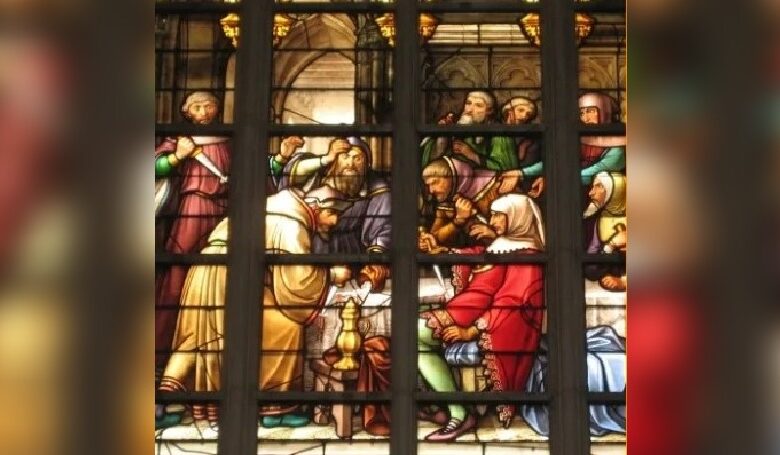
The Catholic Church in Brussels, by removing a historic stained glass window that depicted false accusations against Jews in the Middle Ages and replacing it with a plaque containing a formal confession and apology, has taken an important step in revisiting the past and confronting the legacy of anti-Semitism.
In an unprecedented move that can be considered a watershed moment in the Church’s confrontation with its past, the Catholic Church in Brussels decided to remove one of its historically controversial symbols and in its place present a new and responsible narrative of history. This action not only relates to a reassessment of a dark medieval event, but also demonstrates a profound shift in approach toward the issue of anti-Semitism within the context of European Christianity.
The story dates back to 1370 AD; when a group of Jews in Brussels were accused of a strange and baseless charge: it was claimed that they had stolen the sacred bread of the “Eucharist” ritual and desecrated it. Such accusations at that time were part of a broader atmosphere of “blood libel”; fabricated narratives that attributed demonic acts to Jews, such as harming Christian children or poisoning water sources, and often led to severe violence.
The consequences of these accusations in Brussels were also catastrophic. A number of Jews were burned alive in a brutal manner and the remaining Jewish community of the city was forced to abandon their homes. This event is considered one of the tragic examples of the connection between religious bigotry and social violence in Europe.
Over the centuries, this false narrative was not only forgotten, but was also reproduced in the form of religious art. In the early twentieth century, a stained glass window was installed in one of Brussels’ churches that depicted this very story: Jewish men striking sacred bread with blood flowing from it. This image, although presented in the form of art, was in a sense a reflection and continuation of the same anti-Semitic narratives.
Now, after years of criticism and dialogue, this work has been removed from its place and replaced with a plaque that takes a completely different approach. The text of this plaque is written in several languages, including Hebrew, and explicitly refers to historical errors: “We acknowledge that in various parts of Europe, baseless accusations have been made against Jewish communities regarding desecration of Eucharist ceremonies. These slanders led to unjust persecution, massacres and expulsion of Jews. We ask forgiveness of the Jews for the suffering caused by these accusations.”
At the ceremony unveiling this plaque, religious leaders from both communities were present. The Archbishop of the region, emphasizing the incompatibility of anti-Semitism with the Gospel message, stressed the necessity of reviewing teachings and historical narratives and said: “Christ’s Gospel calls for truth, justice and brotherhood. We ask forgiveness for the suffering resulting from the events of 1370 and subsequent anti-Semitism.”
On the other side, the leader of the Jewish community of Brussels also described this action as a positive step in interfaith dialogue, but at the same time emphasized the importance of preserving historical memory. He explained that complete removal of past works is not a solution, but rather they should be accompanied by correct explanation and interpretation so that they become a tool for education and prevention of repetition of mistakes.
This approach reflects a broader evolution within the Catholic Church in recent decades; particularly after the Second Vatican Council in the 1960s, which transformed the Church’s official view of Jews and emphasized the rejection of anti-Semitism. Since that time, efforts have been made to rebuild relations between Christians and Jews, but actions of this kind show that this path continues.
What happened in Brussels today was not merely a physical change in the space of a church, but a sign of acceptance of historical responsibility and an effort to heal wounds created centuries ago. This action can serve as a model for other religious and cultural institutions to courageously review their past and open a new path toward a future based on truth and coexistence.