Intensifying Pressure on Religious Minorities in Iran; Two Baháʼí Citizens Transferred to Prison to Serve Sentences
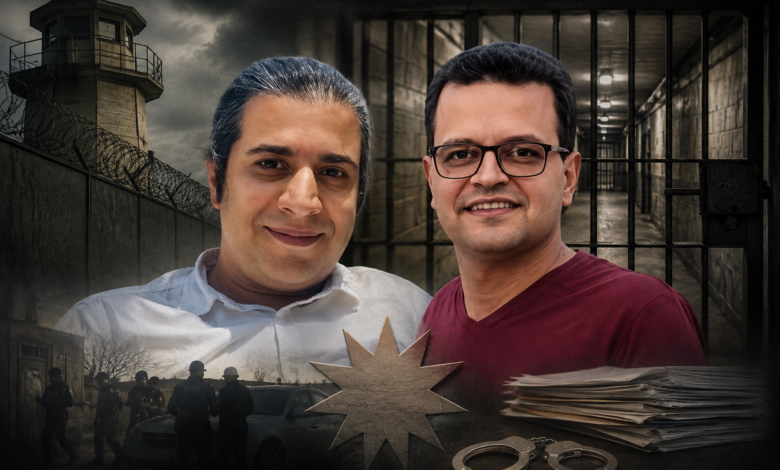
In the continuing wave of pressure on Iran’s minorities, two Baháʼí citizens, Iman Rashidi and Arslan Yazdani, were arrested in recent days and transferred to prison to serve their sentences. These two cases have occurred as human rights reports indicate an increase in arrests, summonses, home raids, and court convictions against Baháʼís and other minorities in Iran, with the global Baháʼí community stating that dozens of members of this religious minority are currently imprisoned or detained.
Two Baháʼí citizens named Iman Rashidi in Yazd and Arslan Yazdani in Karaj were arrested on August 22 and 23, 2026, to serve their prison sentences.
According to published reports, Iman Rashidi was arrested on Sunday, August 23, after reporting to the first branch of the Revolutionary Court’s enforcement office in Yazd and was transferred to the city’s central prison. The Hrana news agency also confirmed his transfer to Yazd Prison to serve his sentence.
Rashidi had previously been convicted in a judicial case on charges including “propagandistic activities against the system” and “deviant propagandistic activities contrary to the sacred Islamic law” to three years, six months, and one day of punitive imprisonment. In addition to prison, he was also imposed with 15 years of deprivation of social rights and ordered to pay 371 million rials in fines.
According to human rights sources, Rashidi was also arrested by Yazd intelligence agents in October 2023 and was released after several months on bail. Hengaw has also reported that his interrogation and trial proceedings were conducted without access to a lawyer. Rashidi had previously been arrested and convicted due to activities related to the Baháʼí community.
One day before Rashidi’s transfer to prison, Arslan Yazdani, a 43-year-old Baháʼí citizen residing in Karaj, was arrested during a security forces raid on his home. During the arrest of Yazdani, security forces also searched his house and confiscated several electronic devices belonging to family members. He was then transferred to Tehran’s large prison, known as Fashafuyeh, to serve his sentence.
Hrana had also reported Yazdani’s actual arrest on August 22. The Iran Human Rights Documentation Center also wrote in a report on this case that security forces confiscated mobile phones and a laptop during the arrest.
Yazdani had previously been sentenced to five years in prison for “membership in Baháʼí organizations” and one year of imprisonment for “propaganda against the system.” Based on regulations regarding sentence consolidation, five years of this conviction was enforceable; however, the appeals court in December 2023 reduced his prison term to three years. He had been previously arrested in September 2021 by the Intelligence Organization of the Islamic Revolutionary Guard Corps and was later released on bail.
The coincidence of these two cases with several other instances of arrest and conviction of Baháʼís has increased concerns about continued systematic pressure on this religious community. Hengaw has also recently reported the arrest of several Baháʼí women in Sari. According to this report, security forces searched a number of homes and confiscated some personal and electronic items. Regarding some of these individuals, the agents had search warrants, but according to Hengaw, the issued permits did not necessarily include arrest authorization.
These reports demonstrate that the cases of Rashidi and Yazdani are part of a broader process that has once again drawn the attention of human rights organizations to the situation of the minority community in Iran in recent weeks.
In a report published on August 19 by Iran Wire, citing information from the global Baháʼí community, it stated: “As of August 14, 55 Baháʼís, including 31 women and 24 men, have been detained or imprisoned in Iran due to their beliefs.”
The same report states that more than 21 others were serving their sentences outside prison under electronic monitoring or on leave. These individuals are held in prisons, detention centers of the Ministry of Intelligence, facilities affiliated with the Revolutionary Guard, and undisclosed locations.
Moreover, cases of physical and psychological abuse, lengthy interrogations, solitary confinement, beatings, forced confessions, and deprivation of proper medical treatment have been raised in various Baháʼí cases. These incidents highlight human rights reports about the intensification of pressure on these religious minorities in Iran.
This process has not only been raised by Iranian non-governmental organizations or human rights media. The Office of the United Nations High Commissioner for Human Rights, in April 2026, within the framework of this organization’s special mechanisms, communicated with the Islamic Republic government about allegations related to arbitrary detention, enforced disappearance, torture or cruel and degrading treatment, extraction of forced confessions, and detention of members of the minority community in Iran.
In this formal communication, the cases of seven specific individuals were raised, and the United Nations expressed concern about the status of some of them, including claims of danger to their lives.
The United Nations had previously also warned about an increase in systematic targeting of Baháʼís, including arrests, summonses for interrogation, enforced disappearances, and home raids. In one of its formal communications in 2024, the cases of 47 Baháʼí women in several Iranian cities were brought to the attention of United Nations human rights experts.
The Baháʼí community is not officially recognized by the Islamic Republic as one of the religious minorities recognized in the Constitution. The U.S. International Commission on Religious Freedom stated in its 2026 report that conditions for religious freedom in Iran remain very poor and that the government intensified systematic pressure on religious minorities, including Baháʼís, Christians, Jews, Sufis, and Sunnis in 2025.
This commission, in its section on Baháʼís, referred to matters such as home raids, arrests, asset confiscation, and issuance of prison sentences. It also reported economic discrimination against Baháʼí business owners and closure of some of their commercial units.
Thus, pressure on Baháʼís is not limited to judicial prosecution and can extend to areas such as education, employment, economic activity, and social life. Recent cases have been raised in circumstances where the arrest and imprisonment of Baháʼís have a long history in the Islamic Republic.
The U.S. Commission on Religious Freedom, in its prisoners of conscience database, has recorded multiple cases of Baháʼís who have been arrested and convicted in recent years due to their beliefs or religious activities. For example, in one case, a Baháʼí citizen faced prison sentences due to educational and religious activities.
This process has also continued into 2026. Reports indicate the existence of multiple cases in cities such as Shiraz, Isfahan, Babil, and Tehran in which Baháʼís have faced arrest, conviction, or other forms of deprivation.
The arrests of Iman Rashidi and Arslan Yazdani are ostensibly two separate judicial cases, but their timing and coincidence with a new wave of Baháʼí arrests have once again drawn attention to the situation of this religious minority in Iran.
Rashidi was arrested after reporting to the enforcement office and went to Yazd Prison to serve his sentence; Yazdani was also arrested during a security forces raid on his home and transferred to Tehran’s large prison.
In both cases, the judicial charges are linked to the religious or social activities of these two Baháʼí citizens; an issue that has also been raised in reports by international human rights organizations as one of the patterns of continued pressure on Iran’s Baháʼí community.
Given the increase in arrests and convictions in recent months, the cases of these two citizens cannot be considered merely as two isolated incidents. What emerges from collating reports from international organizations is a picture of the continued judicial and security pressure on a community that has faced religious and social restrictions in Iran for years.
These developments are of particular importance for the Christian community and other religious minorities; because freedom of religion and conscience is a universal right, and its restriction for one religious community may be an indication of broadening restrictions on freedom of thought in a country.