Iranian Nationality for Children of Iranian Women Conditional on Approval by Ministry of Intelligence and IRGC Intelligence Organization
After three reviews, the Guardian Council approved on October 1, 2019 the bill determining the status of children born from the marriage of Iranian women with foreign men. The Guardian Council made granting Iranian nationality to children born to Iranian mothers conditional on confirmation of the absence of security issues for the child’s father and mother by the Ministry of Intelligence and the Islamic Revolutionary Guard Corps (IRGC) Intelligence Organization.
This condition of making the child’s enjoyment of maternal nationality contingent on approval by two parallel security and intelligence bodies reflects a security-oriented approach to one of the most fundamental human rights—the right to nationality—and punishes children for their parents’ activities. Furthermore, since a similar condition is not provided for granting nationality to children born from the marriage of Iranian men with non-Iranian women, this condition also contains discrimination against women. This discriminatory practice based on individuals’ political opinions and beliefs will follow, and given the lack of transparency in the performance and criteria of the Ministry of Intelligence and IRGC Intelligence Organization in determining “lack of security problems,” it opens the way for abuse and the application of personal preferences by intelligence and security officials.
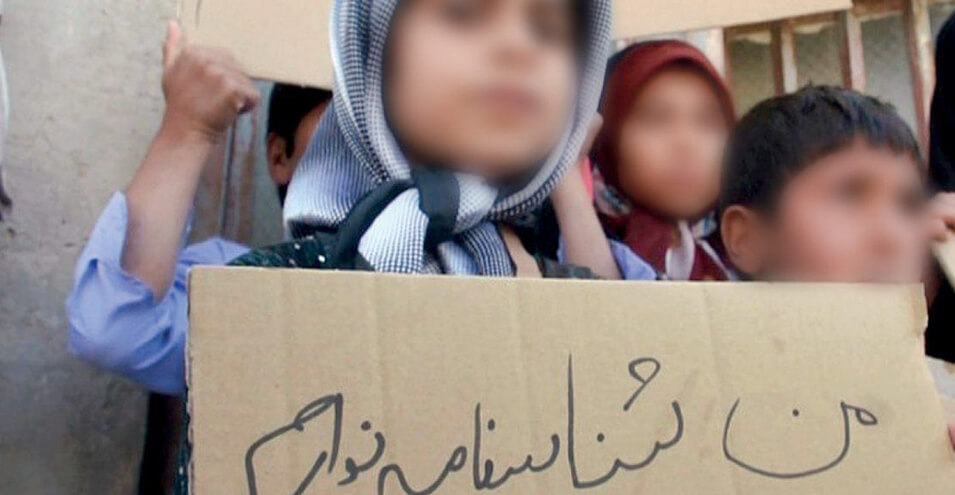
According to Ahmad Midari, Deputy for Social Welfare at the Ministry of Cooperatives, Labor and Social Welfare, “Currently, 49,000 and 60 children in Iran lack birth certificates due to the impossibility of transferring nationality from the mother. Additionally, it has been stated sporadically that approximately 150,000 to one million children lack birth certificates and identification documents.”
Children without nationality and identification documents face numerous problems in accessing healthcare and education services. Those of these children who live outside Iran need to obtain visas to travel to Iran, which creates numerous legal and administrative difficulties for families. Additionally, stateless children living within the country, mostly born from marriages of Iranian women with Afghan or Iraqi men, may be vulnerable to exploitation or even human trafficking due to unregistered births, and protection from them by protective and judicial authorities will be difficult. Ahmad Midari, the Deputy Minister for Welfare, told the ISNA news agency: “One of the worst types of poverty is legal and identity poverty. In other words, it refers to children that the law does not recognize officially.”
On October 1, 2019, Abbassali Kadkhodaei, spokesperson of the Guardian Council, wrote on his Twitter account: “The bill to amend the law determining the status of nationality of children born from the marriage of Iranian women with foreign men was approved by the Guardian Council today.” This bill will likely be enforceable within a few weeks following notification by the President and publication in the official gazette.
Under this law, Iranian women can request that their children, who have a non-Iranian father, be granted Iranian nationality and Iranian identification documents, regardless of whether the father’s presence in Iran is legal or illegal, and whether their marriage was formally registered in Iran or not. With the amendments made by the Guardian Council, granting nationality is conditional on confirmation of the absence of security problems by two intelligence bodies, namely the Ministry of Intelligence and the IRGC Intelligence Organization. Additionally, the non-Iranian fathers of these children will also be able to obtain permission to reside in Iran if they have certification of having no security problems from these two intelligence bodies.
The review of the bill to amend the law determining the status of nationality of children born from the marriage of Iranian women with foreign men began approximately four years ago in the government and after changes were made by the Legal and Judicial Commission of Parliament, it was passed by Parliament in two sessions on April 11 and 12, 2019. However, the Guardian Council returned it to Parliament twice, and in the final stage, the Legal and Judicial Commission of Parliament on August 24 amended it by adding the name of the IRGC Intelligence Organization alongside the Ministry of Intelligence and sent it to the Guardian Council. Now, after a month has passed, the Guardian Council finally approved it to enter the stages of publication and notification.
According to this resolution: “Children born from the marriage of Iranian women with non-Iranian men, who were or will be born before or after the passage of this law, before reaching the age of 18 (full solar years) at the request of their Iranian mother and on condition of having no security problem (as determined by the Ministry of Intelligence and IRGC Intelligence Organization) will acquire Iranian nationality.”
This resolution also provides that if the mother does not exercise her right to request nationality, the aforementioned children, after reaching the age of 18 (full solar years), “may request Iranian nationality, and if they have no security problem (as determined by the Ministry of Intelligence and IRGC Intelligence Organization), they will be accepted into Iranian nationality. The response to the security inquiry must be completed within a maximum of three months, and the law enforcement will proceed to issue a residence permit for the non-Iranian father on condition of having no security problem (as determined by the Ministry of Intelligence and IRGC Intelligence Organization).”
Also, according to Article 2 of this law: “Stateless individuals who have been born in Iran themselves and at least one of their parents has been born in Iran may, after reaching the age of 18 (full solar years), request Iranian nationality, and if they do not have a criminal record problem and also do not have a security problem (as determined by the Ministry of Intelligence and IRGC Intelligence Organization), they will be accepted into Iranian nationality.”
Source: Human Rights Campaign