Islamic Republic Transforms the Gallows into a Tool for Silencing Dissent in Isfahan
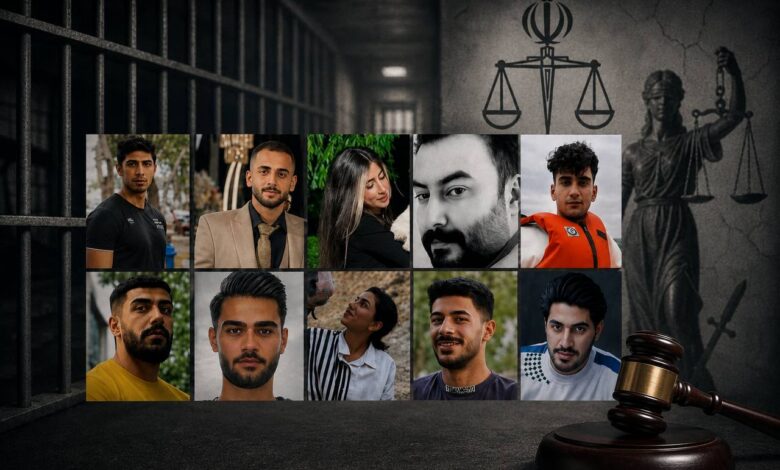
The First Branch of the Isfahan Revolutionary Court has issued death sentences for 10 detainees from the January 2026 protests and handed down a total of 256 years in prison for 16 defendants in the case; a ruling that, alongside reports of restricted access to lawyers, torture allegations, and warnings from the United Nations and human rights bodies, once again raises the question of whether the Islamic Republic’s judicial apparatus has become an instrument of suppression and silencing of protests.
The First Branch of the Isfahan Revolutionary Court has issued death sentences for 10 defendants in the case known as the “Martyrs’ Square of Isfahan”; verdicts that, along with lengthy prison sentences for other defendants, represent one of the latest examples of the Islamic Republic’s severe judicial treatment of protesters.
According to a report released by the Hrana Human Rights Organization, “Trane Rahimi,” “Navid Eliasi,” “Abolfazl Dadgostar,” “Mahdi Mansouri,” “Ahmadrezā Saeedi,” “Mehrdad Bueri,” “Mohammad Mahdi Asadi,” “Armin Ghollami,” “Parsa Jafari,” and “Mahdi Jafari,” known as “Mahdi Khosravi,” have each been sentenced to death and 11 years in prison.
Six other defendants, named “Romina Rahimi” and “Milad Bueri,” have each been sentenced to 36 years, “Hamed Mehr Alian” to 26 years, and “Setayesh Saeedi,” “Sajad Abedi,” and “Ali Bueri,” have each been sentenced to 16 years in prison. In total, 16 defendants in this case have been sentenced to 256 years in prison. These sentences are preliminary rulings and subject to appeal.
The charges brought against the defendants include “enmity against God,” “destruction of public property,” “gathering and conspiracy,” and “propaganda activities against the system.”
However, the primary concern of human rights organizations is not limited to the severity of the sentences. The proceedings of this case are also facing serious questions about the observance of the right to defense and fair trial.
According to human rights reports, the defendants’ lawyers did not have adequate access to the case contents and were not given sufficient opportunity to study documents and prepare their defense. One human rights source previously described the proceedings of the case as unfair and warned of the risk of issuing and carrying out death sentences.
Ahmadrezā Saeedi also alleged during the trial that he was tortured during interrogation, with the interrogator using an electric shocker to cause injury to his neck and genitals. This allegation has been reported by human rights sources and requires independent and transparent judicial investigation.
Meanwhile, the death of two people during the events at Martyrs’ Square of Isfahan has also been mentioned in narratives related to this case; a member of the Islamic Revolutionary Guards Corps and a homeless citizen. However, according to information released about the case, no specific murder charge has been brought against these 16 individuals.
Regarding the homeless citizen, it has been reported that images in the case file show Trane Rahimi attempting to prevent him from being beaten; an issue that, if accurate, is inconsistent with a simple narrative that could hold a protester responsible for the man’s death. These sentences cannot be examined separately from the broader wave of executions and convictions of protesters in Iran.
In recent months, the Islamic Republic has also moved to carry out death sentences against protesters. The United Nations Independent Fact-Finding Mission called on Islamic Republic officials in July to halt executions of protesters and warned of executions related to the protests. This body also condemned the execution of death sentences issued for two protesters in Isfahan.
Amnesty International also warned in response to the increase in executions and death sentences in Iran that Islamic Republic officials are using capital punishment to suppress opponents.
“Hiba Morif,” Amnesty International’s Regional Director for the Middle East and North Africa, said regarding this process: “Iranian authorities have unleashed a horrific wave of executions and death sentences to punish and suppress opponents and display an image of absolute power and control.”
This statement places the importance of the Isfahan case beyond the fate of the 16 defendants. If executions and lengthy imprisonments become the government’s primary response to protests, the judicial apparatus no longer stands merely in the position of investigating crimes; it can become part of a mechanism of political intimidation.
This concern has not been raised solely by human rights organizations. “Volker Türk,” the UN High Commissioner for Human Rights, also warned in August about the increase in executions in Iran. According to a Reuters report, the United Nations stated that since March 19, at least 56 people have been executed in Iran in cases related to national security charges, with 27 of them connected to the early-year protests. Türk criticized the use of capital punishment to create fear and suppress opponents.
For the Islamic Republic, issuing such sentences may be an attempt to increase the cost of protest and create fear in society; a message telling citizens that opposition to the government can be answered with lengthy imprisonment or even death. However, suppression does not necessarily eliminate discontent.
In recent months, the execution of death sentences against protesters has been unable to end domestic and international concerns about the state of human rights in Iran. Conversely, the execution of protesters has brought a new wave of international condemnations. The European Union and 26 other countries also condemned in a joint statement in August the execution of protesters in Iran and called for an immediate halt to the use of capital punishment and the release of arbitrarily detained individuals.
Therefore, the “Martyrs’ Square of Isfahan” case is not merely about several court rulings, but about a pattern in which social protest becomes a security issue, a protester is transformed into a security suspect, and ultimately the gallows become a tool for responding to dissenting voices.
A government that resorts to execution and suppression to maintain power may be able to silence the streets for a time; but imposed silence is not consent.
The death sentences issued for these 10 individuals are still reversible as long as they have not been carried out. It is now the responsibility of the Islamic Republic’s judicial apparatus to, instead of proceeding toward the execution of these sentences, make the trial proceedings transparent, independently investigate torture allegations, guarantee effective access to legal counsel, and prevent the transformation of capital punishment into a tool for silencing protests.