Islamic Republic’s Approach to Eliminating Opponents Abroad Has Become More Aggressive
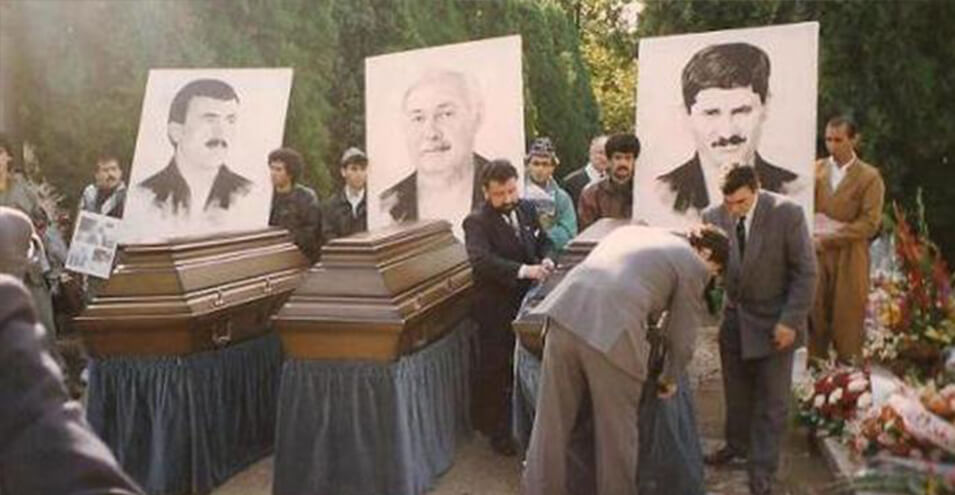
The head of the Iranian Political Refugees Center in Berlin, referring to the anniversary of the Mykonos assassination, warned of repeated murders of Islamic Republic opponents in Europe. He says Tehran officials have reduced the policy of “caution” in Europe.
Twenty-seven years after the Mykonos assassination and the Islamic Republic of Iran’s conviction by a German court, Hamid Nozdari, head of the Iranian Political Refugees Center in Berlin, says the Islamic Republic has adopted a “more aggressive” approach to eliminating its opponents abroad compared to previous years.
Many experts believed that the Mykonos incident and the conviction of Iranian officials would end opposition elimination operations. On September 17, 1992, 27 years ago, Sadegh Sharafkandi, successor to Qassemlou in leading the Democratic Party of Kurdistan of Iran, along with three of his companions, were assassinated in the Mykonos restaurant in Berlin. The Mykonos court accused “senior officials” of the Islamic Republic of involvement in the murder of opponents abroad, and Iran was convicted for the first time for state terrorism by the Mykonos court.
Nozdari believes that the arrest of some Islamic Republic officials and agents in Austria and several Western European cities in recent years shows that “the policy of eliminating opponents” by the Islamic Republic continues.
He refers to the arrest of the third secretary of the Iranian embassy in Austria, who last year (2018) was pursued on suspicion of participation and involvement in a bombing plot at the Mujahedin-e Khalq gathering in Paris, and was eventually arrested.
Nozdari says that at the fortieth anniversary of the Islamic Republic’s rule in Iran, the regime’s policies regarding cross-border issues have changed, and terrorist operations and elimination of opponents abroad continue to occur.
The End of the “Caution” Policy
After the Islamic Republic’s conviction in the Mykonos court, political observers believed that Iranian officials would limit or halt the scope of their cross-border operations on European soil; a notion that Nozdari believes was initially assumed but whose reality has been “faded” by the Islamic Republic of Iran’s activities in Western European territory over the past two or three years.
Nozdari, referring to the fact that the Mykonos assassination has taken other forms and Iran’s intelligence activities abroad, particularly in Western Europe, have increased in recent years, says: “After the Mykonos case, it was thought that the Islamic Republic would have less activity and act more cautiously on European soil, but with the arrest of the third secretary of the Iranian embassy in Austria for bombing at the opposition gathering in Paris, we realized this perception was far from reality.”
He evaluates the activities and “movements” of the Islamic Republic in Denmark, the Netherlands, Belgium, and France as indicators of the expansion of the Islamic Republic’s intelligence and operational activities abroad, and believes these activities have increased compared to the past.
Nozdari adds that the Islamic Republic “at least for a period” acted “very cautiously” regarding intelligence and operational activities on Western European soil.
It appears that the reason for this caution was the consequences of the Mykonos assassination and the Islamic Republic’s conviction, which darkened relations between European countries and Iran. Following the issuance of the Mykonos court verdict, European governments in a coordinated move recalled their ambassadors from Tehran until shortly after when Mohammad Khatami became President of Iran and relations with Tehran gradually improved.
“A Stray Bullet in Africa”!
Nozdari refers to the Islamic Republic’s “temporary retreat” from cross-border operations and elimination of opponents in Europe but says that simultaneously with this temporary retreat, Islamic Republic officials acknowledge that they have conducted cross-border operations in neighboring countries and against their regional opponents: “The Islamic Republic confirms such actions as bombing Kurdish positions in Iraq and attacking the Mujahedin-e Khalq. Even Mahmoud Alavi, the Islamic Republic’s intelligence minister, said that a person in Africa was hit by a stray bullet from the soldiers of Imam Zaman. All of this shows that the physical elimination of opponents beyond borders has continued.”
Source: DW