Nasrin Sotoudeh Protests ‘Cruel Conditions’ in Iranian Prisons with Hunger Strike
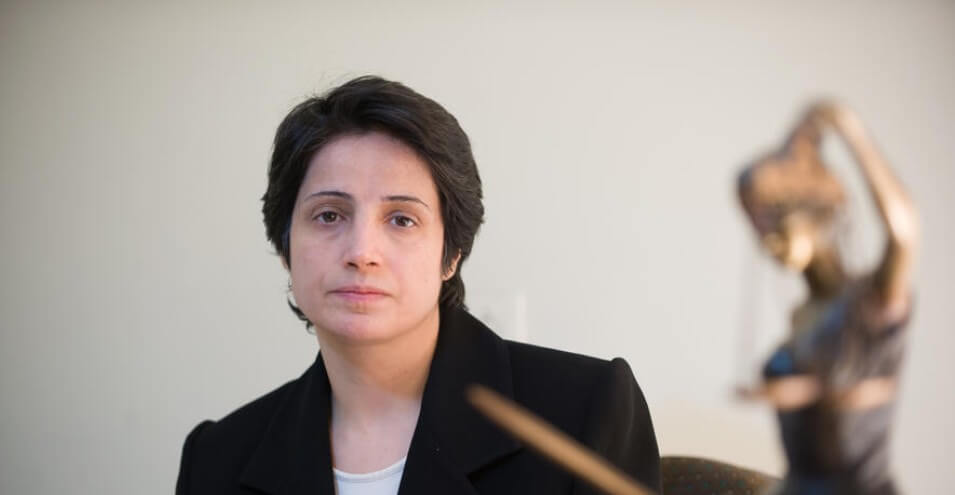
Nasrin Sotoudeh, an imprisoned lawyer and civil activist, went on a hunger strike at Evin Prison in protest against the failure to release political prisoners amid the coronavirus pandemic crisis and the “cruel conditions” in Islamic Republic prisons, after releasing a letter.
Reza Khandan, a human rights activist and husband of Nasrin Sotoudeh, said on Tuesday, August 12, in an interview with Voice of America that Ms. Sotoudeh had conducted correspondence over recent weeks and months with prison officials, the prison organization, and judicial authorities regarding prisoners’ rights, living conditions inside prisons, in-person visits, prison furloughs, and the issuance of lengthy sentences for political prisoners. He stated that today, in protest against receiving no response to all her correspondence and the failure to release political prisoners, she began a hunger strike in prison.
Mr. Khandan told Voice of America, referring to Ms. Sotoudeh’s demands of judicial officials, that this imprisoned civil activist has not announced a specific timeline for ending her hunger strike, but she may end her protest if all her stated demands are met, or even if only some of them are fulfilled.
In a letter, a copy of which was sent by Mr. Khandan to Voice of America, Ms. Nasrin Sotoudeh announced to human rights activists that, “In the midst of the coronavirus crisis that has engulfed Iran and the world, the conditions of political prisoners have become so harsh and difficult that continuing imprisonment under these cruel conditions has become impossible.”
According to this imprisoned lawyer and civil activist, “Many prisoners are now eligible for conditional release and many of them will be released with the application of the new law, but prisoners are treated as if no law exists and none of them have the right to benefit from any legal recourse. Prisoners’ correspondence seeking legal remedies has gone unanswered.”
Reza Khandan, a human rights activist, referring to Nasrin Sotoudeh’s letter and the demands of this imprisoned lawyer and civil activist, told Voice of America: “Currently, there is great pressure on political prisoners in prison. They have prevented conditional release for prisoners who meet the criteria for various reasons, created telephone restrictions, and even the sentences issued for political prisoners are extremely cruel.”
Mr. Khandan stated: “My wife and many men and women who are in prisons as political prisoners, and solely because they voiced their criticisms on social networks and gave interviews to various networks expressing their criticisms—is their crime greater than someone whom the judiciary claims spied for Mossad, that they received sentences of more than 10 years? The issuance of such sentences narrows the space for prisoners and forces them to use available means of protest, including hunger strikes, to make their voices heard.”
This human rights activist also referred to the blocking of Nasrin Sotoudeh’s bank accounts in recent months by order of the Tehran prosecutor without prior notice, saying: “This order was issued and executed while we repeatedly contacted different judicial institutions and inquired about the reason for blocking Ms. Sotoudeh’s accounts. But the question is: how does the prosecutor enter the private sphere of individuals and authorize himself to unjustly block the personal accounts of those he has convicted with a judicial order?”
Mr. Khandan expressed concern that “this order may be executed for many individuals, and this same restriction and confiscation of bank accounts may extend to the property and assets of activists and they may be seized, which is a serious danger for all prisoners, civil activists, and human rights activists in Iran.”
This is not the first time that Nasrin Sotoudeh, a prominent lawyer and women’s rights activist serving her sentence in Evin Prison, has gone on a hunger strike. She was previously among political prisoners who announced on Monday, March 16, through the release of a statement, in response to the prevention of political prisoners’ release amid the outbreak and spread of the coronavirus in Iranian prisons, that she would go on a hunger strike.
Ms. Sotoudeh, who has been in detention since June 13, was sentenced by Branch 28 of the Islamic Revolution Court on charges of “gathering and conspiracy against national security,” “propaganda activities against the system,” “effective membership in an illegal and anti-security group, the Center for Defenders of Human Rights, Legam (Stop Executions), and the National Peace Council,” “inciting people to corruption and indecency and providing the means for it and appearing without proper Islamic hijab at the branch interrogation office,” “disrupting public order and tranquility,” and “spreading lies with intent to disturb public opinion” to a total of 38 years in prison and 148 lashes, of which 12 years of this sentence will be executed according to Islamic Penal Code.
U.S. Secretary of State Mike Pompeo recently said in a press conference: “We have asked not only Syria, but the Islamic Republic of Iran to release not only American citizens, but all those who have been unjustly imprisoned during these conditions. This is a humanitarian measure, and beyond the fact that these individuals have been illegally imprisoned, in these circumstances humanitarian principles dictate that they be released from prison.”