Pope Leo XIV Meets with Archbishop of Tehran Following His Departure from Iran
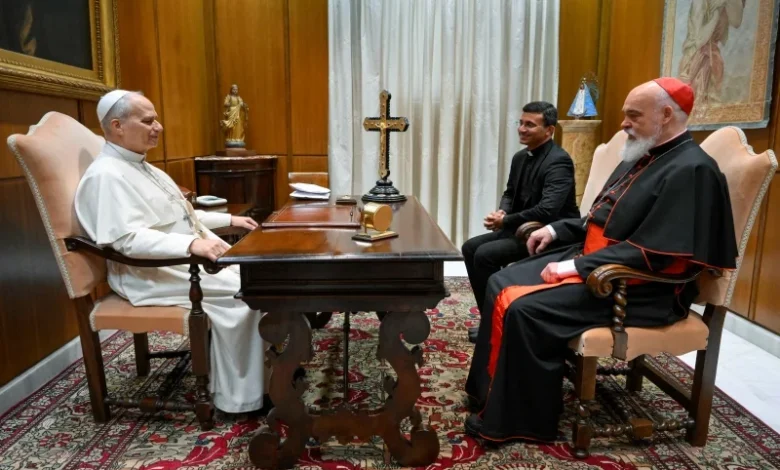
Pope Leo XIV, in a conversation with Cardinal Dominic Mathieu, Archbishop of Tehran-Isfahan, who left Iran following the escalation of regional tensions, emphasized the necessity of peace in the Middle East.
As military tensions in the Middle East have increased to an unprecedented degree, Pope Leo XIV met on Wednesday, March 11, at the Vatican with Cardinal Dominic Mathieu, the Catholic Archbishop of Tehran-Isfahan, and stressed the need to end violence and pursue peace in the region. This meeting took place after the Belgian archbishop left Tehran and returned to Rome following the escalation of the security crisis in Iran.
Pope Leo, in his remarks on Sunday, addressed the faithful saying: “Dear brothers and sisters, let us continue to pray for peace in Iran and throughout the Middle East, especially for the many innocent civilian victims, including many innocent children.”
These remarks were made as recent military confrontations have raised widespread concerns about the expansion of war in the Middle East.
Cardinal Dominic Mathieu, who heads the Latin Catholic Church in Iran, arrived in Rome on March 8. His departure was part of a complete evacuation operation of the Italian Embassy in Tehran, which also houses the seat of the Catholic Diocese of Tehran-Isfahan.
In fact, the Catholic Cathedral “Consulata,” the residence of the archbishop and administrative offices of the diocese, are all located within the grounds of the Italian Embassy. For this reason, with the temporary closure of the embassy and the transfer of diplomatic staff, the activities of the Latin Catholic Church in Tehran were effectively suspended.
Italy’s Foreign Minister previously announced that due to security conditions, the country’s embassy in Tehran was temporarily closed and approximately 50 Italian citizens were transferred to the Republic of Azerbaijan, although Rome emphasized that it would maintain its diplomatic channels with Tehran.
Following the onset of joint military attacks by the United States and Israel against Iran on February 28, communications within Iran were severely restricted, and for several days the fate of Cardinal Mathieu remained unknown. This issue created concerns among church circles and Christians in the region.
It was eventually confirmed that he left the country with Italian Embassy staff and, after being transferred to Azerbaijan, made his way to Rome. This evacuation operation took place as regional military confrontations were rapidly expanding.
Upon arriving in Rome, Cardinal Mathieu sent a brief message addressed to Christians in Iran: “I arrived in Rome yesterday, but this journey was not without feelings of regret and sorrow for our brothers and sisters in Iran.” He added: “While you await my return, pray for the transformation of hearts toward inner peace.”
The Catholic Church in Iran is one of the smallest and least heard Christian communities in the world. According to church statistics, the Catholic population in the country is only a few thousand, with the Latin rite comprising approximately 1,300 believers.
In recent years, Cardinal Mathieu has been responsible for leading this small community, a community whose activities have been primarily focused on spiritual presence, pastoral care, and maintaining contact with the universal Church.
He was appointed Archbishop of Tehran-Isfahan in 2021 and was elevated to the rank of cardinal by Pope Francis in 2024; a move that many analysts viewed as a sign of the Vatican’s attention to small Christian communities in sensitive regions of the world.
Cardinal Mathieu had previously warned repeatedly about the escalation of tensions in the Middle East. In an interview last year, he expressed concerns about the spread of the view that peace should be pursued through military force.
He had said: “Hearing the idea that peace can be achieved through force is disturbing; a place where violence becomes the only means of addressing conflicts.”
According to him, the increase of nationalist sentiments in the region has caused countries to move toward strengthening armaments and creating more barriers; a process that increases the risk of wider confrontations.
In recent weeks, Pope Leo XIV has repeatedly warned about the humanitarian consequences of war in the Middle East and has called on all parties to replace dialogue with military confrontation.
In one of his recent messages, he said that continued violence could drive the region toward greater instability and called on the international community to pray for an end to the war.
The Pope’s meeting with Cardinal Mathieu is also viewed within this framework; a meeting that, in addition to its pastoral dimension, provided an opportunity to receive a direct report on the situation of Christians and the people of Iran in the midst of recent crises.