“Prince Pahlavi” Considers “Hyrcanian” Fires a Symbol of Government Indifference
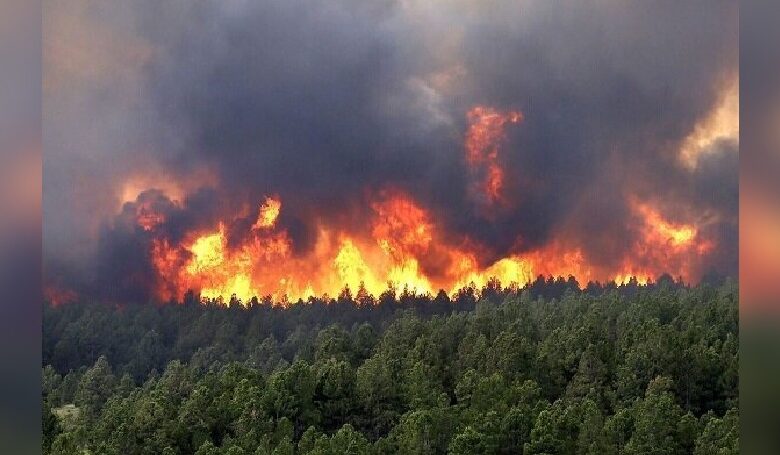
“Prince Reza Pahlavi,” referring to the “Hyrcanian” fires, blamed the Islamic Republic for this situation and declared that Iran has no importance to the government as it is burning its thousands-year-old heritage.
Widespread fires in the “Hyrcanian” forests, one of the world’s oldest biological reserves, have once again exposed the crisis-ridden structure of environmental management in Iran. While these forests are considered part of the country’s natural and historical identity, the way the Islamic Republic has handled them is not only insufficient, but according to many experts, “inattentive, belated, and politicized.”
In these circumstances, the explicit reaction of Prince Reza Pahlavi has received widespread resonance and has sparked a broader discussion about the government’s devaluation of Iran’s heritage.
He issued a statement, noting that “this regime does not value Iran’s heritage,” and warned: “The Islamic Republic is indifferent to the fire that has engulfed the Hyrcanian forests; because for this anti-Iranian regime, the destruction of Iran’s thousands-year-old natural heritage is of no importance.”
The Prince then compared the burning of ancient forests to the destruction of generations and wrote: “The Iranian nation will end this path of destruction, and with the end of this tyranny, the country’s environment will also be saved.”
Reza Pahlavi also mentioned the environmental program “Iran Flourishing Project” and emphasized that “a comprehensive and practical program for the restoration of Iran’s environment” has been developed by the most prominent specialists.
The question is: why is Hyrcania so important? The Hyrcanian forests are 20 to 25 million years old and are considered remnants of the Tertiary Period in geology. In addition, they are home to thousands of plant and animal species, including Iran’s endemic species, which in recent years have been inscribed on UNESCO’s World Heritage List.
These forests are not just a “green area,” but one of the world’s oldest biological heritages. Fire in such a place is similar to destroying a tens-of-millions-of-years-old natural museum.
Now many believe this crisis is structural. But why? Iran has for years reduced funding for the protection of natural resources, firefighting budgets, helicopter modernization, forest equipment, trained personnel, and rapid warning systems due to insufficient budgets. However, at the same time, the budgets of propaganda and security institutions have increased several times over.
Government’s Delayed Response: Despite the fires beginning on November 11th, authorities “officially” announced the incident on November 24th, a delay that contributed to the spread of the fire. The inability to use air forces is another problem that experts have warned about for years—Iran lacks a standard firefighting fleet and is forced to request foreign assistance every year.
Institutional conflicts and fragmented management are also other structural factors in this crisis, as different organizations (natural resources, environment, crisis management, IRGC, governorates) lack a unified structure, and their cooperation is slow and often tense.
Politicization instead of scientific management is also a large part of environmental management, which is under the influence of security decision-makers rather than specialists.
This crisis and similar ones carry environmental consequences ranging from soil erosion to the loss of biodiversity, and the widespread fires in Hyrcania will also have these consequences:
- Destruction of irreplaceable genetic reserves
- Increased soil erosion and destructive floods
- Reduction in the forest’s ability to produce oxygen and absorb carbon
- Threat to the livelihoods of local communities
- Acceleration of the destruction process of northern forests, which have now decreased from 3.6 million hectares to less than 1.6 million
Experts have warned that some burned areas will not be able to recover for up to 40 years.
This catastrophe is not just a fire, but has become a symbol of Iran’s lack of priority in the eyes of the Islamic Republic. When the budget for forest protection decreases, but the budgets for proxy and security groups increase, and even requests for help from Turkey are made after “much delay,” it is natural for citizens to feel that the government sees Iran not as a “home” but only as a “base.” This is why Prince Pahlavi’s words received such widespread resonance.
Prince Pahlavi, referring to the role of the Iran Flourishing Project in the future of the environment, claimed that:
- A program has been designed for the complete restoration of forests, water resources, soil, wetlands, and endangered species.
- The best Iranian specialists inside and outside the country are participating in this project.
- Scientific monitoring and reconstruction models such as GIS, ecosystem engineering, and sustainable resource management have been incorporated into it.
Given the severe destruction of natural resources, if such a project is implemented, it could be a turning point in Iran’s history, but its implementation is only possible when environmental management becomes science-based, transparent, and accountable.
In the end, the main question is: “How many other parts of Iran’s heritage must burn before officials realize the importance of this land?”