Verbal Attack by Matteo Salvini, Italy’s Deputy Prime Minister, on Migrants
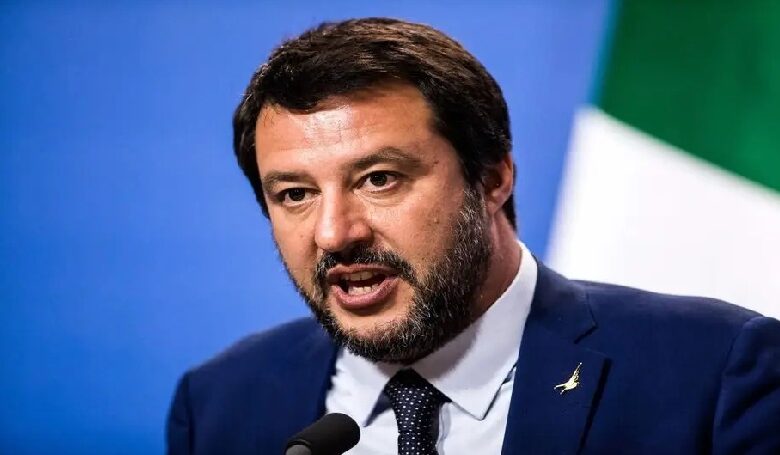
At an electoral rally in the city of “Bari,” Matteo Salvini, Prime Minister of Italy, made verbal attacks on migrants in his remarks.
Salvini’s remarks about migrants, particularly Muslim migrants, have intensified political tensions and reactions to Italy’s immigration policies.
Matteo Salvini, leader of the right-wing “Lega” party and Deputy Prime Minister of Italy, addressed migrants at an electoral rally in Bari, saying about those who, according to him, “do not respect Italy”: “Let them get their graves out of here.” While criticizing the widespread entry of migrants, particularly Muslims, into the country, he added: “We expect those who come to our cities to respect our culture, symbols, religion, and constitution.”
In these remarks, Salvini emphasized that those who are not willing to behave “in a Christian and authentic” manner should “get their graves out of here and return to where they came from.” Salvini’s positions can be seen within the framework of Italy’s strict immigration policies that have centered on “border control,” “deportation of illegal migrants,” and “support for national identity.”
However, field studies show that Italian public opinion on this matter is diverse. A comprehensive survey has shown that a significant percentage of citizens still believe in the principle of “accepting migrants” and a purely strict position does not represent the entire society.
From the perspective of civil society and churches, reactions have also been varied, with some Catholic publications severely criticizing Salvini’s policies. For example, the Catholic weekly “Famiglia Cristiana” had compared him to the devil in its headline.
Local churches in Italy, as well as Catholic publications, while emphasizing Christian teachings on “compassion for the stranger,” have opposed Salvini’s anti-immigration positions. For instance, a priest in Umbria had said in a speech: “There is a demonic force of racism, and Salvini has fueled this force.”
From a Christian perspective, expressions such as “let them get their graves out of here” are not only evaluated as xenophobic, but also contradict the concept of “the savior’s suffering for suffering humanity.” This contradiction between political rhetoric and Christian values has sparked debates about “Christian identity” and “acceptance of others” in Western society.
In this regard, it is important to note that Salvini, in his remarks, has linked the entry of migrants to the danger of disrupting the social, cultural, and economic fabric of the country; that is, he has raised a combination of cultural, economic, and identity concerns.
From the perspective of international law and European regulations, similar statements can be considered “degradation of migrants” or “incitement against minorities” and provide grounds for international criticism. For example, European institutions have warned that Italy has engaged in “racial profiling” in some cases.
Cases are also underway in Italian courts that address the strict policies of the Italian government in dealing with migrants; for example, a ruling by this country’s supreme court ordered the government to compensate migrants who were detained on a ship for ten days.
This reality shows that immigration policies involve not only the domestic arena but also the legal and international spheres, and can have special meaning for Christian audiences who attach importance to justice, acceptance of migrants, and civil liberties.
Christianity, which has placed values such as love of neighbor, hospitality, compassion for the vulnerable, and acceptance of “the other” at its center, comes into conflict with positions that view migrants as “foreigners” or “intruders.”
Salvini’s remarks fall precisely at the intersection of identity-oriented politics, economic concerns, religion, and culture; this combination can be a turning point for churches, religious institutions, and Christian charitable organizations working with migrants to reconsider: “How can both the country’s security and the human dignity of migrants be ensured?”, “What role do the church and Christian institutions have in amplifying the voices of migrants and encouraging dialogue?”, “How can identity-based biases that may lead to the negation of the other be prevented?”
This event is an opportunity for Christian organizations not only to cover the politics, but to highlight its deeper meaning from the perspective of Christian ethics and human rights.