Why Today’s Protests in Iran Are Accompanied by Profanity
The research and writing of this article is solely for the purpose of examining the social factors of today’s Iranian society, and its publication does not constitute approval of its practice.
From the type of profanity used in any language during protests, one can discern what the people of a country or region want.
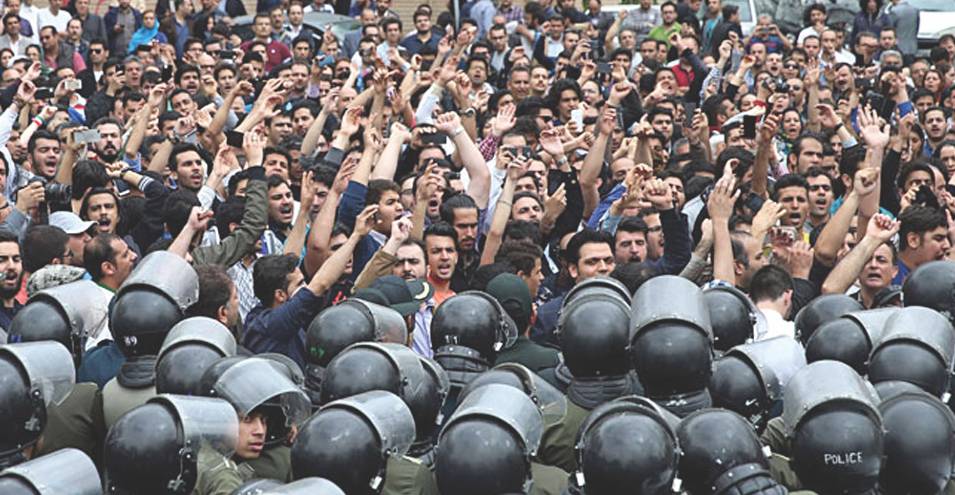
In Iran’s current protests, in addition to slogans directed against the Islamic regime, crude and harsh language can be heard from various segments of society that carry messages for the leaders of the Islamic regime.
For more than forty-three years, the Iranian people have been under the oppression, despotism, and coercion of government rule, and this resort to profanity as a tool has angered suppression forces.
Many sociologists and psychologists believe that profanity in protests stems from the anger of the protesters; because when a protester lacks a means to express this anger, profanity becomes the most effective tool.
Unfortunately, the Velayat-e Faqih regime in Iran has blocked all paths of dialogue and means of expression for its opponents, and the atmosphere of oppression in Iran does not allow people to make their voices heard.
A society that has been suppressed and ignored for more than four decades now hurls the crudest profanities at the leader of the Islamic regime and his accomplices in its slogans.
This story began in Tehran and Sharif University, a university that has gained its reputation through winning medals in mathematics and physics olympiads.
However, before Sharif University, Iran’s protests against the Islamic Republic regime were accompanied by harsh profanities. Then came the time when Sharif University students, by creating the crudest slogans against Iran’s Islamic leader, brought their hashtag on Twitter close to one million people.
On Sunday evening, the 10th of Mehr, regime security forces dealt savagely with Sharif University students, rooted in the harsh and crude slogans that students had directed at the country’s supreme leader. This type of harsh slogan-chanting against Iran’s Islamic leader greatly angered regime supporters at the university.
The truth is that this type of conduct also has opponents. Opponents who have overlooked the essence of the protests and, in a sense, approach this matter from a morally and culturally comfort-seeking perspective.
Some sociologists and social experts say in this regard: In many cases, people tend to resort to moral and linguistic considerations that are morally and culturally incorrect.
However, when we examine the root of profanity in the form of a political matter, we must see whether this type of crude and harsh slogans benefits the protester’s political objective, or brings harm and damage to them.
This type of crude and harsh political slogans can bring benefits to the protesters, including when targeting Iran’s leader. Because it severely diminishes the symbolic dignity of the leader and his circle, and in this way destroys the straw structure of sanctification that they have tried to elevate to higher levels over these years, the rebuilding of which is impossible.
Imagine a situation where a security force or basiji who played a role in suppressing people is subjected to criticism or advice by their own family to stop their cooperation with the regime in suppressing protesters. This can be an instance of an attempt to erode social support for suppressors among their own families. If we look at the matter from this angle and consider more instances, it can help us understand that the ultimate harm of this method (especially if it continues and spreads) brings more damage than benefits for the protesters to reach their goals, affecting matters beyond just the regime leaders.
Regarding today’s Iranian society, it must be said: Protesters curse at Iran’s rulers because their lives are on the line and they can no longer tolerate this situation. They cannot live in society the way they want, and with the continuation of the regime’s rule, they see no ordinary future for themselves, nor can they escape this situation. In response, they hear all kinds of disrespect, humiliation, irrational profanities, and the most illogical arguments about the world, life, and youth from national and official media.
If you lived in such an unsuitable, hopeless, and fractured society where you had no right to protest or speak, would you remain silent and speak in conventional language? The result of living in such a place can be a linguistic explosion that we call profanity. Profanity is actually a type of severe internal and emotional discharge expressed through speech and the use of words.
The words of profanity are the same internal explosion and emotion being discharged, stemming from the person’s intense anger. The more severe this anger, the harsher and more intense the profanity becomes.
One of the harshest types of profanity in our Iranian culture is honor-based profanity. Honor-based profanity can deliver the greatest blow to the other person; because it can strike the other party with greater effect and with a specific target.
Honor-based profanity in our culture, which is considered a patriarchal culture, is a destructive element. On the other hand, honor-based profanity usually contains quick allusions to sexual organs and the sexual act itself.
In patriarchal culture in the Middle East, the perpetrator of a sexual act is considered superior and a possessor, and the object of the sexual act is considered vanquished and possessed. So when this sexual relationship is performed by force, it means that the object is brought to shame and humiliation.
The conclusion of this discussion is that sexual and honor-based profanity is actually an attempt to humiliate and dishonor the other party, with the view that they were the object.
When a person or persons do not possess superior tools, they resort to honor-based profanity and use this type of symbolic tool to show their anger and protest.
Therefore, it is obvious that today’s protesting people, necessarily resort to this culturally undesirable linguistic tool to express their anger and dissatisfaction with the dictatorial regime.
For when the enemy imposes force upon people, not from the heart, curses and insults flow from the tongue.