Workers' rallies and protests continue despite Hassan Rouhani's advice
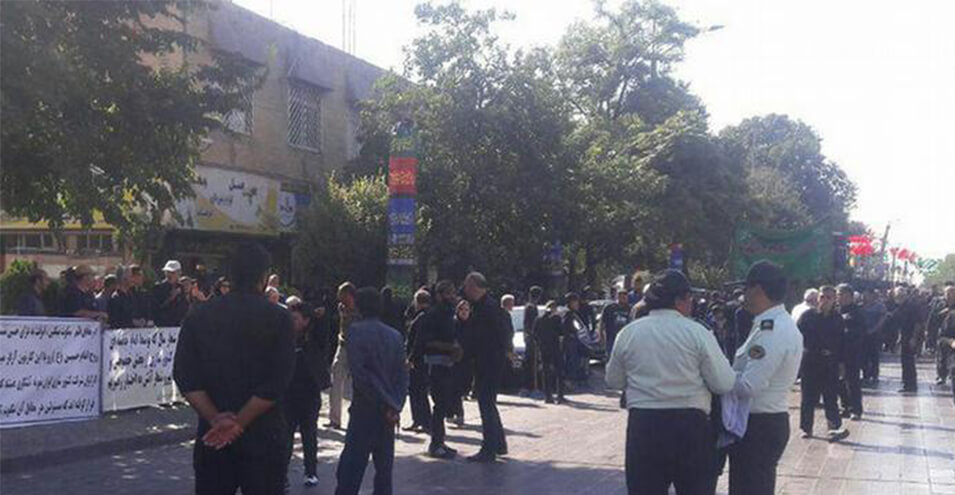
Qazvin meter workers gathered in front of the city's Friday prayer leader's office. But Hassan Rouhani advised the workers to solve their problems through elections. Labor activists also said they no longer have hope that government institutions will solve their problems.
On Thursday, September 12, ILNA news agency reported that Qazvin meter workers gathered in front of the office of the Friday prayer leader of the city. These workers protested for the umpteenth time in the past few weeks and called on provincial authorities to think about the meter construction situation.
The workers' representatives stated that since 2017, each worker has owed nearly 10 million tomans, and the judiciary has issued a ruling to pay these claims. The workers' representatives also said: "This year, after four months of working without pay, they locked and chained the company door and said we don't have raw materials!"
Rouhani: Workers should achieve their demands through elections
The workers' protest continues despite maximum pressure on them, including the issuance of heavy prison sentences against their representatives.
Iranian President Hassan Rouhani, many labor and civil society activists believe, has remained silent on the demands of workers and the heavy sentences handed down by the Revolutionary Court against their representatives. On Wednesday, September 10, Rouhani said, “Workers and women can achieve whatever problems they have through elections,” without referring to the workers’ protests or the heavy prison sentences handed down to their representatives.
Rouhani added that the main way to achieve the rights of workers and women is through elections. He emphasized that workers and women have no other way to achieve their rights and demands than through elections.
The Iranian president has advised that there is nothing wrong with criticizing and speaking out, but the main way to win and achieve more rights is through elections.
A member of the Free Union of Iranian Workers told Deutsche Welle about Hassan Rouhani's advice: "Workers have no hope in the authorities to solve their problems, and Rouhani, fearing labor protests on the eve of the elections, has advised workers not to take to the streets. This is because the last months of the year are months of labor crisis, and in most sectors, protests become more intense due to their accumulated demands and the approaching end of the year. Rouhani, fearing that these protests will not be contained during the elections, has given moral advice, otherwise he himself knows that no worker has any hope in his and his gang's solutions."
Zibakalaam: Rouhani must break the silence
Sadegh Zibakalam, a faculty member at the University of Tehran and a reformist political activist in Iran, has also written an open letter asking Rouhani to "break the silence."
In an interview with Deutsche Welle, Zibakalam also referred to Rouhani's remarks regarding "achieving demands through elections," and said: "Unfortunately, Mr. Rouhani has practically lost his social base. In other words, Mr. Rouhani no longer has the 24 million votes he got 25 months ago, and if elections were held tomorrow, I don't think even 2.4 million people would vote for him. Those 24 million votes were the reputation and credibility of the reformists. Workers and women no longer listen to Rouhani. Therefore, what he is saying is a joke that he wants workers to come to the polls and vote. Rouhani has practically lost his political and social credibility."
Continuing his talk about why the workers of Qazvin “clung to the lap of the Friday Imam” of this city, Sadegh Zibakalam explained: “Perhaps there is some concern that if they spontaneously and independently come to gather, protest, and march, the heavy sentences given to the Haft Tappeh sugarcane workers may be issued against them as well. So in a way, the workers are saying that we rely on God first and then on you. You should support us so that we don’t end up in detention, conviction, and revolutionary courts. The workers want to say that we support the appointed part of the system anyway, and all our hatred and grudge is against the elected part, the clergy, and the executive authorities, and perhaps in this way they want to vaccinate themselves against the actions that the judicial and security organizations want to take against them.”
Source: DW