According to the Deputy Interior Minister, the resilience of the Iranian people has decreased in recent years and the desire for fundamental changes is increasing. He says that the people's distrust in the effectiveness of the religious government in dealing with existing challenges is a warning sign.
At a conference held in cooperation with Shahed University and held at the ministry, Taghi Rostamvandi, Deputy Minister of Interior and Head of the Social Affairs Organization, presented statistics on the increase in social harms in Iran and the decrease in people's resilience due to intensifying economic pressures.
According to Fars News Agency, the second national conference on confronting social harms from an Islamic perspective began on Sunday morning, January 16, with the presence of Interior Minister Ahmad Vahidi, a number of his deputies, and a number of members of parliament.
The head of the Social Affairs Organization said at the conference that research in recent years has yielded indicators, including those about the desire to migrate, that are "quite worrying."
Desire for fundamental changes, tendency towards secular government
Taghi Rostamvandi says the desire for fundamental change in Iran is increasing. He called the index of the desire to protest another worrying component.
Referring to the index of tendency toward secular government, the Deputy Minister of Interior said: "If we feel that due to inefficiencies, people's attitudes are moving in a direction that suggests that the religious government is not successful in solving the country's challenges and that perhaps another government, such as a secular and non-religious government, can solve the country's problems, then an alarm bell will ring for us."
The Islamic Republic presents itself as a religious government based on Shiite precepts, and over the past four decades, it has not only been ineffective in addressing challenges, but has also fueled problems such as corruption and poverty.
The desire for “non-normative” protest
Referring to the index of the tendency to protest, Taghi Rostamvandi said: "This protest can manifest itself in the form of norm-breaking or deviant behavior. On the other hand, in recent years, people's resilience has decreased with increasing economic and livelihood pressure."
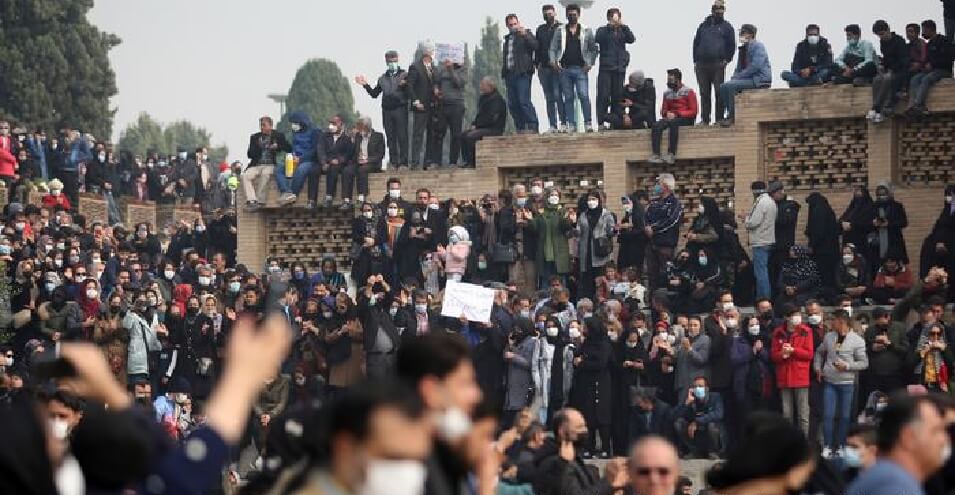
In recent years, the scope and intensity of social protests in Iran have expanded, and the time gap between them is constantly shortening. One of the characteristics of the protest movements, especially since 2017, has been their rapid anti-government orientation, which is apparently called “non-normative and deviant.”
According to the head of the Social Affairs Organization, 40 to 45 percent of citizens believe that neither the people nor the officials respect the law, and 50 percent of them believe that the level of justice and equality in society is low.
Increasing poverty and marginalization in the theocratic state
The inefficiency of Iran's theocratic government is also reflected in the sharp increase in poverty and homelessness. The Ministry of Labor announced in a report in October this year that more than a third of Iran's population lives in absolute poverty.
Farshad Momeni, head of the Institute for the Study of Religion and Economics, also said in November, citing the latest research, that in the three-year period between 2017 and 2018, the population below the poverty line in Iran had more than doubled.
Now, the head of the Social Affairs Organization has called marginalization one of the social problems and says that 11 to 13 million people in Iran live in "informal settlements" that need to be organized.
Alcohol consumption, suicide, abortion
In another part of his speech, the head of the Social Affairs Organization referred to the increase in alcohol consumption in Iran, saying that it is estimated that between 9 and 10 percent of people between the ages of 15 and 64 consume alcohol, which amounts to about five million people.
Taghi Rostamvandi also said that about 100,000 people commit suicide in Iran every year, of which between 5,000 and 5,500 lose their lives, and that this trend is "on the rise" and must be controlled.
He says that according to Ministry of Health statistics, 230,000 illegal abortions are performed in Iran every year, but some studies estimate the number to be 300,000 to 400,000 per year.
Drinking alcohol, suicide, and abortion are actions that are considered haram and prohibited in the Islamic Republic according to laws derived from Islamic law.
Source: DW