Aban International People's Court; Testimony of Khatam al-Anbiya Headquarters Employee
At the fifth and final session of the “International People’s Court of November” in London, a number of witnesses to the suppression of the nationwide protests of November 2019 testified. In several different cities, ambulances have been taking the injured to detention centers instead of hospitals.
The “International People’s Court of Aban,” which began on November 10 (November 19), ended on November 14. The task of this symbolic court was to investigate possible crimes committed by the Islamic Republic in response to the nationwide protests of 2019.
On the last day of the trial, as in previous days, eyewitnesses and relatives of victims of the nationwide protests of November 2019 expressed their observations and experiences.
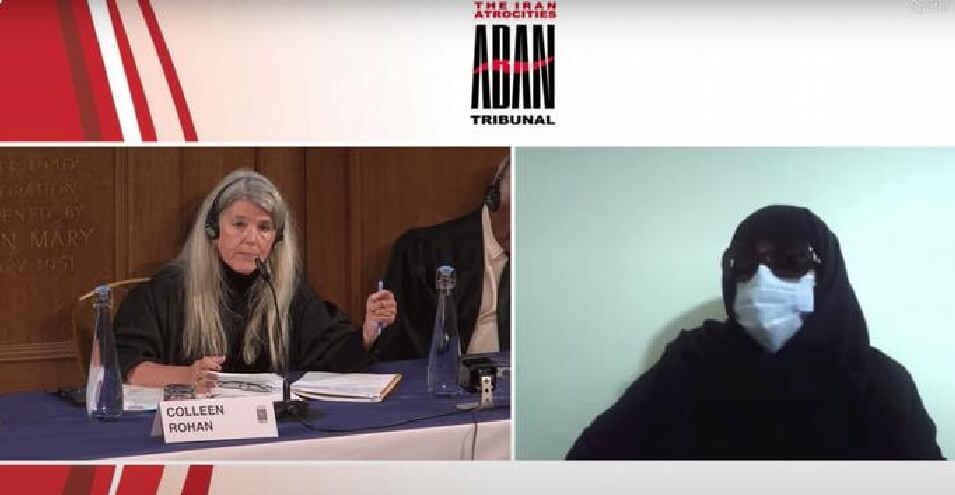
Most of them appeared in video testimonies with their heads and faces covered, while some, who live outside Iran, testified without covering their faces.
The judges had asked the witnesses to avoid giving any clues that might reveal their identities, as much as possible. For this reason, only some of them named their city or region.
Among the witnesses who appeared without a mask and with their real names and hometowns was Jamshid Ariana, who testified on behalf of his family.
One of his close relatives, Borhan Mansournia, was killed during the November protests in Kermanshah.
According to Mr. Ariana, Burhan and two other people were shot. The two were killed on the spot, Burhan was taken to Farabi Hospital, but the hospital refused to admit him. He was taken to Taleghani Hospital. At first, they did not intend to treat him there, but after two hours of bleeding, Burhan was taken to the operating room.
Ariana went on to say that Burhan's relatives witnessed the bodies of at least eight people being removed from the operating room. Burhan also did not survive.
Complaints filed by the victim's family in Iran have so far been unsuccessful, and authorities have asked them not to pursue them.
According to Jamshid Ariana, they claimed that Burhan was not killed by an “organizational bullet” but by a bullet fired by protesters. The witness emphasized that the bullet hit Burhan from behind and exited from the front, leaving no trace of the bullet on his body.
Ariana also said that authorities have asked the victim's family to say on camera that Burhan was a government supporter and was "martyred" by protesters.
Transporting the injured to the detention center by ambulance
What some witnesses said in the past few days was repeated on the last day: government agents were involved in the violence and the burning of public places.
In addition, several others who apparently witnessed protests in various cities reported that ambulances were transporting the injured to detention centers or intelligence offices instead of hospitals.
One of these witnesses, whose head and face were completely covered, saw security forces shoot a teenager to death. He said: “It was November 15 when I went out for an important task. I saw that the streets were crowded. All the streets were closed. Cars had stopped and their engines had been turned off. The protest was about why gasoline had become more expensive. There were special forces with motorbikes and cars where I was. I call God to witness that when an ATM caught fire, I told one of the special forces to call the fire department to come and put it out. They said, ‘We are not allowed to call.’ There I realized that their intention was to cause violence. People were also filming. They were chanting, ‘Death to the dictator.’ I chanted, ‘Death to Khamenei.’ Someone next to me told me, ‘Don’t politicize it.’ I said, ‘What do you mean, don’t politicize it?’ Khamenei is the cause and the originator of our misfortunes. The essence of his system is his.’”
He witnessed two people being hit by “plastic bullets with bullets inside,” “one below his eye and the other above his ear,” on November 15.
According to him, several people were injured in another clash with security forces, and an ambulance transported them to the intelligence department instead of the hospital.
“They were hitting people with motorbikes”
Another witness said: “They shot at us from a distance of two meters. Both from the front and from the top of their heads… I saw them hitting the protesters with their motorbikes.”
He is injured and leaves the scene of the demonstration: "I was limping towards home. I was wounded in the leg and bleeding. They caught me, took me to where there were other protesters. From the very first moment, they beat us, insulted us, and took us to the detention center in a car with maybe seven people in the back seat... There they also kicked us out with batons, punches, and kicks. They said there weren't even a thousand of you, we'll kill you all. There were also fourteen- and fifteen-year-old children there."
Another witness testified that no one in his city had firearms: “It was peaceful. People were chanting slogans against the high price of gasoline. There were some people among the people who encouraged the demonstrators to be violent. I identified two of them, they were active in the mobilization in our area. That is why those who burned the banks were from the government itself. I witnessed that the people did not start the violence.”
Helicopter barrage
What “shocked” this witness was an incident that occurred on November 15 in the city of Sadra, Shiraz. He said: “I wanted to go to the city of Sadra, Shiraz, to do something. When I entered, I saw a scene that looked like a war. I have experienced war myself. In the city of Sadra, the scene was a war scene. On one side were unarmed people and on the other side were military forces who were shooting directly at the people. A helicopter was flying at a maximum level of 50 meters of the ground. I was about 100 meters away from the helicopter. I thought they had come to film the demonstrators so that they would deal with them later. But they opened fire on the people from the helicopter. There were a lot of demonstrators in the Sangi neighborhood of the city of Sadra, Shiraz, and they shot at them to disperse the people.”
He continued by saying that he had approached the crowd and witnessed the scene from a distance of about 50 meters: "I saw a 15 or 16-year-old teenager, I'm not sure if it was Mohammad Dastankhah or not, being shot and falling to the ground. And so that no one could help him, they also drew a volley of bullets around that teenager. Even though I have experienced war, I have never seen such a scene. It was very upsetting."
Request for police support
Another witness who emphasized the peaceful nature of the initial demonstrations was Aram Mardukhi, who described his observations in the city of Sanandaj.
According to him, since the morning of November 15, special forces and counter-riot forces have been in control of the streets, and in some places, snipers have been stationed on tall buildings.
He said that people initially chanted "peaceful" slogans and called for police support.
Continuing his testimony, Mardukhi said: "They were putting the arrested protesters in Toyotas that had something like a cage on top. They were imprisoning people inside those cages. They had made people into human shields so that they could not damage these cars."
He also observed ambulances transporting the wounded to the detention center.
The testimony of an employee of the Khatam al-Anbiya headquarters
One of the witnesses, who testified with his head and face covered, said that he was a contract employee for one of the projects of the Khatam al-Anbiya construction site and was tasked with participating with the security forces in suppressing the protesters.
For this purpose, he is taken to the protest site in Shahriar, but he refuses to intervene in the repression, which is why he is expelled.
He also emphasized that vandalism such as setting fire to banks, cars, and shops was the "work of special forces" and "private clothing."
The witness said that the ambulances that entered the scene of the conflict belonged to the IRGC and were only transporting their own wounded and did not care about the wounded protesters.
Another witness said the arrested protesters were stripped completely naked and “sexually abused” some, especially teenagers.
MP confesses to participating in killing of protesters
Hassan Norouzi, deputy chairman of the parliament's judicial commission, said on Sunday, November 13, in response to the "International People's Court of November", "I was one of those who shot at people. We killed them. Now who wants to put us on trial? The person who set fire to the bank came, we killed him too."
An official from the Islamic Republic has previously reacted to the trial. The organizers of the trial, citing European sources, said that Ali Bagherikani, Iran's deputy foreign minister, had said that the continuation of the London People's Trial could cause a partial halt to the nuclear negotiations.
In five sessions of the Aban International People's Court, 45 witnesses and experts testified in person. In addition, 120 written testimonies were also made available to the court.
This court was formed at the initiative of three civil society organizations, "Justice for Iran", "Iranian Human Rights", and "Together Against the Death Penalty", in response to the request and advocacy of the victims' families.
The verdict of the six-member panel of judges will most likely be issued early next year.
Source: DW