The fate of the country, the theoretical framework of Tom and Jerry, and Islamic teachings • Interpretation
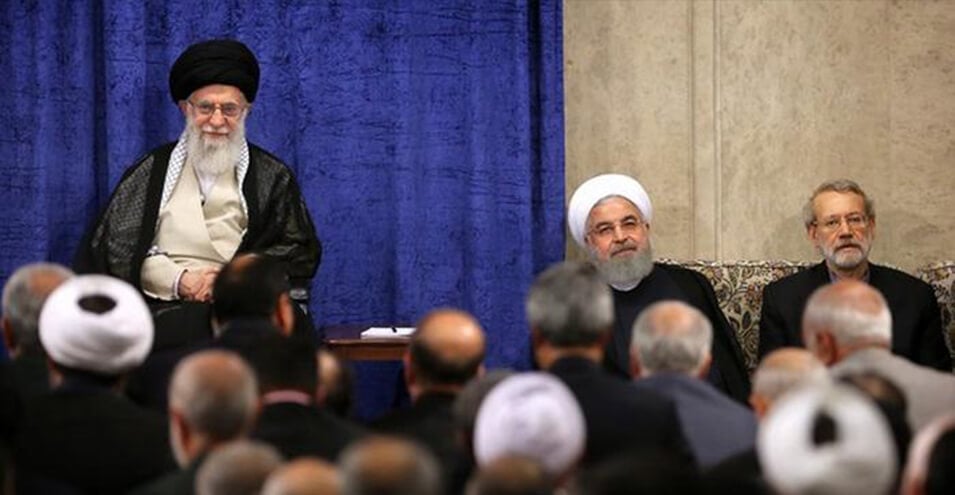
Perhaps nothing will be remembered from the Islamic Republic Leader's speech except that "America will fail again, like the famous cat from the Tom and Jerry story," and even his conditions for negotiations with Europe will be ignored in practice.
Commentary by Jamshid Barzegar, head of Deutsche Welle's Persian department
Perhaps nothing is remembered from the speech of Ali Khamenei, the leader of the Islamic Republic, and his more or less harsh but expected tone other than that "America will be defeated again, like the famous cat from the Tom and Jerry story. We have no doubt that the enemy will be defeated, and anyone who is familiar with Islamic teachings knows this."
How familiarity with Islamic teachings leads to an analysis of the Tom and Jerry cartoon and makes it possible to conclude that America, like the cat in the American cartoon, will fail in confronting the Islamic Republic, will likely be a hot topic for a long time, at least on social media and in media outside of Iran.
The Leader of the Islamic Republic uses the cartoon Tom and Jerry to help explain the issue, not in public, such as elementary school students, but in the presence of senior officials in his system. Of course, Ali Khamenei's speech in this way is not limited to current officials.
Seven years ago, during a meeting with then-President Mahmoud Ahmadinejad and members of his government, he once again based his analysis of the situation on the Tom and Jerry cartoon and said, “I need to thank this group that is working against sanctions. You should use all the right, logical, clever, and wise methods. Neutralize the sanctions. Neutralize the strategy of the powerful but actually weak enemy. When we see this seemingly huge military and economic volume of arrogance in front of us, one is reminded of the cat in the cartoon “Tom and Jerry”! He is very active, very noisy, and his size is large, but the result of his work is not as he expects or the viewers expect. That’s really how it is. It depends on your cleverness.”
The cleverness of the mice in the story, or "Jerry," and the "correct, logical, clever, and wise methods" were nothing more than circumventing sanctions, which, according to not only Mahmoud Ahmadinejad's critics, but also his former associates and supporters, paved the way for unprecedented economic corruption based on multilateral brokering for the sale of oil, purchase of goods, and transfer of money to Iran.
Apparently, only two years were enough for the Leader of the Islamic Republic to conclude that the "strong enemy" was not as "weak" as he had thought, and that the result of the sanctions was what both the story's narrator and his viewers had expected. Otherwise, after agreeing to start negotiations and eventually reaching the JCPOA, why did he repeatedly say, "The JCPOA was originally intended to lift sanctions; to lift oppressive sanctions. Could it be anything other than this?"
With such a Tom and Jerry-style analysis of the situation, it seems difficult to take seriously the opposition of the Leader of the Islamic Republic on June 2, 2018, to engaging, or more accurately, renegotiating, with the United States to reach a new agreement. By the same token, his opposition to continuing negotiations with the European Union will also be ignored in practice, and negotiators will do their best to obtain at least minimal guarantees from the European Union.
In his speech, on the anniversary of the election that was supposed to end such methods of governing the country 21 years ago, Ali Khamenei set six conditions for the Europeans.
If the Islamic Republic is to stand by these conditions, without any doubt, the negotiations with the European Union should be considered closed right now, and it is expected that European countries will stop trying to keep the JCPOA alive and, by siding with the United States and increasing pressure on Iran, will try to bring the leaders of the Islamic Republic to the negotiating table, the goal of which is no longer to preserve the JCPOA, but to sign a new agreement that can satisfy the hardliners in the White House and countries like Israel and Saudi Arabia.
European leaders have openly said that preserving the JCPOA is especially important because it can be used to persuade Iran to change its regional and missile policies through dialogue.
Opponents of the JCPOA, of course, do not think so. From their perspective, the "bad deal" of the JCPOA has in effect given the Islamic Republic the opportunity to pursue its missile programs more quickly, expand its influence in the region, and continue its strict policies in various areas at home.
For this reason, setting conditions such as the leaders of the three European countries must commit and promise that they will absolutely not raise the issue of missiles and Iran's regional presence, guaranteeing the purchase of Iranian oil in the amount needed by the Islamic Republic, guaranteeing European banks to deal with Iran, and finally threatening to resume suspended nuclear activities, makes no sense except that negotiations with Europe are effectively over.
However, neither Ali Khamenei's performance record nor the domestic, regional, and international situation of the Islamic Republic are such that, even after such explicit statements and the imposition of conditions that seem impossible for the European Union to accept in advance, they will abandon these negotiations and carry out the threat of resuming the suspended nuclear activities.
The words of the Leader of the Islamic Republic make things harder for people like Federica Mogherini and easier for people like Donald Trump. The solution to change this situation will probably be a new speech and the re-use of a term like "heroic softness."
Apparently, in the real world, the Tom and Jerry cartoon is not an effective analytical tool for making decisions, understanding problems, and finding appropriate solutions, and the fate of a country is more complex than an entertaining children's cartoon; but if we want to insist on using the allegory of cat and mouse to depict the current situation, like the leader of the Islamic Republic, is the story of cat and mouse Doesn't Obaid Zakani explain the situation better?
Source: DW