Heavy sentences issued for 23 Gonabadi dervishes: from 6 to 26 years in prison, flogging, and exile
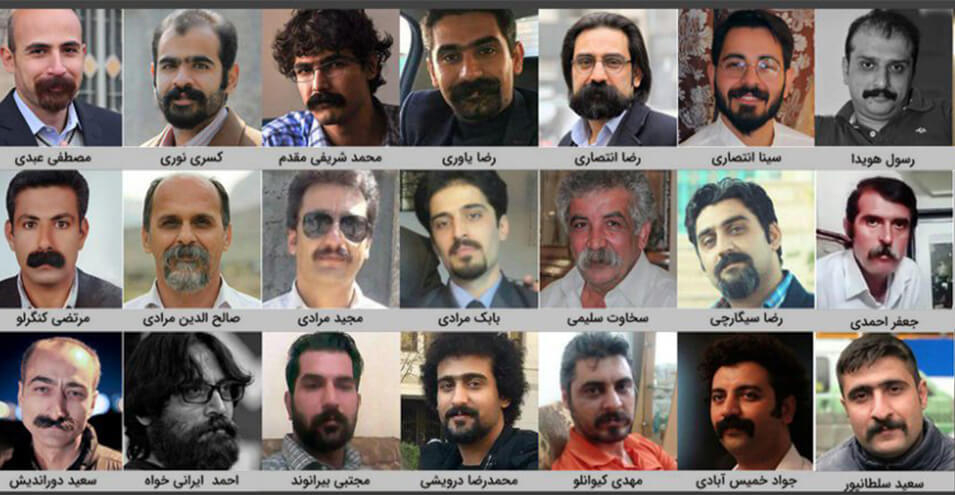
The final sentences of 23 imprisoned Gonabadi dervishes were announced in the Court of Appeal. These 23 dervishes, who did not attend any of their first and second trial hearings in protest against the unfair process of the Revolutionary Courts, were faced with the full confirmation of the heavy sentences issued by the first trial court.
According to a report by the Majzooban Noor website belonging to the Gonabadi dervishes, 23 dervishes were sentenced to a total of 190 years in prison, 46 years of exile, 1,776 lashes, a 46-year ban on leaving the country, and a 46-year ban on membership in political and social groups and parties, as well as media activity. The appeals court's verdict was delivered to them in Tehran's Grand Prison between March 8 and 10.
The names of these 23 Gonabadi dervishes who are currently in Tehran's large prison ( Fashafoyeh ) are as follows : Kasra Nouri, Mohammad Sharifi-Moghaddam, Mostafa Abdi, Reza Yavari, Reza Entesari, Sina Entesari, Morteza Kangarloo, Saleh al-Din Moradi, Majid Moradi, Babak Moradi, Sakhvat Salimi, Reza Sigarchi, Saeed Durandish, Ahmad Iranikhah, Mojtaba Beiranvand, Mohammad Reza Darvishi, Mehdi Keyvanloo, Javad Khamisabadi, Rasoul Hoveida, Ardeshir Ashayeri, Jafar Ahmadi, Saeed Soltanpour, Amin Soleimani.
Among these dervishes, Mustafa Abdi faces the heaviest sentence, 26 years and three months in prison. Kasra Nouri and Mohammad Sharifi Moghadam are also sentenced to 12 years each, and Reza Yavari to nine years. Another 17 were sentenced to seven years in prison each, and two of them to six years each. All 23 were also sentenced to 74 lashes, two years of exile, two years of deprivation of liberty. And they have been banned from leaving the country for two years.
Among these dervishes were Kasra Nouri and Mohammad Sharifi Moghaddam, human rights activists and administrators of the website Majzooban Noor, who played an important role in informing about the situation of Iranian dervishes.
Previously, the Majzooban Noor website belonging to the Gonabadi Dervishes published an open letter from imprisoned dervishes who had abandoned their appeals against their harsh sentences. In the letter, they wrote : " It is unwise to appeal to a government that is the cause of injustice and persecution. "
These 25 dervishes refused even in their own initial trials because they were “ prescriptive and showy. ” In a letter announcing that they would not appeal their harsh sentences, they wrote : “ The government of the Islamic Republic expects those who, according to history and documents, should be in the position of plaintiffs to appear in the position of defendants and to accept the judge’s rhetoric dictated by security officials.”
According to a report by the Majzooban Noor website, around 110 dervishes are currently serving their sentences in Fashafoyeh and Qarchak prisons. The female dervishes are in Qarchak prison and the male dervishes are in Fashafoyeh prison.
These prisoners are scheduled to serve their heavy sentences in inadequate sanitary conditions in the Greater Tehran Prison.
Previously, various sources had spoken about the dire health and security situation in Tehran’s large prison. A source familiar with the situation of the Gonabadi dervishes in the prison’s first brigade hall told the Campaign in November 2018 : “ 400 people are held in the first brigade hall of the prison, which has a capacity of 100 people. There is only three hours a day, from 11 am to 1 pm, to bathe in cold water. Even in this season, not all prisoners have access to hot water. Of course, some who do not go beyond the fingers of one hand and, as the head and veterans of the hall say, have the right to use hot water. ”
Also, according to this source, most prisoners are forced to pay money to have the smallest amenities, even a bed, " and otherwise they have to sleep in the corridor only at night. Many prisoners don't even remember when they last ate fruit because buying fruit in prison is very expensive and it doesn't fit in the daily meal plan list, which is why many poor prisoners don't have money to buy fruit. "
Source: Human Rights