Warning Over Danger of Collapse of Two Old Neighborhoods in Ahvaz
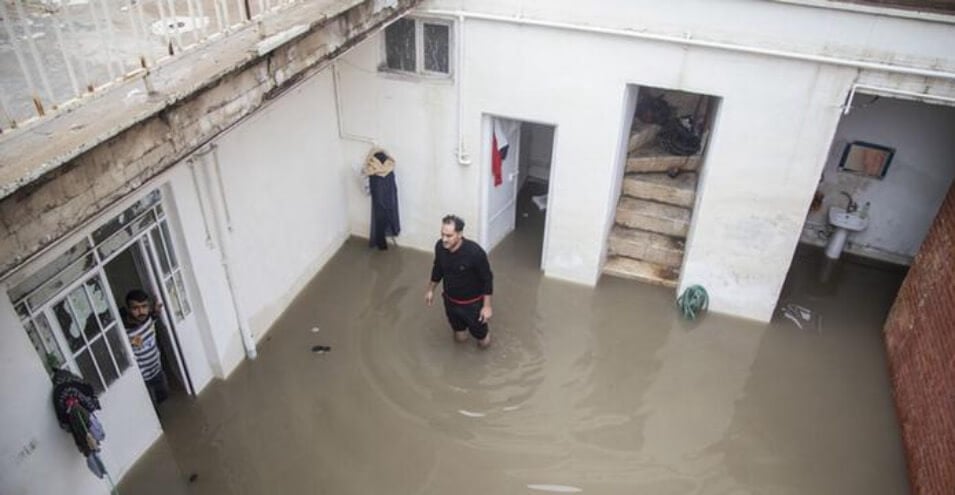
An expert warned about the destruction of two old neighborhoods in the sewage-plagued city of Ahvaz. Meanwhile, discussions continue about the “perpetrators” of this catastrophe and the wastage of a multi-hundred million dollar World Bank loan for reforming the sewage system of Ahvaz and Shiraz.
Two old neighborhoods in Ahvaz have faced flooding and sewage overflow following heavy rains that began on December 15 (Esfand 25).
On Monday, December 30 (Dey 9), the ISNA news agency reported, citing Kiamars Hajizadeh, head of crisis management for Khuzestan Province, that a 5.4 magnitude earthquake could destroy some houses located in Bagh Sheikh and Adham Street, which are considered among Ahvaz’s old neighborhoods, and cause disaster.
According to Iranian news agencies, the absence of a surface water collection network in Ahvaz and the deterioration of the sewage system caused water and sewage to remain in some homes for up to a week.
Askari Molaei Katki, deputy for coordinating civil affairs of the Ahvaz governor, said that Housing Foundation personnel are gathering information about the level of deterioration in these areas.
Recent rains caused flooding and sewage overflow in several Khuzestan cities including Abadan, Ahvaz, Khorramshahr, and Kut Abdullah.
“Critical Condition”
According to Yaseen Kaveh Pour, director of Zone One of Ahvaz Municipality, 70 percent of Zone One faces sewage backflow and street flooding problems.
Kaveh Pour emphasized: “Approximately five zones are in a critical condition.”
This local official noted that the central core of Ahvaz city has never had a sewage system and sewage is disposed of through open channels. This non-standard system also creates health problems.
Kaveh Pour said that Ahvaz Municipality does not even have a comprehensive map of the city’s sewage lines, and this is one of the main problems in urban services and water and sewage sector.
The secretary of Ahvaz Health Council also warned about the spread of various diseases including cholera and dracontiasis due to sewage infiltration into homes and streets, and called for street disinfection with lime.
Warning About Wasting Financial Aid
It is planned that 4,000 billion tomans from the foreign exchange reserve fund will be spent to address Ahvaz’s water and sewage situation.
Jasem Musa Pour, head of the surface water committee of the “Islamic Council” of Ahvaz, has warned that this amount must be “managed so it doesn’t meet the fate of the World Bank loan.”
Musa Pour’s reference is to a multi-hundred million dollar World Bank loan for reforming sewage lines in four cities in 1983, of which 279 million dollars was allocated to Ahvaz and Shiraz.
These days, several Iranian media outlets and news agencies are seeking answers to the question of how the World Bank loan was spent.
In this regard, “IRNA Plus” spoke with Darvish Ali Karimi and Habibollah Moradi, two former CEOs of Ahvaz Water and Sewerage Company.
Karimi said he only played a role in obtaining the loan but had no involvement in spending it.
However, Moradi emphasized that “the work had begun during engineer Darvish Ali Karimi’s time” and part of the loan was received and spent on sewage system improvements, but the remainder of the loan was not paid due to sanctions.
“Money Poisoning”
One of the first media outlets to report on the World Bank loan was the “Donya-e Eqtesad” newspaper. In one of its reports, this newspaper wrote that the expiration date of this loan does not coincide with the timing of sanctions implementation.
In this report, it also cited Abdol-Nabi Mousavi-Fard, the Friday imam of Ahvaz, stating that World Bank credits in this county have not been spent.
In October of the current year, Gholam Reza Shariati, governor of Khuzestan Province, aware of the unknown fate of the World Bank loan, said: “In Khuzestan, we have experienced a kind of money poisoning, meaning that projects are funded, but nothing is done.”
Source: DW