France considers Iran's missile program "very worrying"
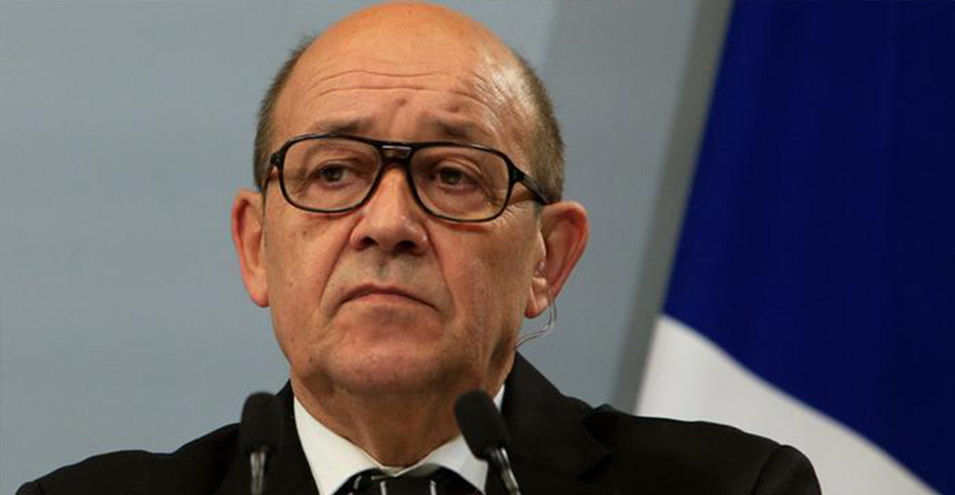
The French Foreign Minister, while reiterating his support for the full implementation of the JCPOA, called Iran's ballistic missile program "very worrying." According to Le Drian, measures need to be taken to ensure that this program does not pose a threat to Iran's neighboring countries.
French Foreign Minister Jean-Yves Le Drian said on Tuesday (February 27) that Iran's ballistic missile ambitions were "deeply worrying" and violated a United Nations resolution.
"It is essential to take measures to prevent Iran's ballistic missile program from becoming a threat to neighboring countries," Le Drian said in a press conference with his Russian counterpart, Sergei Lavrov.
According to Reuters, the French Foreign Minister also supported the full implementation of the nuclear agreement with Iran, known as the Joint Comprehensive Plan of Action (JCPOA).
Lavrov: Discussion on JCPOA only with Iran's participation
Sergey Lavrov said in the press conference that Russia, like France, believes in the full implementation of the JCPOA. According to the Russian news agency TASS, the Russian Foreign Minister emphasized that in Moscow's view, discussions on any issue related to Iran's nuclear program should take place only with Tehran's participation.
Lavrov added: "If there is a desire to address other issues related to Iran, whether within the framework of the JCPOA or in another format, this should be done with Iran's participation and on the basis of an agreement, not through an ultimatum."
The French Foreign Minister also said that during his upcoming trip to Tehran, he will primarily discuss the implementation of the nuclear agreement with Iranian officials.
Controversial issues of the Paris-Tehran talks
Jean-Yves Le Drian is scheduled to visit Iran next Monday (March 5). The French foreign minister will discuss Iran's ballistic missile program, the July 2015 nuclear deal known as the Joint Comprehensive Plan of Action (JCPOA), and Iran's role in the region. Iranian officials, however, have consistently rejected negotiations over their "defense" and missile programs.
On February 5, Iranian President Hassan Rouhani emphasized that “our officials do not and will not need to negotiate or agree with any power for their defense capabilities,” adding: “We will talk and discuss, and if an official comes, we will respond to him,” but he added: “We will also give a firm and decisive response.”
US President Donald Trump has been pressing his European allies, including France, to negotiate with Iran to fix the “flaws” in the nuclear deal. Iran has so far rejected any talks to change the nuclear deal.
US Secretary of State Rex Tillerson announced on February 27 that working groups have begun working to examine the US’s perceived flaws in the JCPOA. He said the US has secured the support of Britain, France and Germany, the European members of the P5+1, to examine the changes the US wants to make to the nuclear deal with Iran. The US Secretary of State also said: “The working groups have begun working to reach agreement on the principles, the issues that need to be raised and how to hold Iran accountable for these issues.”
However, Bahram Qassemi, spokesman for the Iranian Foreign Ministry, said on February 6 that he had "no information" about the JCPOA reform working group, and that the Europeans had not told Iran anything about it.
On January 12, Trump agreed to suspend nuclear sanctions against Iran for another four-month period, but at the same time, noting that this would be the “last time” he would extend the sanctions suspension, he stressed that the ten-year period of suspension of uranium enrichment in Iran must be made permanent, because otherwise the risk of the Islamic Republic obtaining a nuclear weapon cannot be ruled out. The US president has repeatedly accused the Islamic Republic of violating the “spirit” of the JCPOA by “supporting terrorism” and militant groups in the Middle East, destabilizing the region, and continuing its ballistic missile program.