Bank Accounts Frozen and Vehicles Confiscated from Government Critics Over Allegations of Cooperation with the Enemy
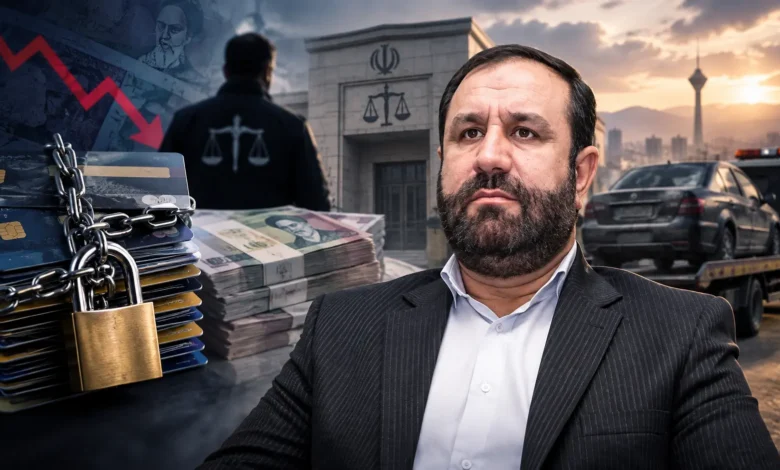
While Iran’s economy is under pressure from inflation, currency devaluation, and heavy war and economic crisis costs, Tehran’s prosecutor has announced the freezing of 2,191 bank accounts and the confiscation of vehicles belonging to 394 people. The judicial authority has accused these individuals of “cooperation with the enemy,” but has not disclosed case details or their identities. This measure, combined with increasing economic and security pressures, has heightened concerns about the expansion of asset seizure from citizens and the use of public assets to meet government objectives.
Ali Salehi, Tehran’s prosecutor, announced that bank accounts and vehicles belonging to 394 people have been identified and part of their assets have been seized. According to him, these individuals have cooperated with the “hostile enemy” in connection with the war and last year’s protests. The Tehran prosecutor has also referred to them with titles such as “counter-revolutionary agents” and “hostile elements.”
According to the prosecutor’s statement, the total number of frozen bank accounts has reached 2,191 and the number of confiscated vehicles stands at 37. However, the important point is that judicial authorities have not yet disclosed the case details of these 394 people, the documentation of the accusations, or the court orders related to each individual. Therefore, the allegation of “cooperation with the enemy” in these cases should still be considered as claims made by the Islamic Republic’s judicial authorities.
Seizing assets from government opponents is not a new issue in the Islamic Republic. Tehran’s prosecutor had previously announced the confiscation of 143 properties and assets in Tehran. Judicial authorities have also stated that when taking into account measures implemented across the country, the total confiscated assets reached 240 cases and the frozen bank accounts reached 182 cases.
Now, however, the announcement of freezing 2,191 bank accounts belonging to 394 people shows a much larger scale of this policy.
Among the confiscated assets, according to the Tehran prosecutor’s announcement, there are properties belonging to some journalists working for foreign media outlets, media activists, and well-known figures residing outside Iran.
These measures are taking place at a time when Iran’s economy faces severe pressures. Sanctions, reduced oil revenues, falling rial value, rising food prices, and war-related costs have placed heavy pressure on the economy and people’s livelihoods. Under such circumstances, confiscating citizens’ assets and freezing bank accounts can have direct and severe consequences for families.
The issue is not merely about a bank account; a bank account may be where salary is received, rent is paid, medical expenses are covered, children’s tuition is paid, or where a family’s daily needs are met. When the government freezes an individual’s account based on a security charge, it effectively cuts off that person’s access to part of their economic life.
In recent years, charges such as “cooperation with hostile governments,” “propaganda against the system,” “actions against national security,” and “espionage” have been repeatedly used in the Islamic Republic’s security cases.
Human Rights Watch has also warned in a report about the suppression of recent protests in Iran regarding the use of broad and vague criminal charges in security cases and the issuance of harsh sentences.
When such allegations are presented without disclosing case details and evidence to the public, the ability to make an independent assessment of the charges and the proportionality of the punishment becomes severely limited.
This issue becomes even more important regarding asset seizure, as confiscation or freezing of assets can be a punishment whose effects are imposed on an individual and their family’s life even before the end of a legal proceeding.
One serious question from the public is where exactly the government’s financial resources are being spent during economic pressure. The Islamic Republic has long supported regional armed groups. The U.S. government also imposed sanctions in September against networks that, according to Washington, played a role in financial support for Hezbollah and other groups affiliated with the Islamic Republic.
Reuters also reported in June that Tehran continues to support Hezbollah and considers it its ally. Therefore, concerns about government resources being spent on military and regional objectives rather than public welfare are not unprecedented.
However, there is no document in the recent prosecutor’s report showing that the money or assets of these 394 people were directly allocated to fund Hamas or Hezbollah.
Iranian citizens today face multiple problems: inflation and declining purchasing power, unemployment, housing crisis, medical costs, and economic insecurity.
Under such circumstances, people expect the country’s resources to be used to improve their lives, not to increase economic pressure on society and simultaneously seize citizens’ assets through security orders and charges. This contradiction becomes more pronounced when the government speaks of “defending the nation” on one hand while, on the other hand, confronting citizens who oppose its policies for political, media, or protest reasons with frozen accounts and asset confiscation.
Freezing a bank account is not merely a judicial action against the account holder. If a person is the family’s breadwinner, freezing their account can affect the lives of their spouse, children, or parents. If they are a media activist, seizing equipment or financial resources can effectively halt their professional activity.
For this reason, widespread use of asset seizure can become a tool for pressure extending beyond the individual themselves. In this context, announcing statistics without disclosing the individuals’ identities, details of allegations, the legal basis for seizure, and the final fate of assets raises serious questions about the transparency of this process.
The figures of 2,191 bank accounts and 37 vehicles are part of a larger picture; a picture in which Iranian citizens face economic pressure on one hand and, on the other hand, may be subjected to arrest, legal proceedings, asset confiscation, or even harsher sentences if they engage in political, media, or protest activities.
If there is no security, freedom, a healthy economy, and a predictable future, seizing people’s assets cannot solve the country’s structural problems. The Iranian people have the right to know how the country’s resources and assets are managed and where their confiscated assets go. Financial transparency, fair justice, and the right to defense, even in cases with security charges, are principles that cannot be ignored.
The Islamic Republic cannot, on one hand, ask people to endure economic difficulties and, on the other hand, freeze their accounts and assets without providing clear details about the cases.
And if the government truly claims these measures are carried out to “protect national interests,” it must answer what national interests ultimately mean: filling security and military budgets and continuing regional expenses, or returning resources to the lives of people who have paid the cost of the government’s policies for years?
People’s assets are the people’s right, and no government should resolve its economic crisis by further emptying citizens’ pockets.