Call for Serious Action Against Rise of ‘Fake Imamzadehs’ in Iran
A parliament member has called for “strong” action against the increase of “fake imamzadehs” in Iran. Another representative has also asked the Endowments Organization to “close these shops.” At least 11,000 imamzadehs have been registered in Iran.
Mohammad Ali Pourmokhtар, a member of the Islamic Consultative Assembly, called on Sunday, December 9 (December 30), for serious action against “fake imamzadehs” in Iran. Pourmokhtар told Khabar Online: “The Endowments Organization should intervene to prevent the diminishment of imamzadehs. Moreover, the Endowments Organization is the primary authority responsible for this matter and is obligated to prevent such misuse.”
This conservative representative, who was a member of the Article 90 Commission in the ninth parliament, during which cases concerning imamzadehs were raised in that commission, spoke about the number of imamzadehs in Iran: “I do not currently have precise statistics, but the last time I was following up on this case in the Article 90 Commission, the number of imamzadehs had reached 11,000. At that time, by raising this issue, we tried to warn people who were creating fake imamzadehs; to some extent, we stopped this activity, and the Endowments Organization was informed and dealt with this practice, but it was expected that the Endowments Organization would address this matter with greater sensitivity.”
Endowments Should “Close These Shops”
Gholamali Jafarzadeh Aman-Abadi, the representative of Rasht in the Iranian parliament, also said about “fake imamzadehs”: “The Endowments Organization should close these shops.”
For several years, criticism of the “unaccounted” increase in imamzadehs has been growing in Iran. Jafarzadeh Aman-Abadi told the “Melli House” news agency: “Between the ninth and tenth parliaments, several thousand were added to the number of imamzadehs; the question people ask is when will the imamzadeh story end? It means what that their numbers are increasing and why do they keep increasing? This increase in imamzadehs makes no sense to young people; somewhere the file on discovering imamzadehs should be closed and imamzadehs should no longer be produced.”
Gholamali Jafarzadeh Aman-Abadi also said: “The discovery of imamzadehs should end at some point; some of these have no genealogy at all and in some villages stories are being fabricated; therefore, the Endowments Organization should stop it and strictly deal with these superstitions and some statements by officials that diminish religion.”
Jafarzadeh Aman-Abadi’s comments were met with a response from Iran’s Endowments Organization. In a reply, noting that “genealogical verification” of imamzadehs has been professionalized, the organization wrote to the Rasht representative: “From this honorable representative, as a legal entity with a podium in the Islamic system, it was expected that before repeatedly raising such sensitive issues that easily become fodder and food for propaganda by media hostile to the system, he would follow up these matters from beyond the margins with this organization, so that if necessary, through holding expert sessions, complete statistics and information of the blessed sites of the country and how they are registered and documented over the past several years in the context of the comprehensive system of information and management of endowments and blessed sites would be explained to him.”
“Unqualified” Official Identified Imamzadehs
It appears that the Endowments Organization’s response to the Rasht representative was not convincing for Mohammad Ali Pourmokhtар, a conservative parliament member. He said: “A person in Qom is responsible for genealogical verification, regarding whom Ayatollah Nouri Hamedani issued a fatwa stating that this person is not qualified to verify the genealogy of imamzadehs. In fact, the person to whom the genealogies of imamzadehs are entrusted to pass down generation to generation to the Imams has been questioned by Ayatollah Nouri Hamedani. This is while some of the imamzadehs have received genealogies from this person. It seems the Endowments Organization should intervene to prevent the diminishment of imamzadehs. Moreover, the Endowments Organization is the primary authority responsible for this matter and is obligated to intervene and prevent such misuse. Another point is that in any case, money is being taken from people in this process and tens of millions are being spent on domes and shrines for these imamzadehs, and if this continues, it will certainly be harmful.”
Pourmokhtар also, in response to the question of “whether any action has been taken to demolish fake imamzadehs,” said: “This is the responsibility of the Endowments Organization, and we have not yet seen any effective action.” According to him, in the ninth parliament, the Article 90 Commission addressed the issue of fake imamzadehs and “to some extent” prevented its expansion, but the issue was later “abandoned.” This parliament member ultimately considered dealing with “fake imamzadehs” “the primary responsibility of the Endowments Organization” and said: “It is expected that this action be carried out with full force.”
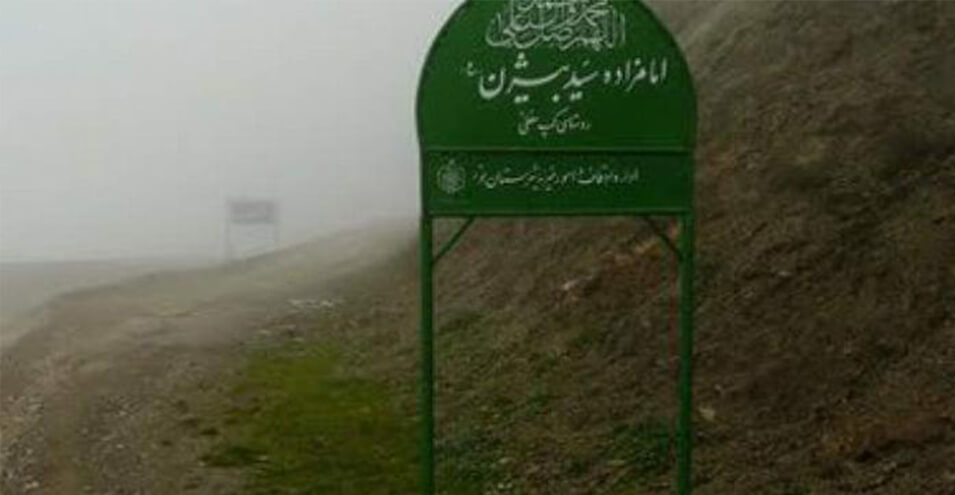
“Imamzadeh Bizhan” or “Imamzadeh Bi-Jan”
Although the “increase” in imamzadehs and their “discovery” in succession in Iran over the past years has faced much criticism, officials of the Endowments Organization do not consider this to be due to the imamzadehs being “fake.” Ahmad Sharfkhani, Deputy for Culture and Social Affairs of the Organization of Endowments and Charities, said in September of last year (2017) on this matter: “A large portion of the imamzadehs have complete genealogies. If some of them do not have genealogies, an authoritative historical book confirms the presence of imamzadehs, or the local and ancient fame that has been transmitted from generation to generation proves to us that there was an imamzadeh in this place. Also, the antiquity of historical and archaeological artifacts present in some imamzadehs indicates that these were truly descendants of the Imams.”
According to this official of the Endowments Organization, the reason for the “increase” in the number of imamzadehs is “the collection of accurate statistics and information of these places” by the organization.
The unconventional names of some imamzadehs in Iran, such as “Imamzadeh Bizhan,” “Imamzadeh Ayn and Ghyn,” and “Imamzadeh Qol Qoli,” became a subject of jokes for some, especially on social networks, and fueled the issue of “fake imamzadehs” in Iran. Officials of the Endowments Organization, however, have provided explanations for these unconventional names.
Hamid Asgari Savadjanи, Director General of “Religious Places and Blessed Sites” of Iran’s Endowments Organization, in an interview with “Mardom-Salari Online” in mid-August of last year, said: “In Nur city, there is an imamzadeh named Imamzadeh Seyyed Mohammad (A.S.). Since the imamzadeh’s surroundings were known as a quiet and unpopulated area, gradually that place became known by the name ‘Bi-Jan’ (unpopulated). People also recognized the imamzadeh by this name. Finally, in the local dialect, the letter ‘j’ was changed to ‘zh,’ and this imamzadeh became famous as Imamzadeh Bizhan. While its original name is Imamzadeh Seyyed Mohammad (A.S.). The original name of Imamzadeh Qol Qoli is also Mohammad ibn Hanafiyyah, who is buried in Gilan Province. Some people believe that to fulfill their wishes, they must roll in this imamzadeh, and if they don’t get hurt from rolling, they fulfill their wishes, while there is no written and documented evidence that confirms people’s behavior in this imamzadeh to fulfill their wishes.”
Published statistics show an at least sevenfold increase in the number of imamzadehs compared to before the 1357 (1979) revolution in Iran.
Source: DW