Economic Fateful Day Against Tehran; Washington Activates Final Pressure Lever
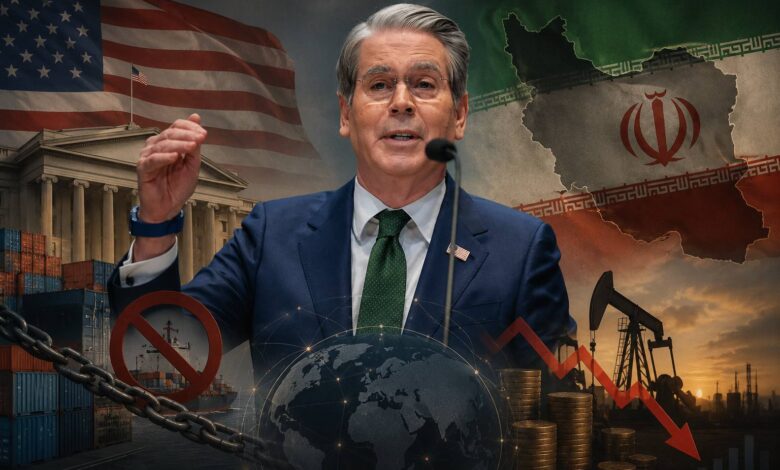
The Donald Trump administration entered a new phase of confrontation with the Islamic Republic from early Monday; a phase that U.S. Treasury Secretary Scott Bessent has described as an “economic fateful day” and the largest financial campaign against an adversary. Washington says the objective of this operation is to sever the Islamic Republic’s revenue, financial, and commercial channels and force Tehran into economic isolation; in response, officials of the Islamic Revolutionary Guard Corps consider American threats as failed and speak of Iran’s readiness for economic confrontation.
Scott Bessent, U.S. Treasury Secretary, announced that the Donald Trump administration will begin implementing a new phase of economic pressure against the Islamic Republic from Monday; an action that, according to him, will be unprecedented in scope and intensity.
Bessent called this campaign an “economic fateful day” and said the U.S. government has now entered the final phase of confrontation with Tehran. He emphasized in a message on social media platform X that the new economic pressure is set to go beyond ordinary sanctions and will also pressure countries and entities that help maintain Iran’s economic ties with the world.
In this context, the U.S. Treasury Secretary identified Washington’s main objective as cutting off the flows that enable the Islamic Republic’s continued economic activity. He said: “The President has created conditions for us to utilize all the capabilities of government institutions, all legal authorities, and measures that many thought we would never resort to.”
Bessent also clarified: “Our goal is to sever all vital economic arteries of this despotic regime until Tehran is completely isolated.”
The importance of this phase of Washington’s policy is not limited merely to new sanctions against Iranian institutions. Reports from international media indicate that the Trump administration is increasing pressure on governments and companies that continue to play a role in trade with Iran.
Reuters reported that the new American measures are primarily targeting countries that trade with Iran. Tehran has also announced in response that if this confrontation intensifies, it may expand the scope of its response to oil exports across the Persian Gulf region.
The Associated Press has also written that Washington’s new campaign will include secondary sanctions against countries and companies that trade with Iran; a matter that could subject Tehran’s economic relations with its key partners to greater pressure.
Furthermore, America’s strategy focuses on cutting off the oil, financial, and commercial pathways that connect Iran to the global economy. The U.S. Treasury Secretary in another part of his message characterized the Islamic Republic’s policy in recent years as based on the assessment that Washington would ultimately be cautious in implementing its threats.
Bessent said: “This government drew its power from a calculation that Iranian retaliation was inevitable and decisive American action was subject to negotiation and bargaining. But under the Trump presidency, this era has ended, and those who fear the risk of counter-retaliation from Tehran should not underestimate the cost of testing Washington’s resolve.”
He further emphasized: “Those who fear the risk of defiance toward Tehran should not underestimate the cost of testing Washington.” This stance shows that the Trump administration is attempting to transform sanctions from a tool of pressure against Iran’s government into a tool for pressuring the economic network surrounding the Islamic Republic.
In Tehran, the Islamic Republic’s response to America’s latest threats has been accompanied by rejection of the effectiveness of this policy. Hossein Mohbai, spokesman for the Islamic Revolutionary Guard Corps, said on Sunday in response to American threats: “We have repeatedly announced that we have scenarios for every hostile action by the enemy, and one of these actions is economic warfare. We also have scenarios to counter the harmful effects of the enemy’s economic warfare and easily establish our economic relations with various countries; therefore, we have no economic concerns.”
He also considered Washington’s intended economic operation as evidence of America’s failure in the military arena, saying: “It is implicit admission of shameful failure in the military sphere.” Mohbai added: “We have economic interactions without America’s knowledge, we bypass America, and you will see the results in the near future.”
His remarks came as international media reported increasing concerns about the economic consequences of this new phase of Tehran-Washington confrontation. Reuters reported that Iran faces doubled economic pressure at a time when a nearly six-month war has also affected this country’s economy and regional trade.
Simultaneously, Iranian officials have issued warnings about the possibility of expanding the scope of confrontation to American economic interests in the region. Mohsen Rezaei, Secretary of Iran’s Supreme National Security Council and former commander of the Revolutionary Guard, announced on Saturday evening the possibility of Iranian armed forces attacking American economic and oil companies in Persian Gulf countries.
These threats are being raised at a time when the economic confrontation between the two countries is also tied to the vital issue of the Strait of Hormuz. This waterway is one of the world’s most important energy transmission routes, and any disruption to tanker passage could have consequences beyond the borders of Iran and America. Reuters reported that Iran’s threat to halt oil exports from the Persian Gulf region has increased concerns about global energy supply.
As Washington is set to announce details of its new measures, global markets have also reacted to these developments.
According to Reuters reports from global markets on Monday, investors were awaiting details of American sanctions against Iran, and oil prices and some stock markets declined in Asian trading. Meanwhile, China, which is considered one of Iran’s most important oil buyers, has adopted a different position in response to American pressure policy toward Tehran, calling for resolution of disputes through diplomatic channels.
Thus, the “economic fateful day” that Bessent spoke of is not merely a new phase in sanctions against Iran; rather, it is a test of Washington’s ability to restrict the Islamic Republic’s economic network and simultaneously a test of Tehran’s ability to maintain its trade routes, oil exports, and financial ties with the world. In such circumstances, both sides are clinging to their positions: Washington speaks of severing the economic arteries of the Islamic Republic, and Tehran promises to bypass economic pressure. The result of this confrontation could affect not only Iran’s economic future, but also energy trade and the economic security of a large portion of the Middle East.