Forced Return of Civil Activist Rezvaneh Ahmadkhanbigi and Her Toddler to Prison Sparks New Wave of Criticism
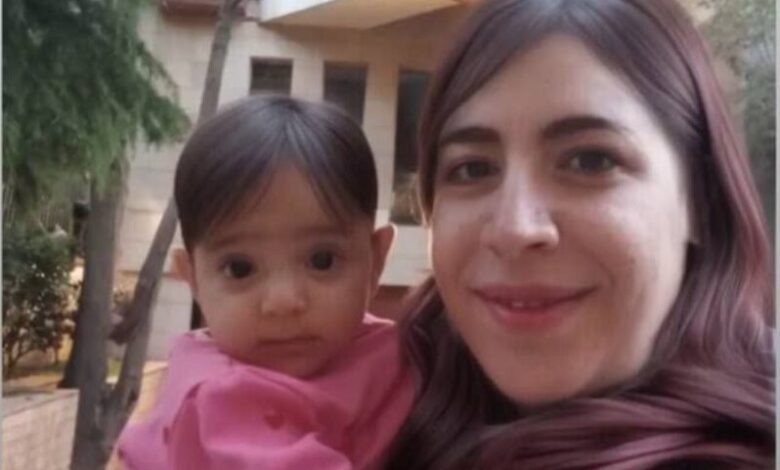
The return of Rezvaneh Ahmadkhanbigi, a civil activist and political prisoner, to Evin Prison alongside her daughter, who is under two years old, has once again brought the issue of children in prison environments to the forefront of human rights defenders’ serious concerns. Experts and human rights organizations have repeatedly emphasized that prison is not an appropriate environment for children’s development and physical and mental health, and separating a mother from her natural family environment or forcing a child to live in prison can have irreversible effects on their future.
Rezvaneh Ahmadkhanbigi, a civil activist and political prisoner, returned to the women’s ward of Evin Prison on Monday, June 29 (Tir 8), accompanied by her toddler daughter, after completing her maternity leave. This child, who has not yet reached the age of two, is now forced to spend her sensitive developmental years in a prison environment—a situation that has drawn widespread reaction from human rights activists.
In September 2024, while serving her prison sentence, Rezvaneh Ahmadkhanbigi was granted leave to give birth. With the end of this leave, judicial authorities ordered her to return to prison with her young child—a decision that has raised serious questions about the observance of children’s rights and the rights of incarcerated mothers.
According to published reports, Ahmadkhanbigi suffered from physical health problems even before her child’s birth and faced concerns about her medical condition during pregnancy. International media had previously reported that she lacked adequate access to medical services during the final months of her pregnancy.
Human rights activists emphasize that although some laws allow young children to remain with their mothers in prison for a period of time, this does not mean that prison is suitable for a child’s development. Secure environments, limited access to educational facilities, confined spaces, constant stress, and deprivation of normal family life can all endanger a child’s physical and mental health.
On the other hand, many human rights defenders believe that a mother who has recently become a parent should have the opportunity to be present with her family and provide a safe environment for her child’s development. In their view, the punishment of a prisoner should not be carried out in a way that a young child must also bear its consequences in practice; because children have committed no crime and should not pay the price of judicial decisions.
Rezvaneh Ahmadkhanbigi and her husband, Behfar Lahlezari, were sentenced to a combined 10 years in prison in December 2023 on charges of “assembly and conspiracy to disturb national security” and “propaganda against the system.” Following the acceptance of an appeal for retrial and case review, the sentence was reduced to 21 months of punitive imprisonment. Her husband is currently also serving his sentence in prison.
The return of this mother and toddler to prison has once again raised the fundamental question: should the execution of punishment come at the cost of having a child spend the first years of her life behind prison walls instead of in the warm embrace of family; a place that was not built for play, nor for development, nor for childhood. From the perspective of many human rights defenders, prison is no place for children, and no judicial interest should override a child’s right to a safe and family environment.