Iran’s People Tremble While Officials Make Speeches
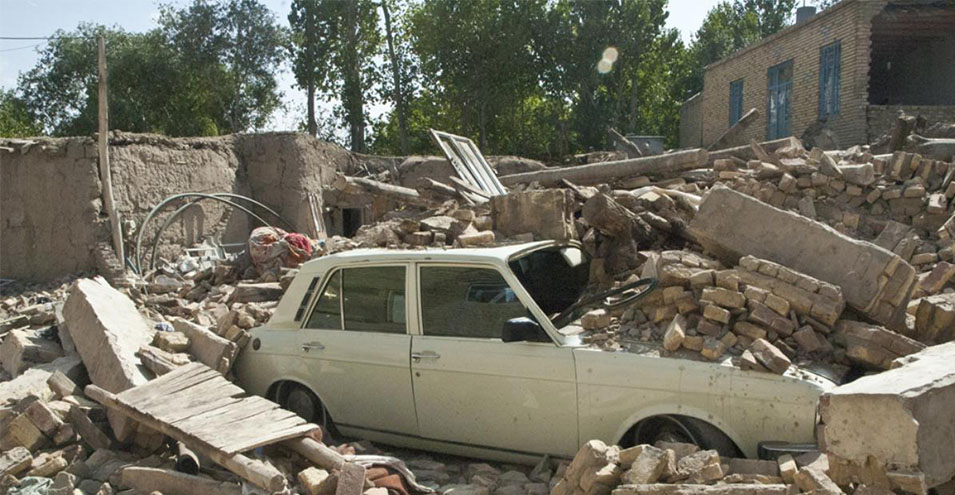
Sara.Kh – CNN Farsi News Agency: People’s bodies tremble. Rumors are intensifying and earthquakes occurring at short intervals in various regions of the country are fueling these rumors and fears. Homes are unsafe and the non-resistant nature of residential buildings, especially in villages, threatens the lives of millions. We live in a country where most of it is located on fault lines and is seismically active. Over the past two weeks, earthquakes have intensified across every corner of the country, but even in these circumstances, national officials are passing the buck to the people to manage this danger.
To assess the severity of the situation, let us review the earthquakes of the past two weeks.
Earthquakes in the Past Two Weeks
Yesterday afternoon, Wednesday, an earthquake of magnitude 4.3 on the Richter scale shook Avaj County in Qazvin Province.
At 10 PM Wednesday night, an earthquake of magnitude 3.14 on the Richter scale struck the center of Bent district in Sistan and Baluchestan Province.
North Khorasan also experienced three natural disasters simultaneously last night.
The occurrence of a 3.9 magnitude earthquake at 2:53 AM in Bojnord, flooding in Raz and Jargalan County, and a fire in the Darkesh area of Mahneh and Samelqan County were among the events that made for a difficult night for our compatriots.
Beyond this, this Thursday morning a storm with winds of 108 kilometers per hour hit the Sankhast area, and a storm with winds of 106 kilometers per hour swept through Mahneh and Samelqan.
Residents of Zarand, Kerman also experienced an earthquake of magnitude 4.9 on the Richter scale on Friday, the 29th of Mehr this year, and until this Thursday have repeatedly felt tremors of less than 3.2 magnitude.
The occurrence of the first earthquake and subsequent earthquakes of magnitude 4.7 and 4.5 on the Richter scale on the 7th and 10th of Aban in this county caused injuries to a number of people and damage to non-resistant buildings.
The delay in providing aid to earthquake victims in Zarand in recent days led to protest reactions on social networks and public gatherings in public places.
The only reaction from Zarand officials to these protests was the statements of Seyyed Mahdi Ghavadel, the General and Revolutionary Prosecutor of Zarand. He emphasized yesterday, Wednesday, in an interview with IRNA: “People who intentionally spread false information on cyberspace to create fear and worry among the people will be identified and dealt with. Investigations have shown that most of these people are not even in need and some appear in these gatherings for adventure, while some are likely deliberately fueling these gatherings to damage the reputation of certain officials. We are following this matter closely.”
Rumors also report the prediction of a 6-magnitude earthquake in Mashhad. The head of the Earthquake Research Center at Ferdowsi University of Mashhad has denied these rumors, but due to Razavi Khorasan Province being located on a fault line, he has confirmed this possibility.
According to this official, seismographic devices deployed in the province record many small and moderate earthquakes in this area every day. Based on this recorded data, the cities of Nishapur, Qochan, Torbat Heydarieh, and Kashmar are more at risk from earthquakes than Mashhad.
Meanwhile, reports indicate that more than 10 earthquakes have been recorded in Razavi Khorasan in the past month. In these tremors, more than 79 rural houses have been damaged.
In Any Case, The Ball Is in the People’s Court
There is no doubt that crisis management and the preparedness of both people and officials to prevent increased damage in a country facing danger is of great importance. Retrofitting homes is one of the important components of this prevention.
Currently, Iran’s situation is such that the majority of non-resistant homes against unforeseen events such as earthquakes are in villages. The statistics confirm these indications.
Meanwhile, we have seen officials talk about the necessity of retrofitting, but they are putting the burden on the people’s shoulders and asking villagers to do so using bank facilities.
Whereas the ability of the country’s villagers in current conditions to spend money on retrofitting their homes has no proportion whatsoever.
National officials know well that drought and lack of proper support have made the continuation of agricultural and livestock activities impossible in villages and poverty is rampant.
Yet they are asking villagers to use low-interest loans to make their homes resistant. While the level of response from the country’s villagers in the past decade reflects their ability and the effectiveness of these government facilities in retrofitting homes and reducing earthquake risk in the country.
The evidence shows that in the past 10 years, only 1 million and 800 thousand villagers have been able to sign contracts with banks for improving their homes. While there are 5 million and 200 thousand rural residential units in the country.
This is while, according to Azizollah Mahdiyan, Deputy for Rural Housing and Reconstruction of Disaster-Stricken Areas at the Housing Foundation of the Islamic Revolution, currently 60 percent of rural homes in the country are non-resistant. Accordingly, more than 15 million of our compatriots in the country’s villages are under threat of earthquakes. If we add the statistics of non-resistant urban homes to this, the gravity of the situation becomes clearer.
Therefore, national officials are expected to occasionally glance from the window of their safe homes at the conditions of millions of Iranians who tremble even on the quietest and warmest nights, because they have never experienced any security under the roof of their unsafe homes.