Principlists’ Confusion in Facing Recent Protest Gatherings
Many principlists view the recent protest gatherings as a “legitimate” response by the people to the government’s economic policies. However, principlists hold differing views regarding the origin of some slogans that target the entire system of governance.
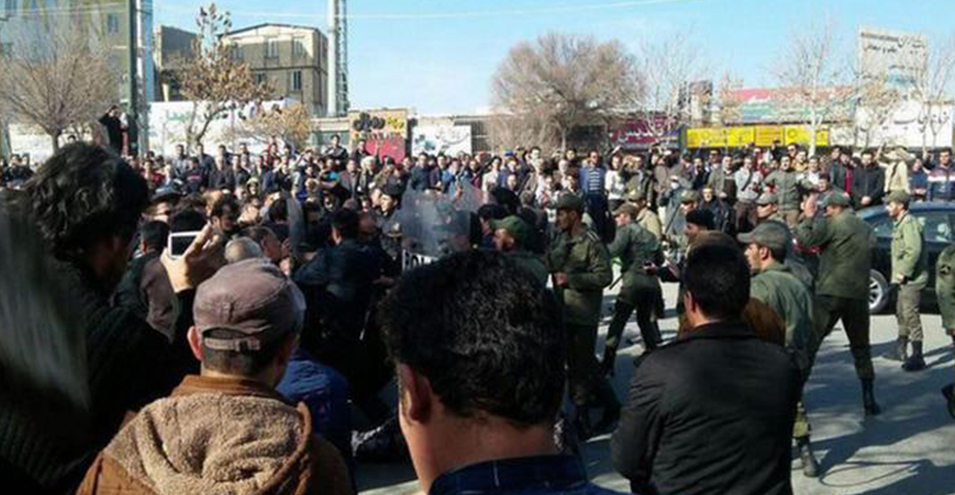
Demonstrations and protest gatherings over the past two days (December 28-29) began in Mashhad and some cities in Razavi Khorasan Province and spread to many other cities, including Kermanshah, Khorramabad, Shiraz, Isfahan, Rasht, Hamadan, Qom, and Qazvin.
Protests in Mashhad took shape under the title “No to Rising Prices” and with the presence of some victims of financial and credit institutions, slogans against widespread corruption in the Islamic Republic system were also widely heard.
In many cities, protesters in response to violent treatment by police and security forces chanted “Police, go catch thieves.” Protesters also chanted other slogans which Hassan Heidari, the prosecutor of Mashhad, attributed to “structure-breaking groups” in an interview with Farsi news agency.
According to the principlist Borna news agency, on Thursday protesters in Mashhad “chanted slogans against the president and government, and these slogans gradually became more intense, and subsequently intense structure-breaking slogans began.”
Based on what is heard in videos published on social media, demonstrators in various cities have chanted, among other things: “Abandon Syria, care about us,” “Not Gaza, not Lebanon, I sacrifice myself for Iran,” and “Independence, freedom, Iranian republic.”
Hojatoleslam Mohsen Mohammadi, head of the Islamic Propaganda Coordination Council, said on Saturday morning in reference to such slogans to ISNA news agency: “We distinguish the account of patient, faithful, revolutionary, suffering, unemployed, and impoverished people from the account of hypocrites and seditionists, and certainly the Islamic system must come to the aid of the people.”
The People’s “Legitimate” Protest
Hojatoleslam Ahmad Alamolhoda, Friday prayer leader of Mashhad, in yesterday’s prayer sermons considered the people’s protest against rising prices “legitimate” and at the same time said: “These people are not opposed to the system, but are under the pressure of economic and livelihood problems.”
According to reports, Alamolhoda, referring to Maryam Rajavi, leader of the Mujahedin-e Khalq Organization, said: “It is wrong for a group in a gathering to say abandon Syria and care about us, and it is wrong for an American whore woman who is the leader of hypocrites to come and thank you for this slogan, and we should not provide fodder for enemy media.”
The Friday prayer leader of Mashhad told the protesters in this city: “Your demands were completely legitimate and chanting against rising prices was a rightful act, but we must know that the enemy wants to strike us, and we should not allow them to abuse these demands.”
Kayhan newspaper, one of the main media outlets of hardline principlists, accused officials of Hassan Rouhani’s government of treating “the people’s economic complaints” with factional and political approach and calling citizens’ protest movements “rivals’ conspiracy.”
The newspaper accused Persian-language foreign media and “opposition activists and institutions affiliated with the West” of “taking advantage of such events and reflecting the protest atmosphere to livelihood problems in a political manner.”
Kayhan and Denial of Anti-Government Slogans
Kayhan’s editorial writer added: “This is while the slogan of people present in protest gatherings was based on economic and financial issues as well as the government’s disregard for electoral slogans and promises.”
It appears that at least some principlists and government opponents were pleased with the organization of protest gatherings and view it as a result of government incompetence, but were confused in the face of “structure-breaking” slogans.
Kayhan wrote in another note: “The root of people’s protests is economic problems that have been neglected by the government, but counter-revolutionary circles are trying to appropriate this legitimate protest against the system.”
“Culprits” of Slogan Changes
Kayhan in this note accused “some government-supporting media and seditious currents” of welcoming “escalating tensions and turning the mentioned livelihood protest into political unrest.”
“Sedition” is a term used by Islamic Republic leader Ali Khamenei and government supporters for the protest movement regarding the announced results of the 2009 elections. Kayhan claims that the slogan “Not Gaza, not Lebanon,” which was also repeated in 2009 protests, was “dictated” to protesters by Israel’s foreign ministry.
Thus, from the principlists’ perspective, a wide spectrum was involved in or welcomed the transformation of “legitimate” livelihood protest into political unrest, but as the Friday prayer leader of Mashhad claimed, “the people are not opposed to the system.”
Meanwhile, on Saturday, December 30, the principlist representative of Rasht and vice-chair of the independents’ faction in the Islamic Consultative Assembly told ILNA news agency: “Attributing [protest] gatherings to hypocrites and royalists is certainly a mistake.”
Gholamali Jafarzadeh Imamabadi, who is also a member of the budget reconciliation commission, cited the motivation for recent protests as concern over price increases and the elimination of a large portion of subsidy recipients mentioned in the proposed budget bill for next year. He assured that the parliament and government have “received the message” of protesters and there is no need to worry about rising prices.
Questioning “the System from Top to Bottom”
Jafarzadeh views leading people to chant anti-government slogans as influenced by the behavior of extremist opponents of the government: “The problem is that in recent days hardliners and anxious individuals in their speeches, under the pretext of undermining Rouhani’s government, have questioned and criticized the system from top to bottom.”
The Rasht representative in parliament told ILNA news agency: “It is the same everywhere in the world, and when people see the government moving toward economic austerity, they try to make their voice heard to the authorities, and this is while according to Article 27 of the Constitution, measures must be taken so that people can make their voice heard through non-violent gatherings.”
The vice-chair of the independents’ faction also yesterday, stating that people do not distinguish between government, authorities, and the system, warned those who, according to him, have targeted the government: “We are all on the same boat, and if anyone punctures this boat, we will all sink together.”
Source: DW