Reactions to Zarif Interview; From Structural Duality Problem to ‘Scandal’ and ‘Lies’
The government says about Zarif’s “confidential” conversation, “hasty and unfair” judgment should not be made. Some see the purpose of its publication as weakening Vienna negotiations, while others consider it a “scandal.” Families of Ukrainian airplane victims call Zarif a liar.
Saeed Khatibzadeh, spokesperson for Iran’s Ministry of Foreign Affairs, at a press conference on Monday, Ordibehesht 6 (April 26), in an attempt to mitigate the consequences of releasing Zarif’s conversation file, called it a “normal and confidential matter in government” and emphasized that “hasty judgment” should not be made based on sections of it. His remarks were aimed at hardliners of Iran’s government who have severely criticized and attacked him since yesterday (Ordibehesht 5) when the file was released by foreign Persian-language media.
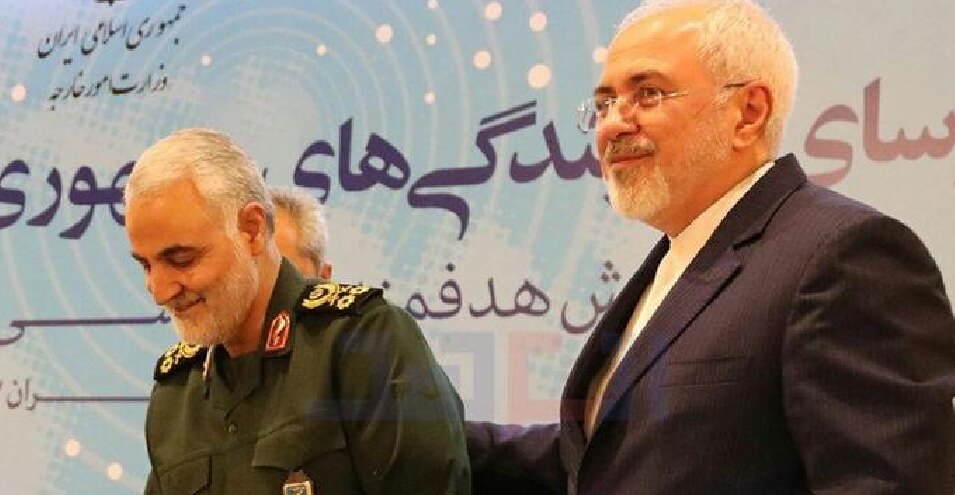
Zarif, in parts of this interview with Saeed Leilaz, an economic journalist, has exposed the backstory of many major policymaking in the Islamic Republic. He has discussed Russia’s destructive role in preventing the nuclear deal from succeeding, how to deal with the news of the Ukrainian airplane being shot down, and the role of the Islamic Revolutionary Guard Corps and Qasem Soleimani, the former commander of the Quds Force, in foreign policy and domestic affairs.
Zarif, regarding Russia’s destructive role, says at one point in this interview: “From the day the JCPOA was finalized, Tir 23, 1394 [July 14, 2015] until the day it was finalized, Dey 26, 1394 [January 16, 2016], that is over a period of about six months, numerous measures were taken to ground the JCPOA.” He adds that “Russia’s will was for the JCPOA not to happen,” and “it was in Russia’s interest that our relations with the West not be normalized, but Russia did not want them to be normal.”
At another point, he says that he was informed by John Kerry, his former American counterpart, about the extent of Israeli attacks on Iranian forces in Syria.
Regarding Qasem Soleimani as well, the foreign minister of the Rouhani administration has made statements that did not please hardliners: “We claim that Mr. Soleimani dragged Putin to war. But Putin had made his decision. Putin entered the war, but with air force. But he also dragged Iran’s ground forces to war. We didn’t have ground forces at that time. Syrians and Arabs and Afghans and volunteers were there.”
Whose Displeasure?
The Foreign Ministry spokesperson, regarding the publication of this interview, has said it is unclear “who and why released it” and “a displeasure was seen in some media outlets to segment Zarif’s statements, but the whole should be seen.”
He has invited “everyone” to “fair judgment” and said: “It is not that these contradict our stated policies.”
But “everyone” is not willing to simply let the opportunity pass. Mohammad Baqer Qalibaf, the speaker of Iran’s parliament, in reaction to Zarif’s audio file tweeted: “The prudence and bravery of Hajj Qasem conquered fields and opened the corridors of diplomacy; nothing but political game or naivety can hide this clear truth.”
In the continuation of this tweet, it reads: “Now that Hajj Qasem is gone, we will not allow opportunism to be used to reach their political goals and reverse the historical role of Martyr Soleimani.”
Purpose: Undermining Zarif and Damaging Vienna Negotiations
Jalil Rahimi Jahanabaadi, a member of the parliamentary Commission on National Security and Foreign Policy, told IRNA on Monday that the release of the audio file of the foreign minister “was carried out with the aim of damaging Vienna negotiations.” According to him, Zarif “trusted the government body” and it is these “Zionists” who want to use it as a tool to “destroy the diplomatic apparatus.” Jahanabaadi has called for identifying the perpetrators of the file release by security institutions.
Meanwhile, Ahmad Amirabad Farahani, the representative of Qom in parliament, announced that a “fact-finding and inspection proposal” regarding this audio file is being drafted quickly and “will be followed up.” He said “perpetrators in (leaking) confidential and secret information of the country in this regard will be referred to the judiciary.”
Nasrollah Pejmanfar, the head of the article 90 commission of parliament, has called for Zarif’s explanation about the content of this interview and said he “apparently does not know that the foreign minister of a country like the Islamic Republic of Iran and challenges issues that are among the red lines of the Islamic Republic that he holds the position of foreign minister in.”
He criticized Zarif, saying “after 40 years in the field of diplomacy in the Islamic Republic of Iran, apparently still does not understand the system’s red lines and the system’s foreign policy.”
A Security Scandal?
Saeed Leilaz’s interview with Mohammad Javad Zarif in Esfand 1399 [February-March 2021] was conducted as an “oral history” project under the supervision of the strategic research center of the presidency.
Fars News Agency in Bahman [November-December 2020] wrote that Hassan Rouhani, the president of Iran, established a center with the name “Center for Preservation and Publication of Works” with Muhammad Qouchani as secretary and titled it “Council for Compiling, Collecting and Organizing the Works of Ayatollah Hassan Rouhani.” It further stated that “the first project that Qouchani is executing in this council is compiling a book titled (Revival of Hope) which is to be compiled based on interviews with prominent political figures about Rouhani and his services.”
The Foreign Ministry spokesperson, in the initial reactions to the release of this interview, emphasized that “this conversation was recorded solely for registration in the organizational memory of the government of prudence and hope.”
But instead of “Revival of Hope,” this audio file turned into a media scandal.
The Farhangiyan newspaper referred to it as a “familiar scandal” and wrote: “Interestingly, Rouhani was secretary of the Supreme National Security Council for years, and Ashnai, an advisor and responsible for the recent project, also had a long history of work in the Ministry of Intelligence. How can it be believed that a confidential state audio file, a file in which the foreign minister said very important things during his national mission, is now in the hands of foreigners? Zarif’s audio file, apart from its content, is a major scandal for the Rouhani government.”
Farhangiyan further asked in another part of this report: “How can a political project from zero to one hundred be managed in an institution under the supervision of the president and ultimately its output be in the hands of counter-revolutionaries in London?!”
“The Problem of the Constitution and Parallel Structures”
In contrast, many journalists from domestic media outlets, in facing these statements, said on social networks that this question is meaningless in a country where confidential documents of its nuclear file are taken out of the country by a van, its nuclear site has been targeted by attack twice in a short distance, and several important figures of its nuclear program have been assassinated in broad daylight.
Sardar Hossein Alai, the first commander of the IRGC Navy, in an interview with NewsOnline also said that paying attention to the content of Zarif’s statements in this interview shows that “the existing flaws in the structure of running the country manifest themselves everywhere, including in foreign policy and diplomacy.”
He linked the problem to the constitution and added: “Due to the shortcomings in the constitution and other laws of the country, there is no necessary cohesion in running the country and parallel apparatuses are active in all fields, sometimes dealing severe blows to national interests.”
Shargh newspaper considered the foreign minister’s disclosures to be “unprecedented” positions of Zarif “about the performance of Commander Soleimani, the Islamic Revolutionary Guard Corps and also Russia’s performance on Iran’s foreign policy stage” and Mohammad Ali Abtiahi considers the publishers of this audio file to be those whose intention is “oppressing Zarif and Soleimani,” but has also added that despite “much uproar, there was no special point in it that has not already been said in general.”
Tasnim News Agency attributed responsibility for leaking this interview to Hossam al-Din Ashnai, Rouhani’s advisor, and demanded that he “be accountable for this great disgrace himself and his subordinates.”
Hossam al-Din Ashnai also considered himself innocent and on his Twitter account, without referring to who is responsible, wrote “God willing, this malice and possible vendetta will return to them.”
“I Could Somehow Treat the Airplane Downing”
One of the most controversial parts of Zarif’s interview is where he says he was not aware of how the Ukrainian airplane was shot down for three days. He describes the scene as follows: “Early Wednesday, they shot down the Ukrainian airplane. I went to a special meeting of the National Security Council secretary on Friday afternoon and said that now the world says it was hit by a missile. If it was really hit by a missile, say so so I can see how we can treat it. God is my witness they treated me as if I had blasphemed Satan.”
Hamed Esmaeilion, from the families of victims of the Ukrainian airplane shot down by the Islamic Revolutionary Guard Corps, in reaction to these statements by Zarif, called him a liar and said he intends to portray himself as a victim. This reaction of his on social networks received widespread coverage.
And finally, Mike Pompeo, the foreign secretary of the Trump administration, with reference to Zarif’s interview, wrote on his Twitter: “Killing Soleimani by our government had far-reaching effects on Iran and the Middle East. If you don’t believe me, ask Zarif. Joe Biden still thinks our action was a mistake.”