Reza Pahlavi: Target the Structure of the Regime to Give People the Opportunity to Return to the Streets
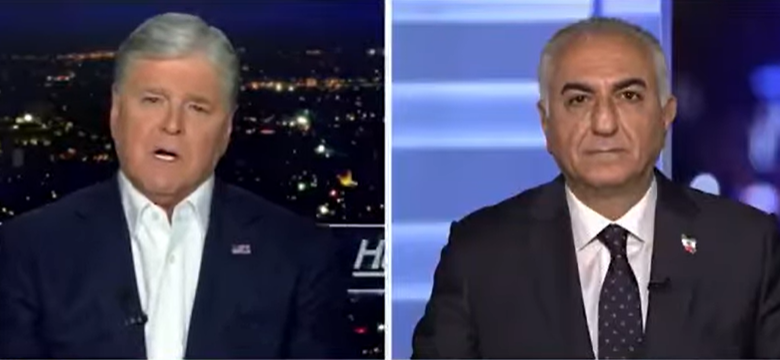
Prince Reza Pahlavi, in his conversation with “Sean Hannity,” called for pressure on the regime’s structure and the continuation of this pressure so that people have the opportunity to return to the streets.
Amid Iran’s rapid developments, Prince Reza Pahlavi’s conversation with “Sean Hannity” on “Fox News” has once again drawn attention to the strategy of “targeted pressure on the structure of power”; a strategy that in his view can not only change political equations but also open a window of hope for people who have waited for years for an opportunity to voice their wishes.
In this conversation, he described the current situation as a sensitive and fateful moment and said: “The ultimate goal is for the Iranian people to reclaim their country. To do this, they must be placed in an equal position. What happened on January 8 and 9 this year was a massacre. In such a way that 40,000 people were killed in less than 24 hours. This cannot be an achievement of any country that believes the Iranian people should be free. In fact, they wanted this intervention to find a way out.”
The Prince, referring to “General Kane’s” remarks, added: “The General is absolutely right. This regime does not care about the Iranian people. If it did, it would not bring us to the point of complete collapse and isolation as a result of its warmongering and terrorism. But the main force on the ground has always been the Iranian people and should still be the Iranian people themselves. However, they need more help and I completely agree that continuing on this path is the best solution.”
This description presents a picture of a historic turning point. A moment in which accumulated pressures can lead to fundamental change. Later, his emphasis on the necessity of continuing and intensifying these pressures is expressed as follows: “Maintain the pressure on them and target the infrastructure of the regime. Make sure the Iranian people now have an opportunity to finally return to the streets. Let us not leave this work unfinished. To go all the way, we must bring it to the brink of collapse.”
In this context, “pressure” is not merely a political tool, but part of a broader process that must, according to him, reach a decisive point: “The decisive blow, the final blow.”
However, what is highlighted in this narrative is the distinction between “the structure of power and the people”; a distinction that is repeatedly emphasized: “The target is the Islamic Republic, not the country itself.”
This perspective, in the Christian media space, can be a reminder of a deeper concept: the separation between structures of oppression and the people living within them, where hope for liberation is still preserved for the people even if the structures are on the verge of collapse.
In connection with the role of the people, the vision of the future is also drawn in an expectant tone: “The time for returning to the streets is near.”
This statement is not only a political prediction, but a sign of a society’s readiness to reclaim its voice; a voice that may have been silenced at one point, but has not been lost.
The totality of these remarks presents a picture of a phased path: “Pressure on the structure, weakening the coherence of power, creating cracks in government forces and creating the right time for people to return to the streets.” In this process, the concept of “opportunity” has a special place; a concept that is repeated many times in his remarks: “Now we have a golden opportunity at our disposal.”
In religious literature, “opportunity” is often linked with “the right moment” or “the appointed moment”; a moment that, if properly understood, can change the course of history. In this view, what is taking shape today is not merely a political transformation, but can be a point for the return of hope to the heart of society.
Prince Pahlavi’s conversation with Fox News network is, in sum, a narrative of a strategic vision in which “targeted pressure” is not defined as the end of the path, but as the beginning of a new phase, a phase in which the presence of the people can determine the final meaning and direction of developments.
Finally, this narrative emphasizes above all one central idea: that even in the darkest circumstances, the possibility of opening exists, and sometimes, pressure on rigid and closed structures can be the very factor that opens the way for the return of voices, movements, and hopes.