Saba Sepiddar, Baha’i Citizen, Transferred to Qarchak Prison to Serve Sentence

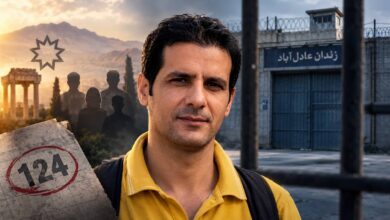
As part of intensifying pressure by the Islamic Republic on religious and faith minorities in Iran, Saba Sepiddar, a Baha’i citizen residing in Tehran, was arrested and transferred to Qarchak Prison in Varamin to serve a sentence of three years and five months; a case that once again highlights concerns about the use of the judiciary to suppress religious beliefs and restrict freedom of thought in Iran.
According to Hengaw’s report, Saba Sepiddar was arrested on the morning of Thursday, September 19 (September 10) in front of her personal residence by government forces. According to informed sources, the officers arrested her while she had just received a legal two-month grace period to report to the prosecutor’s office. Sepiddar was first transferred to the Jannatabad Prosecutor’s Office and then directly sent to Qarchak Prison in Varamin to serve her sentence.
This Baha’i citizen was previously arrested in December 2021 and spent 45 days in temporary detention. She was subsequently released conditionally after posting bail. The 29th Branch of Tehran’s Revolutionary Court, presided over by Judge Ali Mazloom, convicted her of charges including “membership in groups opposed to the system” and “propaganda activities against the system,” sentencing her to a total of four years and five months imprisonment. This sentence was reduced to three years and five months of punitive imprisonment on appeal after Sepiddar was acquitted of the charge of “propaganda against the system.”
The case of Saba Sepiddar cannot be viewed as merely an isolated legal matter. Human rights reports and international media outlets report an intensification of organized pressure on Iran’s Baha’i community in 2026; from arrests and summons to house raids, confiscation of property, and issuance of lengthy prison sentences.
According to information released by the Baha’i World Community, as of September 4, 2026, at least 69 Baha’i citizens in Iran were in detention or prison solely because of their beliefs; 39 of them are women and 30 are men. At least 21 others were serving their sentences outside of prison under electronic surveillance or on furlough.
These pressures have escalated to broader dimensions in recent months. Human Rights Watch stated in its annual report on Iran that harassment and persecution of Baha’is, including arbitrary arrests, unfair trials, and property confiscation, have intensified. The organization also reported increased pressure on other religious minorities, including Christians, Jews, Sunnis, and Gonabadi Dervishes.
Reports published in recent months even document cases of prolonged detention, solitary confinement, torture, forced confessions, and deprivation of medical treatment among Baha’i citizens. In July 2026, UN experts also expressed concern about increasing arbitrary arrests, enforced disappearances, torture, and harassment of members of Iran’s Baha’i community.
For a Christian news outlet, what matters particularly in this context goes beyond a specific legal case. Freedom of conscience and freedom of choice and expression of faith are among the most fundamental human rights. When a government places citizens under security, judicial, and prison pressure because of their religious beliefs, the issue is no longer limited to a religious minority; rather, it signifies the undermining of the principle of freedom of religion and conscience for all citizens.
Iran’s Christian community has also faced security and judicial pressures in recent years, particularly against converted Christians. The 2026 British government report also emphasizes that Iranian authorities continue to arrest Christian citizens and some active Christians, try them on vague charges such as “propaganda against the system” and security crimes, and punishments have become increasingly severe in some cases.
The arrest of Saba Sepiddar in front of her home and her direct transfer to prison, alongside dozens of similar cases, present an image of a government that, instead of respecting the religious diversity of Iranian society, has intensified pressure on religious minorities. Prison, harsh sentences, and security treatment of followers of different religions cannot erase freedom of thought, but they impose a heavy human cost on families and a society that demands the right to choose faith and live according to their conscience.