The Government Labels as Accusations, Intimidates with Bullets, and Silences with Prison
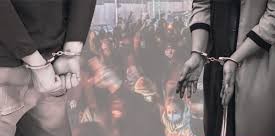
Arrest on charges of “royalism,” repeating a pattern of suppression to impose a government that the people do not want.
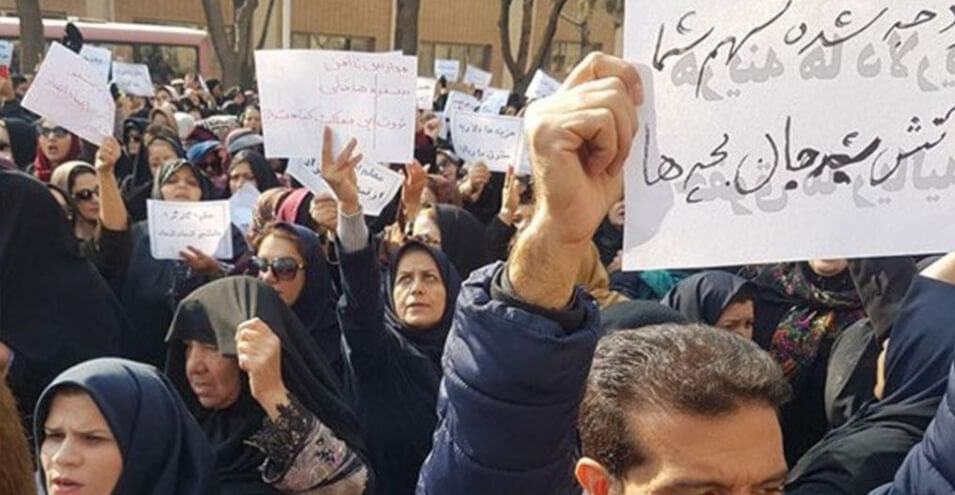
As a wave of public discontent in Iran has once again spilled onto the streets, the security apparatus of the Islamic Republic, following its customary pattern, has chosen the path of suppression, arrest, and case-making instead of responding to the demands of the people.
Based on reports from the city of Mashhad, the Intelligence Organization of the IRGC in Khorasan Razavi Province announced the arrest of a number of citizens and claimed these individuals are “elements affiliated with royalist groups.” In the same statement, it was claimed that the detainees were accused of destroying public property and the murder of a security officer, and a significant number of weapons were reportedly discovered and seized from them.
However, as has been seen repeatedly in similar cases, no transparent information has been provided about the identity of the detainees, their exact number, where they are being held, or their access to lawyers. Silence regarding the details is part of the same mechanism that has been used in Iran for years: heavy accusations, one-sided media propaganda, and denial of the right to defense.
Experience from past years has shown that the Islamic Republic responds to almost every protest movement with labels such as “affiliation with foreigners,” “action against national security and the system,” “promotion of religion contrary to Islamic law,” or “royalism.” In this official narrative, protesting people are never dissatisfied citizens, but are always presented as “guided elements.”
But the fundamental question is this: “If protests do not stem from popular demand, why do they recur repeatedly in different cities and among diverse social groups, from bazaar merchants and workers to students and women?”
Recent protests, which began with occupational gatherings, quickly gained broader dimensions. The participation of different social strata showed that the issue is not merely a limited economic demand, but rather reflects deeper discontent with the political structure and widespread civil restrictions. However, the government’s response was not dialogue or reform, but rather the presence of security forces, widespread arrests, and violent confrontations.
In a country whose constitution apparently speaks of the right to assembly, in practice, the smallest peaceful protest can result in arrest and a security case. Religious minorities, particularly Christians, civil activists, journalists, students, and even ordinary citizens who merely express opinions on social media face the danger of summons and arrest.
Now, in the case of arrests in Khorasan Razavi, without presenting independent evidence, the official narrative attempts to neutralize any public sympathy for the detainees by presenting heavy accusations. The use of terms such as “affiliated elements” or attributing charges of murder and weapons possession, prior to holding a public and fair trial, is less an act of information provision than an attempt to shape public opinion.
The main issue is not merely a few arrests in one province; it is a structural problem in which political opposition is defined not as a citizen’s right, but as a security threat. In such a framework, the critic becomes an enemy, and protest becomes a crime.
Years of suppression, widespread arrests, issuance of heavy sentences, and even deadly confrontations with protesters have deepened the rift between society and authority. Each time the government beats the drum of securitization instead of listening to the voice of the people, it reinforces the message that it seeks its survival not in public satisfaction, but in control and intimidation.
The reality is that despite all pressures, protests in Iran have not stopped. They have changed form, become dispersed, but have not disappeared. This continuity shows that the problem is not merely external incitement or the activity of particular groups; rather, there is deep-rooted discontent among segments of society that view themselves as unrepresented in the power structure.
As long as freedom of expression, freedom of thought, and the right to peaceful protest are not officially recognized, the cycle of arrest and protest will continue. The label “royalist” or any other security designation may be able to manage media space for a time, but it cannot eliminate the fundamental question: Why do some Iranians no longer accept this form of governance?
This question cannot be answered with prisons and suppression. But what has been seen so far is insistence on the same old path: “Imposition instead of persuasion, intimidation instead of dialogue, and securitization instead of accepting people’s right to choose and protest.”