U.S. Supreme Court Approves President Trump’s Immigration Order; White House Response
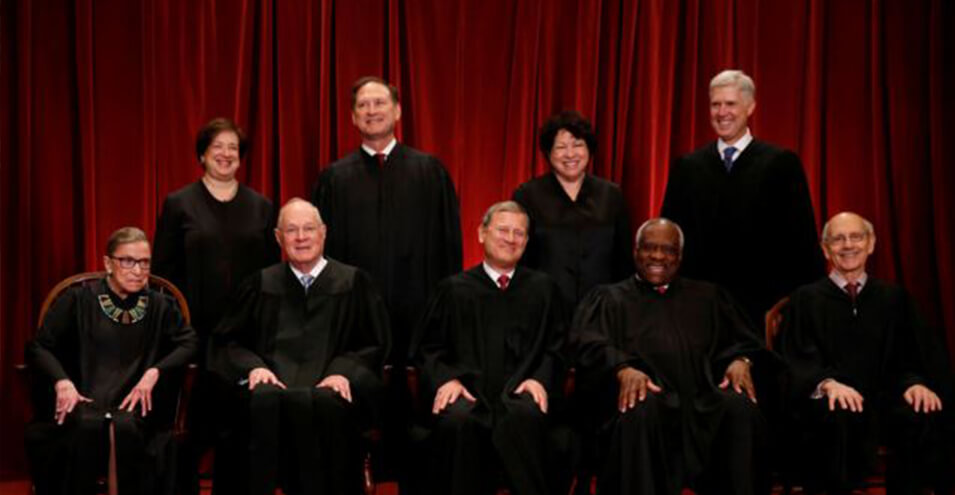
The United States Supreme Court issued its final ruling on Tuesday regarding President Trump’s executive order barring citizens of several predominantly Muslim countries from entering the United States, with the majority of justices finding it legal.
According to Reuters news agency, in today’s vote, five justices ruled in favor of the government while four justices voted against, arguing that the order constitutes religious discrimination and violates U.S. law.
The case concerning the ban on citizens of six predominantly Muslim countries – which has now become five countries following Chad’s removal from the list – was presented to the nation’s highest court on April 25.
Although the Supreme Court ruled in December to allow full implementation of the order pending review of arguments from both the government and opponents of the executive order, it was required to announce its final decision by the end of June.
Chief Justice John Roberts, while reading the ruling, stated that the president lawfully exercised the authority granted to him by the “Immigration and Nationality Act” to suspend the entry of foreign nationals into the United States.
President Trump issued the third executive order last September – following the suspension of two previous orders by federal courts – to ban citizens of Iran, Syria, Somalia, Yemen, Libya, and Chad from entering the United States.
The ban on Chad citizens was lifted on April 10 of the current year from the scope of this order.
Venezuela and North Korea are also covered by the order, but the challenge centers on the possibility of discrimination against Muslims, which the court had to examine for compliance with the Constitution and other laws and announce its final decision.
Government Response
United States President Donald Trump, shortly after the Supreme Court’s final ruling was issued, welcomed the re-affirmation of his country’s highest judicial authority regarding full implementation of the immigration order in a Twitter message.
President Trump, an hour later, described the ruling as “a tremendous victory for the American people and the Constitution” in a statement, saying the Supreme Court’s decision upheld the clear powers of the president in defending U.S. national security.
In the statement published on the White House website, he said, “In this age when global terrorism and extremist movements target innocent civilians, we must appropriately vet the backgrounds of those coming to this country.”
The American president then emphasized in remarks to reporters at the beginning of a cabinet meeting at the White House that the United States needs immigrant workers, but those who love this country and respect its values should be allowed to enter.
Jeff Sessions, U.S. Attorney General and Secretary of Justice, also previously called today’s Supreme Court ruling on the legal conformity of the presidential executive order “a big victory” for the safety and security of all American citizens.
The U.S. Department of Homeland Security also issued a statement welcoming the opinion of the majority of the U.S. Supreme Court, stating that it will continue its duties in enforcing the country’s immigration laws and will treat everyone with “humane and professional” conduct.
Opposition Response
Sonia Sotomayor, one of the Supreme Court justices who believes the order violates the Constitution and voted against it, says the court completely ignored the president’s previous statements against Muslims.
According to CNN, citing Sotomayor, today’s ruling effectively sends the message to religious minorities in our country that they are outsiders and are not considered full members of our nation’s political community.
The news network, which has taken a critical stance toward President Trump’s policies, also reported on a protest rally by a group of opponents of the immigration order in front of the Supreme Court building.
Democratic Senator Chris Coons, in response to today’s court ruling, said that the opinion that the executive order is constitutional “does not mean it is right, justified, or reflective of American values.”
Kieth Ellison, the first Muslim member of the U.S. House of Representatives, previously opposed the Supreme Court’s final ruling, saying, “Discrimination, racism, hatred, and religious bigotry will ultimately never prevail.”
The state of Hawaii is the most serious opponent of this order, considering it a violation of U.S. immigration laws as well as the Constitution, and arguing that the government should not prefer one religion over another in any case.
However, the government does not consider this order to be based on the religion of individuals and says that reviewing travel applications from citizens of these countries to America requires more time and precision; because there is no information exchange between us and them, and undesirable elements could easily enter the country.
Source: Voice of America