When Religious Bigotry in Indonesia Rises Against Churches, Reconstruction is Prohibited
Religious bigotry and exclusive religious demands in Indonesia have led to protests against church reconstruction and its closure.
Recent protests against the reconstruction of a Catholic church in Indonesia have once again raised serious questions about the extent of this country’s commitment to religious freedom and the rights of religious minorities; an occurrence that, from the perspective of many observers, is not a simple administrative dispute, but a sign of deepening religious bigotry and increasing pressure on Christians in the world’s largest Muslim-majority country.
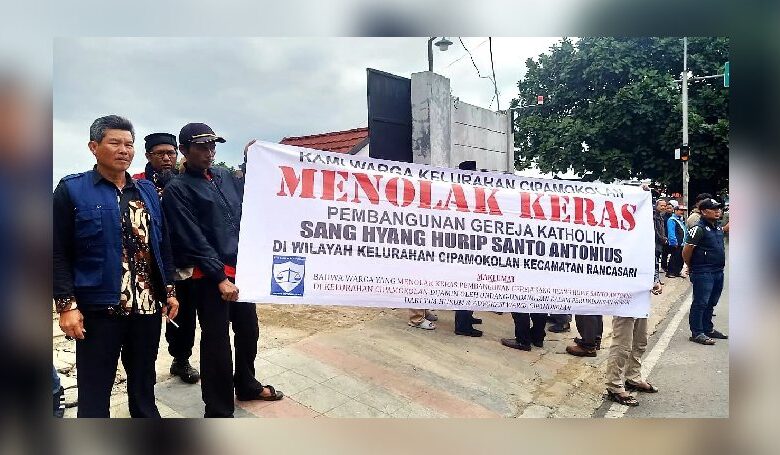
In West Java province, a group of Muslims held demonstrations in the village of “Talahjung Udik” under the “Gunung Putri” district in “Bogor” state, demanding the closure of the Catholic church “Saint Vincentius A. Paulo.” The protesters claim that the reconstruction of this church lacks legal authorization, a claim that contradicts official documents and statements from government authorities.
According to reports from local media, the “Islamic Empowerment and Development Organization” called for the demolition of this church on December 6. During this gathering, protesters held placards with the slogan “Close and demolish illegal churches”; a slogan that, in the view of many, clearly went beyond a legal protest and carried a hostile message against the presence of Christians in the area.
“Anhari Sultani,” spokesman for this Islamic organization, claimed in interviews with media that the church was constructed approximately 25 years ago without adequate coordination with the local community and therefore, current reconstruction efforts should be halted. This is while official authorities present a different narrative.
In response to these protests, “Ahmad Sejukri,” head of the religious affairs office in Bogor district, while expressing regret about the holding of these demonstrations, confirmed that the church’s permit was issued at a November 17 meeting of the Bogor district’s national and political unity committee. According to him, even representatives from hardline Muslim movements were present at that same meeting and the permit issuance process was conducted legally.
On the other hand, “Cyprianus Edi Hardum,” lawyer for Saint Vincentius A. Paulo church, rejected the claims made by the protesters and said: “This church has an official permit that was issued on December 21, 2000.” The official website of the Bogor diocese also announced that this church has been active since 2001 with the support of part of the local community and currently has more than 1,800 members.
What makes this case more concerning is its placement within a broader framework of the duplicitous behavior of extremist Islamic currents in various parts of the world. Critics argue that while Muslims in many countries of the world freely engage in building mosques, Islamic centers and their religious symbols and enjoy legal rights of worship, in countries with Muslim majorities, Christians often face opposition, threats and social pressure even for maintaining or reconstructing their ancient churches.
Multiple international reports show that in some areas, exclusivist interpretations of Islam operate in such a way as if the presence of other religions is intolerable and society should be defined solely on the basis of the religious identity of the majority. This mentality has in some cases led to the destruction of churches, restrictions on Christian worship, and even violence against religious minorities.
The international organization “Open Doors” has also warned that in recent years Indonesia has moved toward a more conservative and less tolerant Islam, a trend that has made churches, especially those that are active or growing, more vulnerable than before. In such an environment, laws and administrative requirements sometimes become not a tool for social order, but rather a pretext for limiting the religious freedom of minorities.
The case of Saint Vincentius A. Paulo church has now become a symbol of a fundamental question: “Is religious freedom in Indonesia a universal right, or a privilege that is only defined within the framework of the will of the majority?”