Satellite Images Show ‘Severe Explosion at IRGC Missile Research Center’
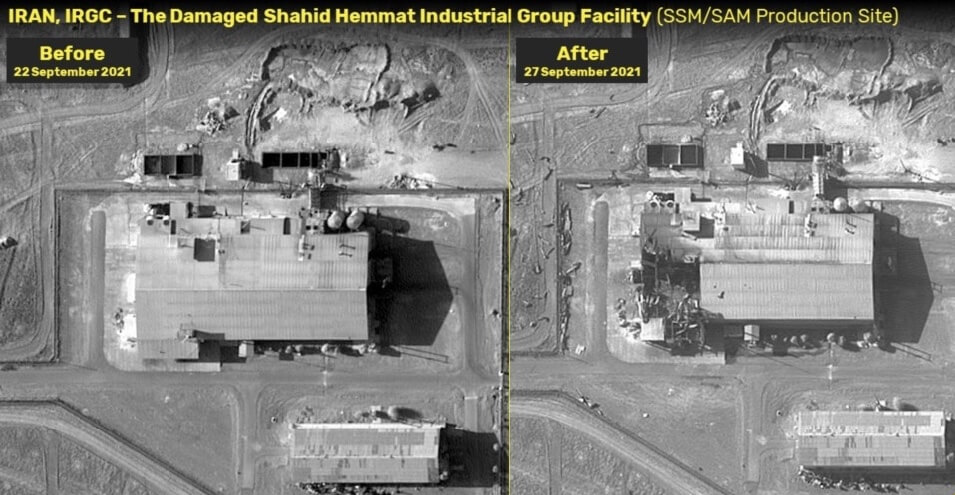
Satellite images released by ImageSet Intel, an international intelligence advisory group, show that an explosion on the fourth of Mehr caused severe damage to a building at a Revolutionary Guards research center.
According to ImageSet Intel’s report, the explosion occurred at the facilities of the “Shahid Hemmat Industrial Group,” which is a “secret missile base of the Islamic Revolutionary Guards Corps.”
ImageSet Intel states that the mysterious explosion at the mentioned center shook western Tehran.
The “Shahid Hemmat Industrial Group” is a subsidiary of the Aerospace Organization under the Ministry of Defense and Support, and is a manufacturer of liquid-fueled ballistic missiles. The United States imposed sanctions on the Hemmat Industries Group in 2005.
Following Iran’s test of the Simorgh satellite launch vehicle in 2017, the U.S. Treasury Department imposed sanctions on six subsidiaries of the “Shahid Hemmat Industrial Group.”
The U.S. Treasury Department stated that six subsidiaries of the “Shahid Hemmat Industrial Group” — namely Shahid Karimi Industries, Shahid Rastegarq, Shahid Charaghi, Shahid Varamin, Shahid Kolbar, and Amir al-Mu’minin — “are engaged in research and development and manufacturing of missile bodies, guidance systems, and liquid fuel.”
Explosion at ‘IRGC Self-Sufficiency Research Center’
News agencies close to the Revolutionary Guards reported on the fifth of Mehr that according to the organization’s public relations office, during a “fire at one of the IRGC’s self-sufficiency research centers,” two employees named Morteza Karimi and Hossein Abedi were killed, and one other person was injured.
According to Farsnews and Tasnim news agencies, the “fire” occurred on the afternoon of Sunday, the fourth of Mehr. However, they did not publish any details about the research center or the cause of the “fire” and only stated that “with the efforts of firefighters at this center, the fire was contained and the victims of the incident were transferred to the hospital.” The news of the death of two of these wounded individuals was published after the initial report of their transfer to the hospital.
In one of the deadliest explosions at IRGC missile bases in November 2011, Hassan Tehrani Moghaddam, head of the IRGC’s Self-Sufficiency Jihad Organization and one of the founders of the Guards’ missile program, was killed.
The IRGC’s public relations office announced a few days after this incident that 17 people were killed in an explosion at the Bidganeh-Malard military base located in western Tehran.
The deputy commander of the IRGC’s Self-Sufficiency Jihad Organization announced at that time that “General Tehrani Moghaddam was killed while conducting research and scientific work.”
Based on ImageSet Intel’s Twitter report on Thursday, the eighth of Mehr, satellite images from the 31st of Shahrivar show that the building of the mentioned center was intact, but images from the fifth of Mehr (one day after the explosion) show severe damage to the building and destruction of part of it.
These images indicate that the destruction of part of this building was caused by an explosion and not a “fire” as the Revolutionary Guards claim.
In the satellite images, it is clear that the roof of the building was blown off after the explosion and its debris was scattered around.
No details about the cause of the explosion have been released yet, but in recent years, fires and explosions at nuclear, security and military centers of the Islamic Republic have become commonplace, and officials of the Islamic Republic have consistently pointed the finger of blame at Israel in this regard.
On the second of Tir, Iranian media reported on the neutralization of a drone attack on Iran’s centrifuge technology company, TESA, in Karaj.
However, the Intellab intelligence institute announced by releasing satellite images that Iran’s Atomic Energy Organization facilities in Karaj were damaged “during a drone attack” on the second of Tir.
Nevertheless, IRGC commanders and officials of the Islamic Republic of Iran chose silence this time and have not yet blamed any group or country for involvement in this explosion.
Source: Radio Farda