Dr. Malekzadeh’s Warning: 45 Percent of Global Opium Consumption Occurs in Iran; A Reality That Cannot Be Hidden
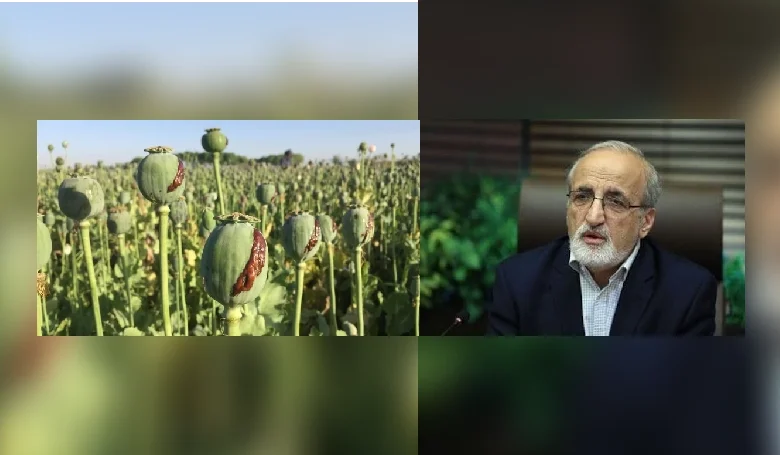
Recent statements by Dr. “Reza Malekzadeh,” former deputy health minister and one of Iran’s most renowned health researchers, have once again brought the alarming dimensions of the opium consumption crisis in the country to the forefront of public attention.
Dr. Malekzadeh, who has spent years researching non-communicable diseases and health risk factors in Iran, states that Iran is the world’s largest opium consumer and approximately 45 percent of globally produced opium is consumed in Iran. In his statements, he declared: “Unfortunately, opium consumption in Iran is extremely high. People over ten years old and approximately 10 percent of Iran’s population consume opium either recreationally or additively. Furthermore, in some regions, the situation is far more severe; such that Rafsanjan with 27 percent and Golestan with 18 percent have the highest rates of opium consumption.”
This researcher has also repeatedly warned that opium is not merely a drug, but is classified as a definite carcinogenic substance and is associated with various types of cancer, including lung, bladder, laryngeal, esophageal, and throat cancers. However, beyond the health aspect, these statistics raise a major question.
If we base our assessment solely on the figures mentioned in some accounts of related research and speeches on this topic and assume that approximately 10 percent of the population over 10 years old in the country are opium consumers, we face a population of around 9 million people. Now, if each consumer on average consumes only 2 grams of opium daily, the country’s daily consumption reaches approximately 18 million grams or 18 thousand kilograms; that is, nearly 18 tons of opium every day.
The consumption of eighteen tons of opium per day is not just a figure; this volume is equivalent to dozens of trucks of narcotics throughout each month. The fundamental question here arises: how does such an enormous volume of drugs reach consumers?
If official institutions are able to provide statistics about the number of consumers, high-risk areas, and consumption patterns, should they not also publish transparent and verifiable reports about the supply network, routes of entry, major distributors, and the financial circulation of this market?
On the other hand, if we estimate the average price of each gram of opium at 100 thousand tomans, the value of just these 18 tons consumed daily reaches approximately 1,800 billion tomans per day. That is, hundreds of thousands of billions of tomans in capital circulate annually in a market whose effects can be observed in the increase of diseases, mortality, family disintegration, and decreased economic productivity. This figure is merely a hypothetical estimate based on assumed consumption levels and prices and will change with fluctuations in market price.
The bitter reality is that the opium crisis in Iran is no longer merely a medical or administrative issue; it is a national problem. A country that, according to the statements of one of its most prominent medical researchers, consumes nearly half of the world’s opium, must necessarily answer the question of where this enormous volume of narcotics originates, how it is distributed, and why, despite decades of official drug enforcement efforts, it remains accessible to millions of people?
As long as there is no clear answer to these questions, the shocking consumption statistics will, rather than being indicative of success in monitoring social harms, be a sign of failure in controlling one of the country’s deepest crises of public health and social security.