Iranian Kurds demonstrate in Brussels on the 30th anniversary of Ghasemlou's assassination
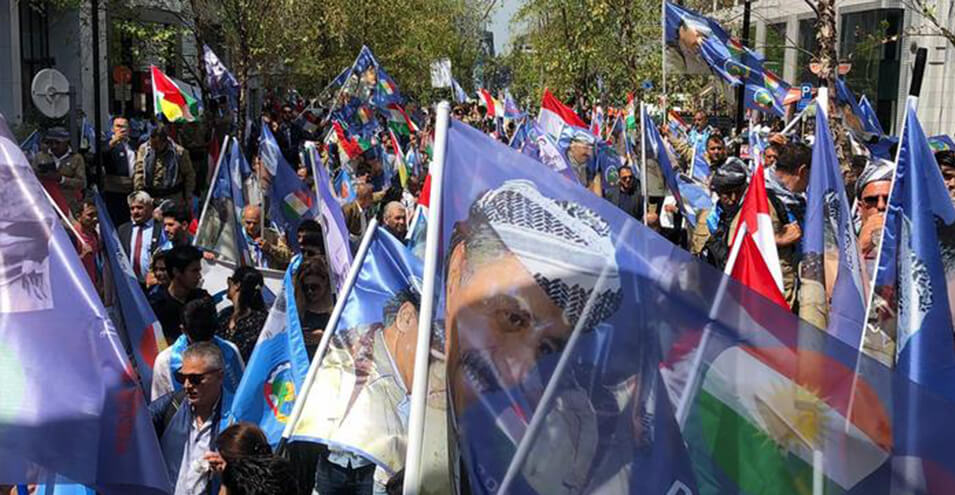
It has been 30 years since the assassination of Abdolrahman Ghasemlou, the Secretary General of the Kurdistan Democratic Party of Iran. On this occasion, more than 1,500 Kurds demonstrated in Brussels. The demonstrators called on Austria and the European Union to ensure justice in the case of Ghasemlou's assassination.
On Tuesday, July 9, more than 1,500 people demonstrated in Brussels to mark the 30th anniversary of the assassination of Dr. Abdolrahman Ghasemlou, former Secretary General of the Kurdistan Democratic Party of Iran.
Some members of the European Parliament, Kurdish artists from different parts of Kurdistan, and representatives of the Iranian opposition were also present.
Rahim Rashidi, a Kurdish journalist based in Washington who came to Brussels to report, told DW Persian: "The demonstration lasted about an hour and a half from the center of Brussels to the front door of the European Parliament. The Kurds marched in front of the European Parliament wearing Peshmerga uniforms and chanted that they were victims of terrorism and that they had been fighting terrorism for about 40 years."
Rahim Rashidi continued: "For the first time, part of the Canadian Parliament, official members of the Canadian government, some representatives of the US Congress, and even some American generals sent a video message."
Mustafa Hejri, the first secretary of the Kurdistan Democratic Party of Iran, spoke at the Kurdish demonstration in Brussels. In part of his speech, he referred to the West's relations with Iran and said: "Iranians have been victims of the Islamic Republic's policy of terror. Iran does not respect international agreements and is the main sponsor of terrorism in the region."
Rahim Rashidi, a Kurdish journalist who was present at the demonstration, told DW: "Due to the 30th anniversary of Qasemlou's assassination, there have been very large demonstrations this year. The demonstrators demanded the reopening of the Qasemlou assassination case, and part of their slogans was related to the implementation of justice in the Qasemlou assassination case, and they asked Austria and the European Union to help in this regard."
The Kurdistan Democratic Party of Iran wrote in a statement issued on the occasion of the 30th anniversary of Ghasemlou's assassination: "On July 13, 1989, Dr. Ghasemlou was assassinated and martyred in Vienna, at a table that appeared to be a negotiation, along with his brother Abdullah Qaderi Azar, a member of the party's Central Committee and the party's representative abroad, and Dr. Fazel Rasoul, one of the brothers of Iraqi Kurdistan."
The leaders of the Kurdistan Democratic Party of Iran said that the case of Qasemlou's assassination is still open 30 years after Qasemlou's assassination. No trial was held in Austria after Qasemlou's assassination. Various sources, including the Kurds themselves, stated that "the terrorists entered Austria under diplomatic cover and left Austrian soil with the cooperation of the Iranian embassy after the assassination."
Hashemi Rafsanjani has repeatedly mentioned the incident of Ghasemlou's assassination in his memoirs. Rafsanjani writes in his memoirs of July 20, 2010: "Mr. [Mahmoud] Vaezi [Deputy Foreign Minister] called from Tehran and reported that the Austrian Foreign Minister had said that Iran was most likely involved in the murder of Ghasemlou. I said, 'Consult us for an answer.' He said that the Austrians had handled it well. They had acquitted the Iranian agent and sent him to Iran . "
Austrian media reported at the time that the Vienna General Court was unwilling to issue an arrest warrant for the Iranian agents due to a lack of sufficient evidence.
Hassan Sharafi, deputy first secretary of the Kurdistan Democratic Party of Iran, but in an interview with Deutsche Welle previously said about Ghassemlou's assassination: "The German judiciary maintained its independence and condemned the top leaders of the Islamic Republic for their involvement in the Mykonos assassination, but Austria has not done so, so Dr. Ghassemlou's case is still open."
The Islamic Republic of Iran has not yet officially claimed responsibility for Ghasemlou's assassination.
Rahim Rashidi told DW that Iranian Kurds recognize Ghasemlou as a national figure and more than just the leader of a political party. Rashidi also said that people in Kurdish areas of Iran are expected to go on a nationwide strike on July 12, the anniversary of Ghasemlou's assassination, as they have done in previous years.