The "Bitter Story" of Children Left Out of Education in Sistan and Baluchestan Continues; Interview with Abdul Sattar Doshuki
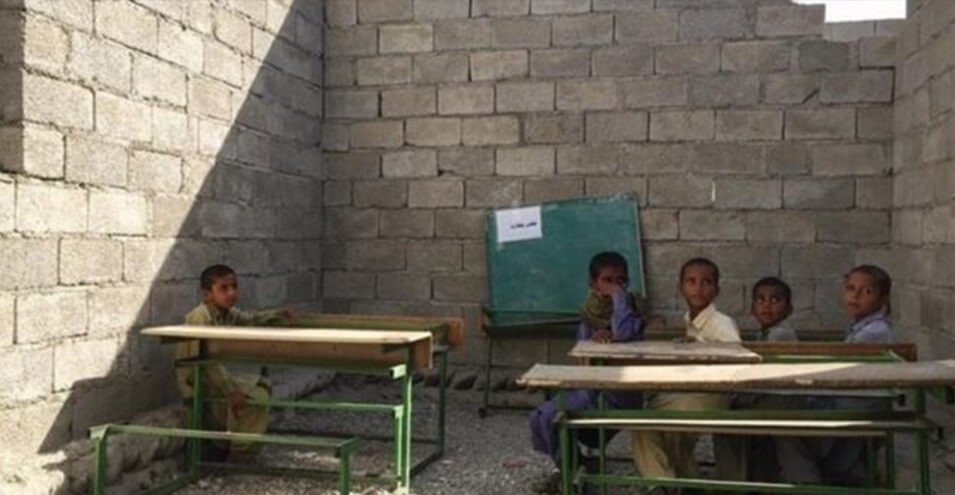
While no exact statistics have been provided on the number of school dropouts in Sistan and Baluchestan province, according to the President's "Deputy for Women and Family Affairs" at the opening ceremony of a charity school in Iranshahr earlier this week, this province has the highest number of school dropouts in the country.
Reports indicate that the majority of dropouts in Sistan and Baluchestan are girls. In addition, deprivations such as distance from school, difficult access from some villages to schools, early marriages, poverty, cultural issues, population dispersion, etc. in Sistan and Baluchestan have caused this province to have the highest dropout rate among the 31 provinces in the country.
Sistan and Baluchestan Province is located in southeastern Iran, as the second largest province in the country after Kerman Province.
Absolute poverty
Abdul Sattar Doshuki, head of the Balochistan Studies Center in London, told the Persian section of Voice of America: "The lack of access to educational facilities is not only in villages but also in cities like Chabahar. The majority of people in these areas are marginalized. There are no schools in these areas. On the other hand, many families, due to financial poverty, cannot afford to buy the minimum educational supplies such as books, bags, shoes, and clothes, as well as transportation expenses. This is while many families do not consider education in Sistan and Baluchestan province beneficial because they see that thousands of university graduates have not achieved anything and are unemployed. For this reason, many children of school age and a number of children who have dropped out of school are attracted to religious schools because education in these schools is free."
Inconsistent statistics
The head of the Balochistan Studies Centre in London also stated that statistics on children out of school are contradictory.
Mr. Doshuki said: "Three years ago, the Minister of Education announced the number of dropouts at 149,000, and this year it is 120,000. These statistics are contradictory. On the other hand, they have not specified whether these number of dropouts are from primary school or secondary school."
He also said about the origin of these children deprived of education: "These children are mainly from families that receive subsidies or are very poor, marginalized, and homeless. After they stop studying, they are attracted to jobs such as diesel smuggling in adulthood."
According to the Constitution of the Islamic Republic of Iran, the government is obligated to provide all Iranians with the conditions for education up to the end of high school.
Mr. Doshouki says that the Islamic Republic of Iran has not only failed to fulfill its obvious duty, but is also projecting.
He said: "The Islamic Republic officials not only provide contradictory statistics but also contradictory reasons regarding the dropouts in Sistan and Baluchestan province, and they always say that girls in this province are not educated due to early marriage, while official statistics indicate that less than 500 girls in the province are married at school age. On the other hand, the claim that families send 7-year-old girls to the house of luck is a complete lie. Some families in the province, like many other parts of the country, send their daughters to the house of luck at the age of 14-15; these are projections of the Islamic Republic to show that children are not educated due to the cultural problems of the people of the province."
Kind to others
This London-based civil activist has another point: He says the Islamic Republic is kind to some who align with the regime's goals, but not to its own people.
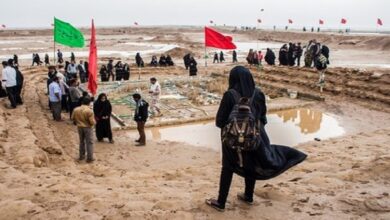
He said: "In the last few days, more than 30,000 Pakistani Arbaeen pilgrims have entered Sistan and Baluchistan through the Mirjaveh border and have benefited from all the health facilities that the Baloch people are deprived of. If the government cannot equip schools and educational facilities in Sistan and Baluchistan province, then how can it reduce the funds of the deprived people of the province and finance these trips for Pakistani pilgrims at government expense?"
The issue that Mr. Doshuki mentions has also occurred in other parts of Iran.
Last week, the Islamic Republic of Iran announced that it would send welfare and medical facilities to Iraq for use by Arbaeen pilgrims. This is despite the fact that there are problems with medicine and treatment inside Iran.
Source: Voice of America