Mohsen Al-Wairi: Jews and Christians are very interested in the mourning ceremonies for Imam Hussein
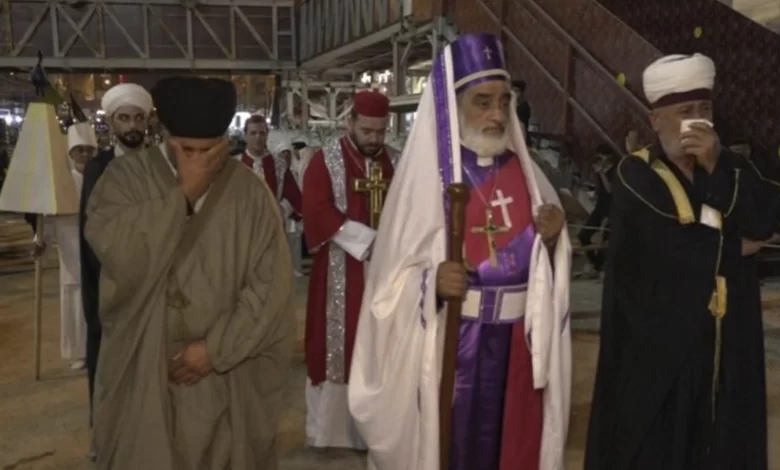
On the eve of Ashura, Hojjat al-Islam and Muslimin Mohsen al-Wairi spoke about the interest of Jews and Christians in the mourning ceremonies for Imam Hussein.
Hojjatoleslam wa al-Muslimeen Mohsen al-Wairi, director of the History Department at Baqir al-Uloom University and editor-in-chief of the quarterly scientific-research journal History of Islam, provided the following explanations to the reporter regarding the interfaith function of Ashura.
In response to the question, "Does Ashura have an interfaith function?", he said: "Ashura and the culture of Ashura share teachings with other Abrahamic religions or cultures similar to them in several aspects. In addition to the similarity of the main teachings of Islam with other Abrahamic religions, six issues about Ashura can be considered with an interfaith approach and, relying on them, convergence between followers of Abrahamic religions can be strengthened."
While introducing Hussein ibn Ali as the heir of Moses (the Word of God) and Jesus (the Spirit of God), Mohsen Al-Wairi added: "In some sections of some pilgrimage books, especially the pilgrimage of the Heir, Imam Hussein (AS) is introduced as the heir of all prophets, two of which are Moses and Jesus, the prophets of the Jews and Christians. In another place, he is also introduced as the heir of the Torah, the Gospel, and the Psalms. When Imam Hussein (AS) is introduced as the heir of the prophets of these two great heavenly religions and the heir of their heavenly book, the role of that Imam as a role model will expand among the followers of other religions, and a great capacity will emerge for the followers of these religions to converge with the followers of the Ahl al-Bayt school."
These words by Mohsen Al-Wairi and the introduction of Hussein bin Ali as the heir of Moses and Jesus come at a time when many Christians and Jews in Iran are being severely persecuted and even facing heavy prison sentences and fines.
He continued his speech regarding the influence of parts of the Shiite mourning tradition on Christian mourning, saying: "From a historical perspective, when we accept that traditions such as mourning that leads to wounding the body or shedding blood from the body have entered the Islamic world from the Christian mourning tradition, we can, while warning against the mixing of Islamic culture with objectionable traditions, use this issue as a proposal and support for intercultural communication in the future and finding a way to mutually influence Christians."
Mohsen Al-Wairi equated the analyses of the Ashura ceremony with the sufferings of Jesus Christ and his crucifixion, adding: "Some of the views and analyses common to us about Ashura and the martyrdom of Imam Hussein (AS) have similarities with some theological views of some Christians about the crucifixion of Jesus Christ (AS). Regardless of our belief about the lack of martyrdom of Jesus (AS) and regardless of whether such views are correct or not in Shiite circles, discussions about concepts such as sacred suffering, sacrifice for the forgiveness of sins, and the merging of the blood of God's servant with the blood of God can pave the way for interfaith dialogue."
His words about the shedding of blood from the body during mourning ceremonies and its introduction from Christianity to the Islamic world, while the blood of Jesus Christ was shed to forgive the sins of humanity, not to perform the tradition of mourning ceremonies, and in this category there is a significant difference between the shedding of Jesus Christ's blood for the forgiveness of sins and the shedding of blood to perform the tradition of mourning ceremonies on the day of Ashura. One of the significant differences in holding the aforementioned ceremony is that Christians do not injure themselves and do not shed their blood for the crucifixion of Jesus Christ, because as Muhsin Al-Wairi mentioned in his statements, Christians believe that Jesus Christ gave his blood as a ransom for the forgiveness of the sins of humanity so that whoever believes in him will have his sins forgiven and have eternal life; but in the tradition of holding the Ashura mourning ceremony, Muslims injure themselves and shed their blood to accompany the killing of Hussein bin Ali in order to experience the correction of the suffering he suffered, not the forgiveness of their sins.
He continued about the reflection of Ashura in Christian literature: "Another area of interfaith interaction is the devotion and fascination of followers of other religions, especially Christians, for Imam Hussein (AS) in the form of their writings and poems. The collection that Mr. Zaeri has compiled in the book "Father, Son, Holy Spirit" is a good example in this regard. Completing such studies and research will initially lead to the convergence of elites and then the convergence of the masses. In areas where followers of other religions peacefully coexist with Shiites, they are almost without exception interested and even very fascinated in attending the mourning ceremonies for Imam Hussein (AS) and helping to hold them (such as welcoming mourners and contributing to the expenses) or performing ceremonies similar to Shiite ceremonies (such as setting up a breast-beating group or visiting the holy shrine of Sayyid al-Shuhada). This issue is even seen among followers of non-heavenly religions, such as Hindus, in Shia-populated cities in India (such as Lucknow). This issue also has an interfaith function and clearly shows how Imam Hussein (AS) is a common divine capital for the gathering of all religious believers, and recording the many memories and experiences related to this issue can help the followers of heavenly religions to empathize with the centrality of Imam Hussein (AS).
Given that in recent years many Iranians have abandoned Islam and converted to Christianity, the government of the Islamic Republic of Iran has imposed severe restrictions on Christians and in many cases has carried out arrests, detentions, torture, executions, long-term imprisonments, confiscation of their property, etc.
On many occasions, we have witnessed persecution of Jews, such as the attack on the tombs of Mordechai and Esther and their burning, as well as the ban on employment and even, in some cases, the ban on education. However, for ceremonies such as presidential elections, parliamentary elections, Ashura ceremonies, and other Islamic traditions, the government of the Islamic Republic extends a hand of friendship to Jews, Christians, and Zoroastrians and asks for their help so that it can portray itself in the eyes of the world as a government that is friendly to all religions and has no problems with them. But is the portrayal of the government of the Islamic Republic in such cases believable?