Masoud Pezeshkian: People Are Under Economic Pressure, But Decisions on War and Peace Rest with “Leadership”
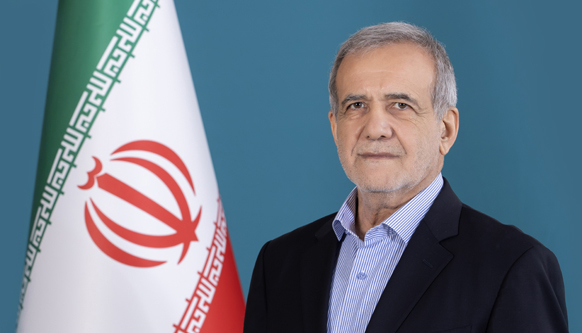
Iran’s President Masoud Pezeshkian, while the country remains in a state of “neither war nor peace,” identified his government’s primary concern as the people’s livelihood and economic conditions, while simultaneously reaffirming Tehran’s readiness to continue dialogue with the United States. His remarks demonstrate that economic pressure, the risk of renewed conflict, and efforts to reach an agreement continue to form the three main pillars of his government’s policy.
Pezeshkian stated on Saturday, August 17 (August 8 in the Western calendar), in his press conference that his primary concern in the current conditions is not, as might be assumed, a renewed American attack, but rather the living conditions of the people. He said: “My most important concern in the condition of neither war nor peace is not that America attacks again; my most important concern is the livelihood and economic conditions of the people.”
Iran’s president, in another section of his remarks, referring to external threats and the country’s internal situation, claimed that the United States and Israel have concluded that they cannot force the Islamic Republic to surrender through military attack alone. He stated: “America, Israel, and their analysts know that wars and missiles can no longer force a country into submission and acceptance of their demands, but through disagreement, division, and internal conflicts, this can be achieved.”
These remarks come at a time when Pezeshkian has also emphasized in recent weeks the importance of internal unity and resolving economic problems. International reports on his recent statements have also emphasized that Iran’s president views economics and people’s livelihood as one of the most important fronts against external pressures.
Another important focus of the press conference was the issue of the internet—a matter that in recent months has become one of the Islamic Republic’s most significant domestic challenges. Regarding the government’s promise to restore internet conditions to pre-restriction levels, Pezeshkian said that some security institutions remain concerned about potential threats.
He explained: “Some security agencies perceive threats in this regard and are also concerned given the attacks on infrastructure that occur through this means.”
Nevertheless, Iran’s president stated that the government has decided to pursue opening the internet. He added: “Despite all these matters, we have decided that the internet should be opened and we will endeavor to improve its infrastructure. We are in dialogue with the heads of the three branches regarding this and are also in contact with the Supreme National Security Council, and we will try to solve the problems.”
The internet issue in Iran remains contentious among different sectors of government, as previous reports have shown that internet restrictions have caused significant damage to businesses and economic activities. Analytical reports have also indicated disagreement within the power structure on how citizens should access the global internet.
Pezeshkian went on to describe the country’s economic situation as “unsuitable and unacceptable” and directly addressed the increase in economic pressures and inflation. He said: “When these pressures increase day by day and instead of solving the issue, it becomes more complicated, naturally I now declare that our situation regarding inflation is absolutely unacceptable.”
This section of Iran’s president’s remarks came at a time when he had previously spoken multiple times about livelihood problems, inflation, and declining purchasing power. Even in foreign reports about the Pezeshkian administration, the economy and livelihood have been identified as among the government’s main challenges.
However, another section of Pezeshkian’s press conference focused on the Iran-Pakistan memorandum of understanding—an agreement that in recent days has become the subject of various discussions and analyses. In defending this memorandum, Iran’s president said that no concessions were made by Tehran.
Emphasizing his position, he said: “Regarding the discussion of the Pakistan memorandum, the memorandum that was signed, I have said many times and I say it now, you will not find any clause in it where we gave something away.”
Pezeshkian challenged critics and analyses that have characterized this agreement as a retreat by the Islamic Republic, saying: “Whoever has read it, let them compare it with the analyses of foreign news agencies. Do they say we surrendered? Did we come up short? Was this agreement, for instance, an irrelevant agreement that was signed? We stand firmly by what we have written and defend it.”
Iran’s president also claimed that following the signing of the memorandum, the process of easing the blockade and restrictions began, and some oil and petrochemical pressures were also reduced. He said: “The day after the memorandum was signed, the blockade was supposed to be gradually lifted. To the extent that we lifted the blockade in the Strait of Hormuz, they too reduced the blockade on their side and lifted our oil and petrochemical sanctions.”
Claims regarding negotiations and pressure reduction come at a time when developments related to the Strait of Hormuz and efforts to achieve new mechanisms for maritime passage remain at the center of regional developments. Oman also announced on Saturday progress in negotiations related to maritime arrangements in the Strait of Hormuz in a “positive and constructive” atmosphere.
Pezeshkian also discussed developments in Lebanon, saying that the Islamic Republic of Iran was able to create conditions for ending the war in that country through political and regional pressures. He said: “They ended the Lebanon war with a few days’ delay, but ultimately, despite being a different country, the Islamic Republic forced them to have America pressure them and stop the war in Lebanon.”
Iran’s president, in another section of the press conference, reported on negotiations regarding frozen financial resources and programs for investment in the reconstruction of war-damaged areas. He said: “We were also negotiating about the return of frozen financial resources, and on the other hand, the negotiating team was in dialogue about investment for the reconstruction of areas damaged by war.”
Despite domestic and international criticism of the negotiation process, Pezeshkian emphasized that the government will continue to pursue the path of agreement, provided that Tehran feels a climate of trust has been restored between the two sides.
He said: “The whole matter is that we are determined, God willing, to use that same memorandum as a basis, on the condition that America abandons the atmosphere of distrust it has created and an atmosphere of trust is established.”
Pezeshkian’s remarks about continuing the path of negotiations with the United States come at a time when international media outlets have also dedicated an important part of today’s discussion to this issue. Reports published after the press conference have characterized Iran’s president’s remarks as an indication of Tehran’s willingness to use current conditions to reach an agreement.
Pezeshkian viewed the current situation as an opportunity for dialogue and pursuing Iran’s demands, saying: “Under such circumstances, we can pursue our rights and demands through dialogue; they must accept that our rights be recognized and provided. Naturally, we too demand nothing other than the rights and rights of our own country and people.”
Finally, regarding the question of whether decisions on continuing war or moving toward peace are in the government’s hands, Iran’s president clearly highlighted the role of military commanders and the Islamic Republic’s leader. Pezeshkian said: “Whether we fight or not, military commanders know better than you and I. They know their own power. The leadership decides.”
Thus, Pezeshkian’s press conference presents a dual picture of the Islamic Republic’s situation: on one hand, Iran’s president speaks of economic pressure, inflation, and concern about the people’s livelihood and considers the economic situation unacceptable; on the other hand, he emphasizes the continuation of security policies, preservation of regional positions, and defense of concluded agreements.
However, the most important political message of today’s remarks by Pezeshkian can be found in his simultaneous emphasis on “dialogue” and “readiness for defense”—an approach in which the government, on one hand, seeks to open the path to agreement with America and, on the other hand, places the final decision on war and peace outside the direct control of the government. Under such circumstances, it appears that the economic crisis and pressure on people’s lives remain the most important internal test for the Pezeshkian government—a test that the president himself described today as more important than concern about a renewed American attack.