Execution of Alireza Sepahi and Alireza Raisi, Victims of the “Aliekhani Square” Case
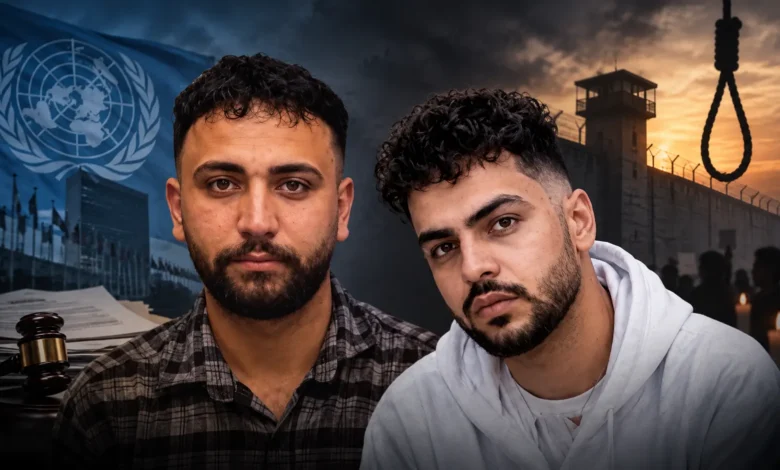
The Islamic Republic, continuing its wave of executions of detainees arrested during December 2024 protests, executed two young men, Alireza Sepahi and Alireza Raisi, sentenced to death in the case known as the “Aliekhani Square” incident in Isfahan, at Dastgerd Prison on Monday morning, October 4, 2025. The executions were carried out despite prior warnings from the United Nations and human rights organizations regarding trial procedures, forced confessions, and violations of the defendants’ rights in this case.
Alireza Sepahi, born in 2001, and Alireza Raisi, born in 2004, were among those arrested during December protests in Isfahan and were defendants in a case formed in connection with the death of four security forces during the January 8, 2026 protests. According to human rights sources, at least 12 people were sentenced to death in this case, facing charges such as “moharebeh” (enmity against God), “efsad fil-arz” (corruption on earth), and participation in the killing of security forces. The Islamic Republic’s judiciary has claimed that the death sentences were executed after confirmation by the Supreme Court.
However, what transforms these executions from a routine judicial sentence into a serious human rights issue is the widespread ambiguity surrounding the trial proceedings. United Nations experts warned in June 2025 that issuing death sentences for 12 people in a single session, in a closed court without clarifying individual responsibility for each defendant, contradicts fair trial standards. They also expressed concerns about reports of arbitrary detention, ill-treatment, and the use of confessions that were broadcast on state television.
Concerns about Alireza Sepahi continued even after his sentence was issued. He was scheduled to be executed on July 28 publicly in Aliekhani Square in Isfahan, alongside Abolfazl Sepahi and Amirhossein Safari, but shortly before the execution was carried out, he suffered a medical condition and was transferred to a hospital. Two other defendants were executed in the same square that day, and Sepahi temporarily escaped death.
However, this postponement was not the end of the matter. In September, Sepahi’s lawyer announced that Branch 39 of the Supreme Court had agreed to a retrial, but the concurrent branch of the Revolutionary Court in Isfahan rejected the request without holding a hearing and sent the case for execution. Iran Wire also reported that his lawyer made this announcement under circumstances where the case was expected to be reviewed again with respect for the defendant’s legal rights.
Human rights reports have also documented allegations of torture of some defendants and attempts to obtain confessions against Sepahi. Iran Human Rights Organization has stated that some other defendants claimed they were subjected to pressure and torture during interrogation to confirm Sepahi’s presence at the scene of the incident; however, no independent and effective investigation into these claims has been conducted.
“Mai Sato,” the UN special rapporteur on human rights in Iran, also spoke after Sepahi’s execution about what she called “serious concerns” regarding the treatment of defendants and adherence to fair trial standards. According to her, there were reports that Sepahi’s mother was tortured in front of him, and he and his cousin were also beaten and tortured in front of family members. Sato emphasized that the temporary halt of Sepahi’s execution due to his medical condition did not mean his salvation, and his death sentence was eventually carried out.
The “Aliekhani Square” case has previously witnessed the execution of four other defendants. Erfan Esfandiari and Golmohammad Mohammadi were executed on July 19, and Abolfazl Sepahi and Amirhossein Safari were publicly hanged in Aliekhani Square in Isfahan on July 28. With the execution of Sepahi and Raisi, the number of those executed in this case has increased, and several other convicts remain at risk of execution.
These executions are also part of a broader process that has been repeatedly criticized by human rights organizations in recent months. Human Rights Watch announced in September that between March 18 and the end of August 2026, at least 59 men have been executed on political charges and vague charges related to national security, with at least 29 of them arrested in connection with December 2025 and January 2026 protests. The organization stated that many of these cases involved very brief trials, violations of the right to defense, and confessions allegedly obtained under torture or pressure.
Now the execution of Alireza Sepahi and Alireza Raisi, just two days after the execution of Siavash Jamshidi Khirabadi, again demonstrates that death sentences issued against detainees from December protests continue to be carried out. For families who have waited for months and sometimes nearly a year for these sentences to be halted, this process means losing their children one after another, and for human rights organizations, the fundamental question remains: can one speak of fair trial in cases accompanied by allegations of torture, forced confessions, closed sessions, and restrictions on the right to defense?
The execution of two other young men in Isfahan has taken place while international organizations have repeatedly called for a halt to the implementation of death sentences against protesters. Nevertheless, the Islamic Republic’s judicial apparatus continues to execute death sentences one after another; a process that human rights organizations view as part of the suppression of protesters and a tool for creating terror in society.