Five More Baha’is Imprisoned in Iran; When Religious Belief Becomes a “Security Charge”
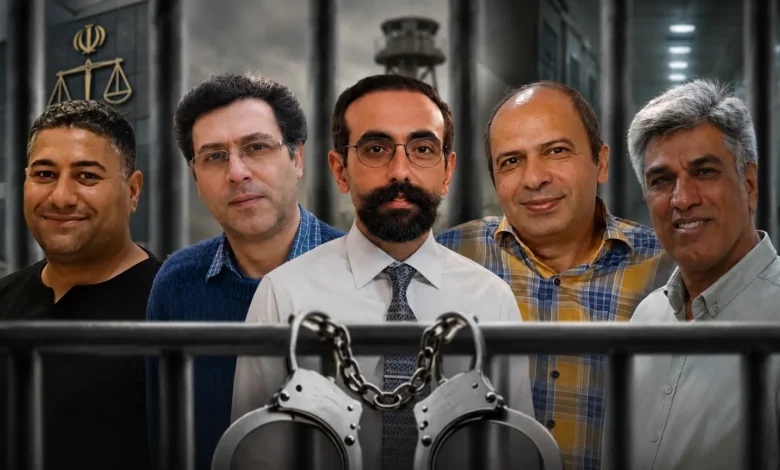
In continuation of the Islamic Republic’s judicial pressures on religious minorities in Iran, five Baha’i citizens residing in Karaj were detained after appearing at the Revolutionary Court of Shahriar to serve a one-year prison sentence. The case, in which “propaganda against the system” and “deviant educational and propagandistic activities contrary to or harmful to the sacred law of Islam” formed the basis of conviction, has once again intensified concerns about the conversion of religious beliefs and activities of minorities into security and judicial cases.
Five Baha’i citizens residing in Karaj were detained on Monday, September 9, 2025, after appearing at the Revolutionary Court of Shahriar to execute their prison sentence. This incident, within the broader context of the Islamic Republic’s judicial pressures against religious minorities in Iran, once again raises the question of religious freedom and conscience, and the boundary between religious belief and security accusations.
According to the Hrana news agency, “Babak Zeinali,” “Sahba Taef,” “Fuad Taefi,” “Shervin Shabrakh,” and “Ali Bagherkashi,” following prior summons, appeared at the Revolutionary Court of Shahriar to serve their one-year prison sentence and were detained on the spot. Their families were initially informed that these individuals would be transferred to Tehran’s Evin Prison, but the five Baha’i citizens were held in Shahriar detention facility, and it was then announced that there was a possibility of their transfer to Qarchak Prison. At the time of Hrana’s report, their exact place of detention remained unclear.
These five individuals were previously arrested on November 7, 2023, at Babak Zeinali’s home in Mehr City, Karaj. Following interrogation and legal proceedings, they were released on bail, but the legal case against them continued, and ultimately all five were sentenced to one year in prison under Article 500 bis of the Islamic Penal Code. The charges against them were identified as “propaganda against the system” and “deviant educational and propagandistic activities contrary to or harmful to the sacred law of Islam.”
Meanwhile, Babak Zeinali’s case demonstrates that judicial pressure against some Baha’i citizens is not necessarily limited to a single arrest or one conviction. Zeinali has previously been arrested and convicted due to his religious beliefs.
However, what makes this case more than an ordinary legal story is that it takes place within the context of decades of structural pressure against religious minorities in Iran—pressure that international human rights organizations have repeatedly documented.
Human Rights Watch, in its global report on Iran, described the Islamic Republic’s policy toward Baha’is as “crimes against humanity in the form of persecution,” and reported on the continuation of arbitrary arrests, unfair trials, and confiscation of Baha’i property. The organization has also emphasized that Baha’is in Iran have faced charges such as “propaganda against the system” and educational and propagandistic activities due to their religious and social activities.
More recent reports show that these pressures have not stopped. In April 2026, UN special mechanisms expressed concern about allegations related to arbitrary detention, enforced disappearance, torture, and inhumane treatment against members of the Baha’i community in Iran. In this regard, the names of several Baha’i citizens, including Parvand Naeimi and Berna Naeimi, were mentioned, and the UN stated that it had received information about serious dangers facing them.
Amnesty International also reported in 2026 that two Baha’i citizens, Parvand and Berna Naeimi, face the risk of execution. According to this report, security officials have subjected them to torture and abuse, and have resorted to beatings, electric shocks, and mock executions to obtain “confessions.” The organization also reported their deprivation of access to lawyers and medical care.
Pressure on Baha’is is, of course, not limited to arrest and imprisonment. Amnesty International has reported a series of measures against this community, including raids on homes, deprivation of university education, dismissal from jobs, forced closure of businesses, confiscation or destruction of property, travel restrictions, desecration of cemeteries, and denial of burial rights.
Christians, particularly converts and those engaged in house church activities, have also not been spared from similar pressures. Amnesty International has reported that Islamic Republic authorities have inspected house churches and arbitrarily arrested Christians. In another report, the organization reported on the arrest of Christians and Baha’is in an intensified security environment in Iran.
Human Rights Watch’s report also emphasizes that various religious minorities, including Baha’is, Christians, Jews, Gonabadi Dervishes, Sunnis, and Yarsan, continue to face discrimination in law and practice. According to the organization, following Iran-Israel conflicts in 2025, a new wave of arrests against some religious minorities, particularly Baha’is, Christians, and Jews, on charges of connection with Israel emerged.
Baha’is, meanwhile, face different and more difficult conditions because they are not formally recognized as an official religious minority in the Islamic Republic’s constitution. For this reason, the Baha’i community has for years faced extensive deprivations in education, employment, property ownership, and social and religious activities. UN reports have repeatedly warned about discrimination against Baha’is and other religious minorities in Iran and have called on Tehran to amend laws and practices that cause religious discrimination.
Even minorities that are formally recognized in the Islamic Republic’s constitution, such as Christians and Zoroastrians, face limitations. The formal recognition of a religious community in law does not necessarily mean that its members enjoy equal rights; since the legal and political structure of the Islamic Republic grants extensive privileges to Muslims, and particularly to followers of the government’s official interpretation of Islam, in political, social, and legal spheres.
Under such circumstances, the issue is not merely the imprisonment of five Baha’i citizens in Karaj. The issue is why religious activity, religious education, gatherings, and even the expression of personal belief can be transformed in Iran into a case with security titles.
In this case, five citizens have been detained to serve a one-year prison sentence; but the accusation titles themselves are also questionable. When the educational and propagandistic activities of a religious community are entered into a criminal case under the heading “deviant” and “contrary to or harmful to the sacred law of Islam,” the boundary between law enforcement and the imposition of a religious interpretation on citizens becomes increasingly blurred.
This is while freedom of religion and conscience does not merely mean the right to follow a religion; it also includes the right to have, change, teach, and express religious belief. The Islamic Republic speaks of “rights of religious minorities” while reports by international organizations present a completely different picture of the actual situation of these communities.
For a Baha’i citizen, Christian, or member of other religious minorities, the issue is not merely fear of prison; the danger can extend from deprivation of university and employment to closure of businesses, home raids, security summons, interrogation, confiscation of property, and in some cases even the risk of torture and severe punishment. Amnesty International has also emphasized that members of religious minorities in Iran have faced arbitrary arrest, unfair trials, and torture and abuse due to the expression or practice of their religion.
This situation becomes even more concerning when the government views religious minorities not as citizens with equal rights, but from a security perspective. In recent years, attributing connections with Israel to Baha’is and some Christians has been a clear example of this approach—an approach that, according to Amnesty International, has been accompanied by government propaganda and the creation of a climate of hostility against some minorities.
Ultimately, the case of Babak Zeinali, Sahba Taef, Fuad Taefi, Shervin Shabrakh, and Ali Bagherkashi does not merely add five more names to the list of Iran’s prisoners of conscience; this case presents an image of a structure in which religious difference can become a factor for surveillance, pressure, and punishment.
A society in which citizens are deprived of education, work, gatherings, or free expression of opinion due to their religious beliefs cannot easily reconcile the claim of equal citizenship with its social reality.
From Baha’is to Christians, from Gonabadi Dervishes and Yarsan to other religious minorities, the fundamental question remains: Is citizenship in Iran only complete and safe when an individual holds the religious belief approved by the power structure?
The answer to this question is not merely an issue of religious minorities, but a test of the concepts of justice, freedom of conscience, and human dignity in Iran.