From Fire at the Tomb of Esther and Mordecai to Memorial Service for ‘Ali Khamenei’ at the Jewish Synagogue
Instrumental exploitation of minorities continues at a time when the Islamic Republic’s dual policy has restricted religious freedoms for years.
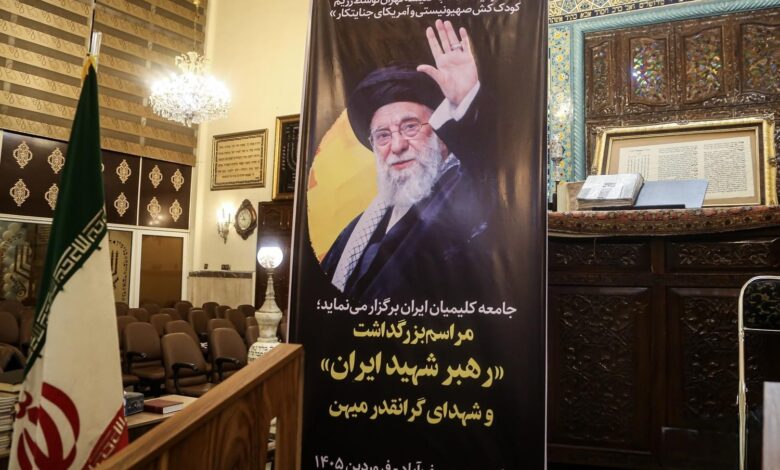
On Thursday, Ordibehesht 27 (April 16), a memorial service for Ali Khamenei was held at the Jewish synagogue in Tehran, once again drawing attention to the contradictory behavior of the Islamic Republic toward religious minorities. A government that has systematically subjected religious minorities to restrictions, security pressures, and social deprivation for years now seeks in certain circumstances to exploit the presence of these very groups to present a different image of itself.
While the Islamic Republic’s authorities attempt at certain times to present a tolerant face through displays such as “the memorial service for Ali Khamenei held at the Jewish synagogue in Tehran,” an examination of past events reveals a different and critical picture. One notable example is the fire at the tomb of “Esther and Mordecai” in Hamadan, a place considered one of the most important pilgrimage sites for Iran’s Jews.
According to reports, this tomb caught fire in Ordibehesht 1399 (May 2020), and the case was investigated by the judicial system, but to date no one has been arrested in connection with the fire. Meanwhile, reports also emerged about the possibility of this act being intentional and previous threats against this site, including threats by certain groups in recent years to destroy this pilgrimage site in reaction to political developments.
Although some officials attempted to minimize the dimensions of the incident or downplay its importance, and even denied damage to the main structure, the very occurrence of such an incident at one of the most important religious sites of the Jewish minority raises serious questions about the security and actual status of these minorities within Iran’s political and social structure.
This contradiction becomes more pronounced when, alongside such incidents, the government attempts at certain moments to exploit the symbolic presence of minorities for propaganda purposes. On one hand, threats, negligence, or lack of transparency regarding attacks on minority religious sites are evident, and on the other hand, these same minorities are presented within a controlled framework as a sign of the government’s tolerance.
This dual approach raises serious questions about the sincerity of official policies regarding religious diversity in Iran. On the one hand, multiple reports of restrictions on religious activities, intense monitoring, and structural discrimination against minorities have been published, and on the other hand, at political or propaganda junctures, these same minorities are presented as a symbol of the government’s “tolerance.”
The ceremony held at the Yosef-Abad synagogue, though appearing on the surface to be a sign of Iran’s Jewish community’s participation in an official event, cannot be analyzed in isolation from the broader policies of the ruling authority. Many believe that such programs, rather than reflecting genuine coexistence, represent a deliberate attempt to present a controlled and desirable image of the status of religious minorities in the country.
In summary, placing these events side by side reveals that official policy is not based on sustainable respect for minority rights, but rather on political and temporary considerations; an approach that highlights the instrumental use of religious minorities and deepens the gap between reality and official narrative. This contradiction between words and deeds not only undermines public trust but also obscures the actual situation of minorities under official narratives; narratives that are primarily political and performative in function.