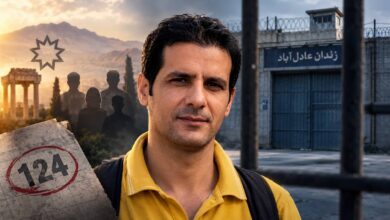
Hassan Shariatemadari: The Next Popular Uprising May Be Uncontrollable
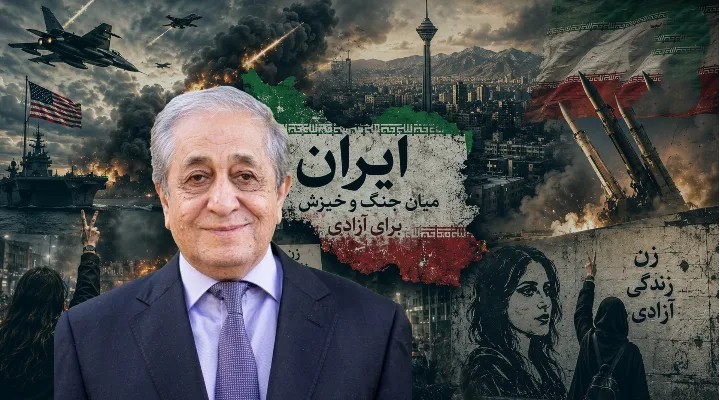
The Islamic Republic, simultaneously facing intensified American economic pressure, maritime blockade, and disputes over continuing the war, is confronted with a deeper crisis within its power structure. Hassan Shariatemadari, a political activist and analyst of Iranian affairs, believes that continuation of current conditions could lead to a new uprising, potentially even broader than the December 2025 protests. Meanwhile, Mohammad Baqer Qalibaf’s unprecedented warning about the danger of people starving, Masoud Pezeshkian’s emphasis on the necessity of understanding with America, and Washington’s announcement of a new strategy present a picture of mounting pressures on Tehran.
As Iran grapples with the consequences of war, sweeping sanctions, and commercial restrictions, Washington has launched a new phase of economic pressure.
Scott Bessent, U.S. Treasury Secretary, in an article published in the Financial Times, called this phase “economic D-Day” and said the goal is to cut off the Islamic Republic’s financial and economic pathways and completely isolate Tehran. He warned that countries and companies that help continue trade with Iran may also face severe consequences.
This situation has emerged while the value of the rial has also reached its lowest levels. According to an Associated Press report, on Monday, August 24, the rial rate in the informal market collapsed to around 2.02 million rials per dollar; simultaneously, anticipation of announcement of new American sanctions has added to economic pressure.
Within Iran, too, signs of concern about the economic consequences of war and sanctions are evident. Mohammad Baqer Qalibaf, Speaker of Parliament, at a meeting of Iranian and Iraqi economic activists in Baghdad, warned about the direct connection between economy and security, saying: “However much military power we may have, if our people are hungry and we lack monetary circulation and economic growth, we will not endure.” Qalibaf also emphasized: “Security and economy are two wings of each other.”
These remarks quickly drew media attention, with some viewing them as signs of concern within the Islamic Republic’s structure about the impact of economic pressure on the regime’s political stability. The Parliamentary Media Center later announced that sections of the Speaker’s remarks had been “cut and distorted” and released the full text of his statement.
However, even in the full version of his remarks, Qalibaf had emphasized that military power without economic backing cannot guarantee the country’s survival. Meanwhile, Masoud Pezeshkian also took a position against opponents of an Iran-America agreement; a position showing that disagreement over the future path of the Islamic Republic is not limited to outside the power structure.
Iran’s President said this agreement was the result of “professional consensus among all those who had a hand in the fire” and emphasized that the decision was made after lengthy discussions and talks.
Pezeshkian, criticizing agreement opponents, said: “They deny it because they either don’t understand the issue or don’t have a hand in the fire.” He then added, using a Quranic expression: “Those who do not want to reason, no matter what you tell them, will not listen.” Pezeshkian has also described the country’s current conditions as a “full-scale economic, military, and security war.”
These statements, alongside Qalibaf’s remarks, suggest that in parts of the Islamic Republic’s formal structure, economic pressure and continuation of war have become an issue related to the regime’s survival.
Hassan Shariatemadari, a political activist and analyst of Iranian affairs, in a conversation with Euronews, does not view the current crisis solely as a result of differences between the government and military forces, and believes that parts of the Revolutionary Guards may see continuation of the war as necessary to preserve their position.
In his analysis of the situation following the death of Ali Khamenei, he believes that groups within the power structure, to prevent a vacuum in leadership, have placed Mojtaba Khamenei’s name at the center of a new structure.
Shariatemadari says: “In my opinion, the insistence on Mojtaba Khamenei’s leadership is more a symbolic function to prevent a leadership vacuum, and now the rumor that his death will be announced is very strong.”
He adds that the question of Mojtaba Khamenei’s status has become part of the competition over the future of the leadership structure.
However, contradictory accounts have emerged regarding Mojtaba Khamenei’s actual condition. In recent months, Islamic Republic officials have spoken of his survival in the March 30 attack, and some officials have even claimed he suffered only superficial injuries. At the same time, his prolonged absence from public view and lack of verifiable images or public appearances have fueled speculation.
Therefore, claims about his death or survival must still be examined within the framework of unconfirmed reports and speculation.
Shariatemadari further considers internal Guard divisions as one of the important factors in complicating the negotiation process. He says: “So far, no other faction within the Guards has been seen except those in the field stirring up the situation.”
In his view, parts of the younger Revolutionary Guards forces may have concerns that the end of war and normalization of conditions could weaken this institution’s special position in the country’s political and security structure.
Shariatemadari connects this concern to the experience of armed groups in some regional countries and says: “Forces within the Guards may fear that after the war ends, a similar fate awaits them.” In such a framework, the fundamental difference is not just about “war or peace”; rather, the question is what changes the end of war will create in the balance of power within the Islamic Republic of Iran.
Shariatemadari believes Tehran simultaneously considers multiple scenarios; from continued negotiations with Washington to military action to break the blockade. He says: “Breaking the Strait of Hormuz blockade or dealing with America are both scenarios the Iranian government has in mind.”
According to him, the Islamic Republic, on one hand, does not want to pay the political cost of an agreement with America, and on the other hand, faces the risk of intensifying internal crisis with continued blockade and cutting off financial resources.
Shariatemadari warns: “If America continues the blockade and leaves no way out for them, under the pretext of attacking American bases, they would attack Iran’s neighbors and compensate their financial shortages through looting them.”
This part of his analysis is a possible scenario and not a report of a definite decision by the Islamic Republic.
Meanwhile, international reports also show that the Strait of Hormuz issue has become one of the main points of concern. Iran has threatened that if countries support America’s economic campaign, it may disrupt oil exports from the region; a threat that has increased concerns about the global energy market.
According to Shariatemadari, the main danger to the Islamic Republic may not come from outside but from within Iranian society. He says: “The continuation of this disastrous situation is dangerous for the Islamic Republic because it causes an inevitable uprising of people; people who in this economic disaster have no option but to rise up against the government, because the continuation of this situation is against the existence of the Iranian people.”
He continues warning that the government will likely try to suppress potential protests through repression, but the scale of future protests may be different.
Shariatemadari says: “The Islamic Republic is deeply concerned about such an uprising and of course will try to prevent the people’s uprising through massacre, like last December, but this time the uprising may be on such a scale that controlling it would be very difficult even through massacre.”
This assessment comes at a time when Iran simultaneously faces inflation, currency value collapse, commercial restrictions, and pressures from war. The Associated Press has also seen the rial’s recent fall as another sign of intensifying economic pressure on Iranian society.
Another axis of Shariatemadari’s analysis is the possibility of reduced loyalty of security and military forces in case of crisis expansion. He says, referring to experiences of other countries: “In any case, global experiences show that at a certain point, even ideologically-driven forces experience moral paralysis and realize the emptiness of their path and become disillusioned and disappointed, and the possibility of creating schism and collapse among them is very high.”
According to him, even within the Islamic Republic’s structure itself, the possibility of repeating widespread protests is mentioned as a serious threat.
Shariatemadari believes the government fears people’s protests more than two major threats—external attack and internal uprising—because if there is a split in suppressive forces, controlling the streets could become much more difficult.
Perhaps the most important part of Shariatemadari’s analysis is not his prediction about war or sanctions, but his assessment of the Islamic Republic’s relationship with Iranian society. He says: “They want people more as a tool to confirm their policies, they don’t recognize an independent personality for civil society and people, and there is no plan in any faction of this system for approaching people, accepting people’s demands, apologizing to people and changing policy; therefore, they have already signed the decree of their own destruction with their own hands.”
This view ties the future of the Islamic Republic less to the mere result of military confrontation with America than to the government’s capacity to manage internal crisis and rebuild its relationship with society.
The sum of recent developments presents a picture of a government facing multiple simultaneous crises: mounting economic pressure, new American sanctions, threats related to the Strait of Hormuz, disagreement over negotiations, and uncertainty about the future of the leadership structure.
Washington explicitly speaks of a strategy aimed at completely isolating the Islamic Republic. The Financial Times has reported that Bessent has asked countries and companies that continue economic relations with Tehran to choose between cooperation with the global financial system and continued support for Iran.
In Tehran, too, warnings about the consequences of starvation and economic collapse are heard, and at the political level, there is disagreement over how to end the war and engagement with America. Qalibaf speaks of the necessity of maintaining economic backing, and Pezeshkian defends an understanding that its opponents do not accept.
In such circumstances, the main question is no longer just whether external pressure can weaken the Islamic Republic; the more important question is that if economic pressure and war continue, for how long can Tehran’s power structure simultaneously control the economy, security forces, and a dissatisfied society.
Shariatemadari’s analysis does not provide a clear answer to this question, but his warning is explicit: if the economic crisis reaches a point where large sections of society no longer have the possibility of continuing normal life, the next protest may not be a repetition of past protests, but a different phase and a far more extensive confrontation between society and government.