Strengthening Iran’s Armenian Heritage with Stone Museum Opening at St. Thaddeus Church, but Concerns Mount Over Community’s Future
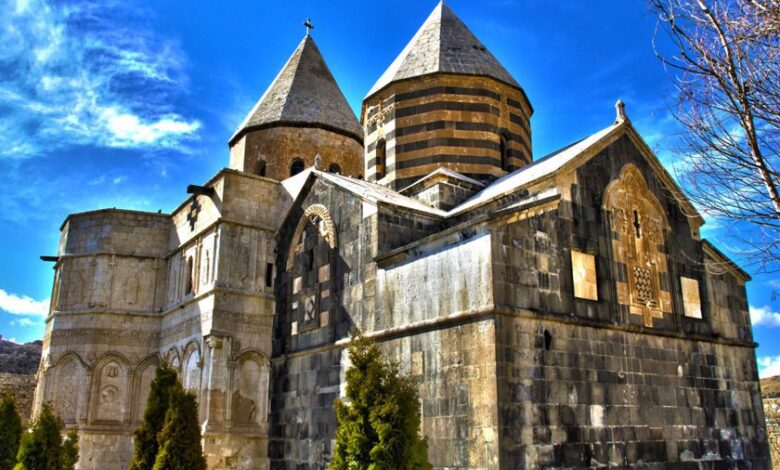
Coinciding with the annual “Badarak” ceremony at St. Thaddeus Church (Qara Kelisa), the first stone museum of this UNESCO World Heritage site was inaugurated, an initiative aimed at preserving Iran’s Armenian historical heritage. However, the declining Armenian population, widespread emigration, and church closures have raised serious questions about the future of this Christian community in Iran.
With the celebration of the annual “Badarak” ceremony at the UNESCO World Heritage site of St. Thaddeus Church (Qara Kelisa) in Chaldoran township, the stone museum of this historic complex was inaugurated in the presence of provincial officials, cultural heritage authorities, and leaders of the Armenian Apostolic Church. The museum was established with the aim of preserving historical artifacts and developing tourism infrastructure at one of Iran’s most important Christian sites. The news was also reported by domestic media and official Iranian cultural heritage sources.
The newly established museum houses inscriptions, stone fragments, architectural elements, and artifacts from excavations and restoration projects of past years. Cultural heritage officials state that these artifacts narrate part of the history of formation and development of one of the ancient centers of Christianity in the region, and provide researchers and visitors with the opportunity for more detailed study.
Rasoul Moghabeli, the political and social deputy of the West Azerbaijan governor, at the museum inauguration ceremony, considered the protection of cultural heritage as part of the region’s sustainable development and emphasized that establishing such centers can help preserve historical artifacts while promoting religious and cultural tourism in northwestern Iran.
Morteza Safaei, the director general of cultural heritage, tourism, and handicrafts of West Azerbaijan, also referring to the historical value of the stone reliefs and architectural fragments in the museum, said: “This collection, in addition to serving tourists, provides a platform for scientific research on the history, art, and architecture of St. Thaddeus Church and the civilizations of the region.”
At the ceremony, His Eminence Archbishop Grigori Chiftchian, the primate of Armenians in Azerbaijan, expressed gratitude for the cooperation between state institutions and the Armenian Church in preserving this shared heritage. He expressed hope that the development of cultural and tourism infrastructure would provide an opportunity for domestic and foreign visitors to better learn about the history of Christianity in Iran and the culture of religious coexistence.
Qara Kelisa, inscribed on UNESCO’s World Heritage List, hosts thousands of Armenian pilgrims from Iran and various countries each year who travel to this sacred site to participate in the religious “Badarak” ceremony. This ceremony is considered one of the most important religious gatherings of the Armenian community in Iran.
Nevertheless, the stone museum’s opening comes at a time when many Armenian institutions and human rights organizations have expressed concern about the continuous decline of Iran’s Armenian population. Over past decades, widespread emigration of Armenians, particularly young generations, has caused a dramatic reduction in this community’s population. Armenian researchers and activists attribute this trend to factors such as economic constraints, limited employment opportunities, and certain structural discrimination.
The population decline has had consequences beyond mere statistics. In recent years, a number of Armenian churches in various Iranian cities no longer hold regular services due to the declining number of active believers, and some are only opened on special occasions. Additionally, human rights organizations and independent media have reported cases of change of use, destruction, or ownership-related problems concerning some properties and buildings belonging to the Armenian community, though Islamic Republic officials have not generally acknowledged these issues.
Under such circumstances, while projects such as the opening of the Qara Kelisa stone museum play an important role in preserving the historical and cultural heritage of Iran’s Christians, Armenian community leaders and activists emphasize that preserving historical structures, without attention to the community’s population situation and social and religious rights, alone cannot guarantee the future of one of the ancient Christian communities of the Middle East.